
Categories
Structural Engineering

Structural Health Monitoring

Blog

Key Indicators Your Industrial Building Needs Retrofitting


Industrial buildings are designed for long service life, but age, loading changes, environmental exposure, and material degradation gradually reduce structural performance. Structural Health Monitoring (SHM) helps identify early warning signs—long before visible failure occurs.

What Is Structural Health Monitoring (SHM)?

Structural Health Monitoring is the process of:

  • Observing structural behavior over time
  • Measuring performance under real loads
  • Identifying distress before failure

It combines engineering assessment with data-driven evaluation.

Why SHM Is Critical for Industrial Buildings

Industrial structures face:

  • Heavy dynamic loads
  • Machinery vibrations
  • Chemical and thermal exposure

Without monitoring, deterioration often remains unnoticed until it becomes critical.

Visible Cracking Beyond Design Expectations

Cracks that indicate concern include:

  • Diagonal shear cracks
  • Widening flexural cracks
  • Repeated cracking at the same location

These often signal overstress or material fatigue.

Excessive Deflection or Sagging Members

Warning signs include:

  • Sagging beams or slabs
  • Uneven floors
  • Misaligned roof elements

Excessive deflection suggests loss of stiffness or increased loading.

Corrosion of Reinforcement or Structural Steel

Corrosion indicators:

  • Rust stains
  • Concrete spalling
  • Section loss in steel members

Corrosion reduces load-carrying capacity and accelerates failure.

Abnormal Vibrations in Floors or Frames

Vibration issues may result from:

  • Machinery upgrades
  • Structural weakening
  • Resonance conditions

Persistent vibration affects both safety and equipment performance.

Change in Structural Usage or Load Patterns

Buildings originally designed for:

  • Light manufacturing
  • Storage

May later carry heavier equipment or stacked loads—often without structural upgrades.

Settlement and Foundation Distress

Key indicators include:

  • Uneven floor levels
  • Wall separation
  • Cracks near columns or footings

Foundation movement directly impacts superstructure stability.

Water Seepage and Moisture Ingress

Moisture exposure leads to:

  • Reinforcement corrosion
  • Concrete strength reduction
  • Loss of durability

Water-related damage is often slow but progressive.

Deterioration Due to Environmental Exposure

Industrial buildings may be exposed to:

  • Chemicals
  • High humidity
  • Temperature cycling

These conditions accelerate material degradation beyond design assumptions.

Ageing Structures Beyond Design Life

Many industrial buildings operate:

  • Beyond their original design life
  • Without periodic structural evaluation

Ageing alone is a valid reason for SHM and retrofitting assessment.

Damage from Seismic or Wind Events

Even moderate events can cause:

  • Microcracking
  • Joint distress
  • Connection weakening

Post-event monitoring is essential even when damage appears minor.

Instrument-Based Structural Monitoring

SHM tools may include:

  • Crack gauges
  • Strain sensors
  • Vibration monitors

These help quantify structural behavior instead of relying only on visual inspection.

When Monitoring Indicates the Need for Retrofitting

Retrofitting becomes necessary when:

  • Structural capacity reduces below demand
  • Progressive deterioration is detected
  • Safety margins are compromised

Early intervention minimizes cost and downtime.

Benefits of Early Retrofitting Decisions

Proactive retrofitting results in:

  • Lower repair costs
  • Improved safety
  • Extended service life

Delayed action increases structural and financial risk.

Role of Structural Engineers in SHM

Structural engineers:

  • Interpret monitoring data
  • Assess residual strength
  • Recommend appropriate strengthening methods

Engineering judgment is critical for correct decision-making.

Conclusion

Structural Health Monitoring provides objective insight into the real condition of industrial buildings. Recognizing early indicators—such as cracking, deflection, corrosion, and vibration—allows timely retrofitting and prevents unexpected failures.

For industrial facilities, SHM is not a reactive measure but a preventive engineering practice that safeguards safety, performance, and long-term asset value.

Categories
Structural Engineering

How Precise Structural Design Optimization Reduces Steel Consumption in PEB

Blog

How Precise Structural Design Optimization Reduces Steel Consumption in PEB


In steel construction, especially in Pre-Engineered Buildings (PEB), the difference between an average design and an optimized design is often measured not in millimeters—but in tons of steel.

Steel is one of the most expensive and carbon-intensive materials used in construction. As project costs rise and sustainability becomes a priority, precise structural design optimization has emerged as one of the most powerful tools to reduce steel consumption—without compromising safety or performance.

At Rakhra Associates – Structural Engineers in Chandigarh, optimization is treated as a core engineering responsibility, not an optional enhancement. This blog explains how structural optimization works in PEB systems, why it reduces steel usage, and what engineering decisions truly make the difference.

Understanding Steel Consumption in PEB Structures

Steel consumption in PEB buildings is influenced by:

  • Structural system selection
  • Load assumptions
  • Member sizing
  • Connection detailing
  • Span and bay planning

Even small inefficiencies in these areas can result in significant excess steel usage.

What Is Structural Design Optimization?

Structural design optimization is the process of:

  • Achieving required structural performance
  • Using the minimum amount of material
  • Ensuring code compliance and safety

In PEB structures, optimization focuses on:

  • Member geometry
  • Stress distribution
  • Load paths
  • Fabrication efficiency

Why PEB Is Naturally Suited for Optimization

PEB systems are ideal for optimization because:

  • They rely on software-driven analysis
  • Members can be tapered or variable
  • Loads are predictable
  • Repetition allows refinement

Unlike conventional steel structures, PEB does not depend on uniform sections—every member is designed for actual demand.

Key Areas Where Optimization Reduces Steel Consumption

1. Tapered Built-Up Sections

Unlike hot-rolled uniform sections:

  • PEB columns and rafters vary in depth
  • Steel is provided only where stress demands it

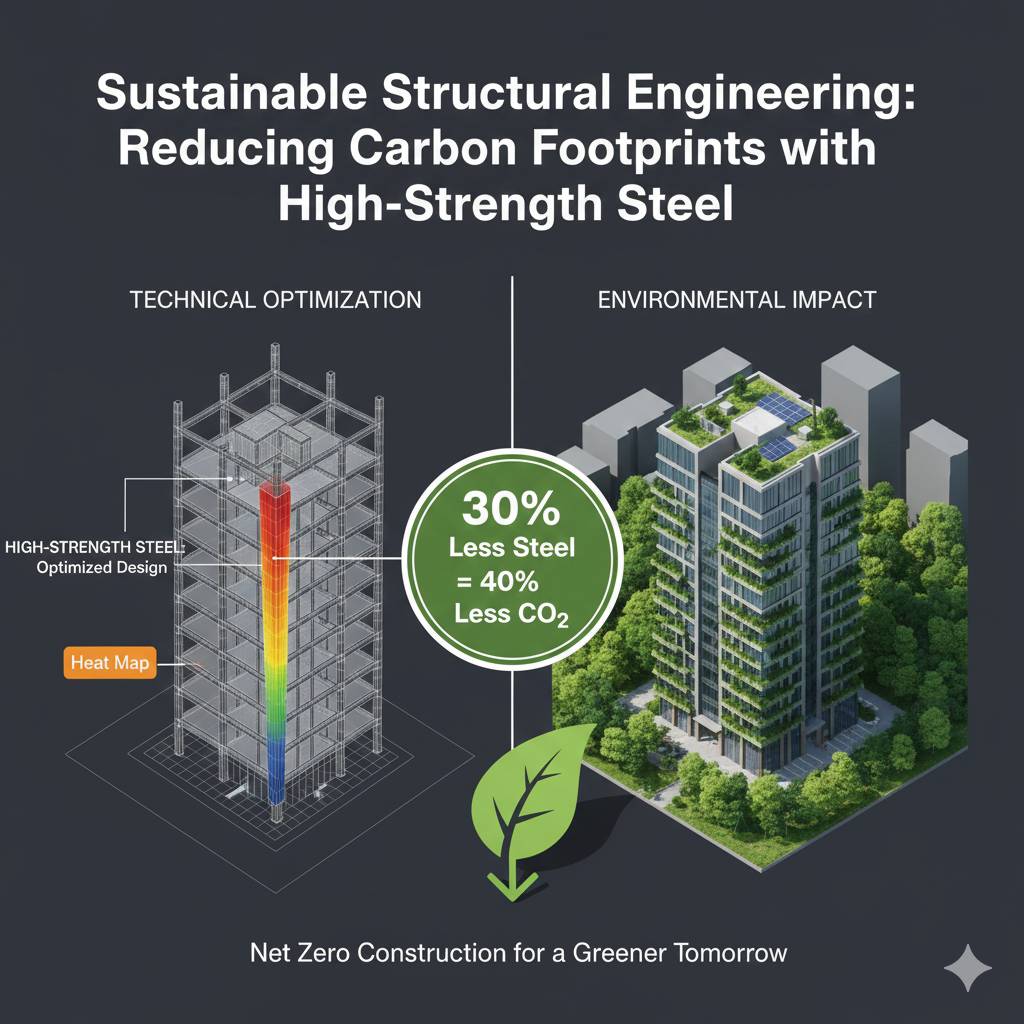
This alone can reduce steel weight by 15–30%.

2. Accurate Load Assessment

Overestimated loads are the biggest cause of steel wastage.

Optimization ensures:

  • Realistic live load values
  • Correct wind load calculations
  • Accurate seismic coefficients

Every unnecessary load increases member size and steel quantity.

3. Efficient Load Path Design

A clear load path:

  • Reduces force concentration
  • Eliminates redundant members
  • Improves force distribution

Optimized load paths directly reduce steel tonnage.

4. Optimized Bay Spacing

Bay spacing affects:

  • Member length
  • Bending moments
  • Steel quantity 

Proper bay optimization balances:

  • Structural efficiency
  • Fabrication economy
  • Architectural requirements

5. Bracing System Optimization

Efficient bracing:

  • Reduces frame forces
  • Minimizes column sizes
  • Improves lateral stability

Choosing the right bracing configuration significantly reduces steel usage.

Role of Advanced Structural Analysis Software

Modern PEB optimization relies on:

  • Finite element analysis
  • Load combination automation
  • Iterative member sizing

However, software alone does not optimize—engineering judgment does.

Connection Design and Steel Savings

Overdesigned connections lead to:

  • Excess plate thickness
  • Unnecessary stiffeners
  • Increased fabrication cost

Optimized connection design:

  • Matches force demand
  • Reduces welding
  • Improves constructability

Foundation Interaction and Steel Reduction

Reducing superstructure steel:

  • Lowers foundation loads
  • Reduces base plate sizes
  • Optimizes anchor bolts

Optimization cascades benefits through the entire structure.

Optimization vs Overdesign

Aspect Overdesign Optimization
Safety Artificially high Code-compliant
Steel usage Excessive Minimal
Cost High Efficient
Performance Average Improved

Optimization does not reduce safety margins—it removes inefficiency.

Impact on Project Cost and Sustainability

Economic Benefits

  • Lower steel procurement cost
  • Reduced transportation and erection cost
  • Smaller foundations

Environmental Benefits

  • Reduced embodied carbon
  • Lower resource extraction
  • Sustainable construction practices

Common Mistakes That Increase Steel Consumption

  • Conservative load assumptions
  • Uniform section usage
  • Ignoring secondary load paths
  • Poor coordination between design and fabrication

Awareness of these mistakes is key to optimization.

Role of Structural Engineers in Steel Optimization

Structural engineers:

  • Define load assumptions
  • Control member sizing
  • Ensure code compliance
  • Balance safety and efficiency

At Rakhra Associates, optimization is driven by engineering clarity—not cost pressure.

Importance of Structural Audits in Optimized PEBs

Structural audits help:

  • Verify design assumptions
  • Identify overdesign
  • Ensure long-term performance

Audits support optimization throughout the building’s lifecycle.

Indian Codes Supporting Optimized Steel Design

  • IS 800 – Limit state design
  • IS 875 – Accurate loading
  • IS 1893 – Seismic efficiency
  • NBC 2016 – Performance-based design

Codes allow optimization when applied correctly.

Future of Steel Optimization in PEB

By 2026 and beyond:

  • AI-assisted optimization tools will increase
  • Performance-based design will dominate
  • Sustainability metrics will influence steel usage

Optimized steel design is becoming industry standard, not exception.

FAQs: Steel Optimization in PEB Structures

1. What is steel optimization in PEB?

Designing PEB structures using minimum steel without compromising safety.

2. How much steel can optimization save?

Typically 15–30%, depending on design.

3. Does optimization reduce safety?

No, it maintains code-required safety levels.

4. Is optimization only software-based?

No, engineering judgment is essential.

5. Why is overdesign common in steel structures?

Due to conservative assumptions and lack of optimization.

6. Can optimization reduce foundation size?

Yes, significantly.

7. Are tapered sections stronger?

They are more efficient, not weaker.

8. Does bay spacing affect steel quantity?

Yes, greatly.

9. Are optimized PEBs earthquake resistant?

Yes, when designed as per IS 1893.

10. Can optimization reduce erection time?

Yes, lighter members are easier to erect.

11. Is optimization suitable for industrial buildings?

Yes, especially industrial PEBs.

12. Does optimization increase design time?

Slightly, but saves construction time.

13. Can existing PEBs be optimized?

Through structural audits and retrofitting.

14. Is optimization sustainable?

Yes, it reduces embodied carbon.

15. Do Indian codes allow optimization?

Yes, under limit state design.

16. Can optimization affect architectural layout?

Usually no, structural changes are internal.

17. Is optimization useful for small PEBs?

Yes, every ton saved matters.

18. Does optimization reduce connection cost?

Yes, through accurate force design.

19. Is optimization different from value engineering?

Optimization is a key part of value engineering.

20. Who should perform steel optimization?

Qualified structural engineers.

Conclusion

Precise structural design optimization is the single most effective method to reduce steel consumption in Pre-Engineered Buildings. By focusing on accurate load assessment, efficient member design, and clear load paths, engineers can deliver structures that are safe, economical, and environmentally responsible.

At Rakhra Associates – Structural Engineers in Chandigarh, optimization is not viewed as an option—it is an essential part of responsible structural engineering, contributing to better performance, reduced costs, and sustainable construction practices.

Categories
Structural Engineering

Value Engineering

Blog

Maximizing Structural Integrity While Minimizing Project Costs


In modern construction, one of the biggest misconceptions is that lower cost means lower quality. From a structural engineering perspective, this belief is not only incorrect—it is inefficient.

The real challenge in today’s construction environment is not cutting costs blindly, but optimizing them intelligently. This is where Value Engineering (VE) plays a critical role.

At Rakhra Associates – Structural Engineers in Chandigarh, value engineering is viewed as a technical discipline, not a cost-cutting shortcut. This blog explains what value engineering truly means, how it improves structural integrity, and why it is essential for sustainable and economically viable construction projects.

What Is Value Engineering in Structural Design?

Value Engineering is a systematic approach that aims to:

  • Improve functional performance
  • Optimize material usage
  • Reduce unnecessary costs
  • Maintain or enhance safety and durability

In structural engineering, value engineering focuses on:

  • Load efficiency
  • Material optimization
  • Design rationalization
  • Lifecycle cost reduction

It is not about reducing safety margins, but about eliminating inefficiencies.

Core Principle of Value Engineering

The fundamental equation of value engineering is:

Value = Function Ă· Cost

Improving value can be achieved by:

  • Enhancing function without increasing cost

  • Maintaining function while reducing cost

  • Improving function and reducing cost simultaneously

Why Value Engineering Is Essential in Today’s Construction Industry

Rising Challenges in Construction

  • Escalating material prices
  • Skilled labor shortages
  • Tight project timelines
  • Increasing regulatory compliance
  • Sustainability requirements

Value engineering addresses these challenges by making structures economically efficient without compromising performance.

Value Engineering vs Cost Cutting

Aspect Cost Cutting Value Engineering
Focus Reduce expense Improve efficiency
Safety Often compromised Never compromised
Approach Reactive Analytical
Outcome Short-term savings Long-term value

Value engineering is a design philosophy, not a budget reaction.

Role of Structural Engineers in Value Engineering

Structural engineers are central to value engineering because:

  • They understand load behavior
  • They control material selection
  • They define structural systems
  • They ensure code compliance

At Rakhra Associates, value engineering begins at the conceptual design stage, not after drawings are finalized.

Key Areas Where Value Engineering Applies

1. Structural System Selection

Choosing the right system:

  • RCC vs Steel vs Hybrid
  • PEB vs Conventional steel
  • Framed vs shear wall systems

Correct system selection alone can reduce costs by 10–25%.

2. Material Optimization

  • Optimizing concrete grades
  • Reducing over-reinforcement
  • Using high-strength steel strategically
  • Eliminating unnecessary safety margins

Material optimization improves both cost and sustainability.

3. Load Rationalization

Overestimation of loads leads to:

  • Heavier sections
  • Higher foundation costs
  • Increased material usage

Value engineering ensures realistic and code-compliant load assumptions.

4. Member Size Optimization

Using:

  • Tapered sections
  • Variable beam depths
  • Optimized column spacing 

Results in:

  • Reduced steel tonnage
  • Efficient force transfer

5. Foundation Design Optimization

  • Matching foundation type to soil conditions
  • Avoiding blanket foundation designs
  • Using geotechnical data effectively

Foundations often account for 20–30% of project cost, making them a major value engineering opportunity.

Value Engineering Across Project Stages

Concept Stage

  • System selection
  • Grid planning
  • Preliminary load assessment

Design Development Stage

  • Section optimization
  • Reinforcement detailing
  • Structural modeling

Construction Stage

  • Constructability improvements
  • Reduced wastage
  • Faster execution

Structural Integrity and Value Engineering

A well-executed value engineering process:

  • Improves load flow clarity
  • Reduces stress concentrations
  • Enhances seismic performance
  • Minimizes long-term maintenance

Structural integrity is strengthened, not compromised.

Value Engineering and Seismic Safety

In seismic zones:

  • Reducing dead load improves seismic response
  • Proper ductility detailing saves material and lives
  • Efficient lateral load systems reduce cost

Value engineering directly contributes to earthquake resilience.

Lifecycle Cost Perspective

True project cost is not just construction cost.

Lifecycle cost includes:

  • Maintenance
  • Repairs
  • Retrofits
  • Operational downtime

Value engineering focuses on long-term economic performance, not just initial savings.

Sustainability Through Value Engineering

  • Reduced material usage
  • Lower embodied carbon
  • Efficient resource utilization
  • Minimal wastage

Value engineering supports green construction goals naturally.

Common Misunderstandings About Value Engineering

  • ❌ It compromises safety
  • ❌ It is done after design approval
  • ❌ It only applies to large projects

In reality, value engineering:

  • Enhances safety
  • Works best early
  • Benefits projects of all sizes

Importance of Structural Audits in Value Engineering

Structural audits:

  • Validate design assumptions
  • Identify overdesign
  • Ensure performance compliance

Audits help maintain value throughout a structure’s life.

Indian Codes Supporting Value Engineering

  • IS 456 – Rational concrete design
  • IS 800 – Steel optimization
  • IS 1893 – Seismic efficiency
  • IS 875 – Load rationalization
  • NBC 2016 – Performance-based design

Codes allow flexibility—engineering judgment applies value.

FAQs: Value Engineering in Structural Design

1. What is value engineering in construction?

A method to optimize cost while maintaining performance and safety.

2. Is value engineering the same as cost cutting?

No, it focuses on efficiency, not compromise.

3. When should value engineering be done?

Ideally at the conceptual design stage.

4. Can value engineering improve safety?

Yes, by improving load paths and detailing.

5. Does value engineering reduce material quality?

No, it optimizes usage.

6. Who performs value engineering?

Structural engineers and design professionals.

7. Is value engineering suitable for small projects?

Yes, even more impactful in smaller budgets.

8. How does value engineering reduce foundation cost?

By matching design to soil behavior.

9. Can value engineering delay projects?

No, it often speeds them up.

10. Does value engineering affect approvals?

No, designs remain code-compliant.

11. Is value engineering useful in seismic zones?

Yes, it improves seismic efficiency.

12. Can value engineering reduce steel quantity?

Yes, significantly.

13. Does it apply to RCC structures?

Absolutely.

14. Is value engineering allowed under Indian codes?

Yes, codes encourage optimization.

15. Can value engineering reduce maintenance costs?

Yes, by improving durability.

16. Does value engineering affect aesthetics?

No, structural changes are usually invisible.

17. Can value engineering be done after construction starts?

Limited benefits compared to early stages.

18. Is value engineering sustainable?

Yes, it reduces resource consumption.

19. Does value engineering apply to retrofitting projects?

Yes, very effectively.

20. Is value engineering a one-time process?

No, it continues through the project lifecycle.

Conclusion

Value engineering is not about building cheaper—it is about building smarter. By focusing on function, efficiency, and long-term performance, value engineering ensures that structural integrity is preserved while unnecessary costs are eliminated.

At Rakhra Associates – Structural Engineers in Chandigarh, value engineering is approached as a responsibility toward safe, sustainable, and economically sound construction, contributing to better-built environments and informed decision-making across the industry.

Categories
Structural Engineering

The Evolution of Multi-Storey Pre-Engineered Buildings in Urban Industrial Spaces

Blog

The Evolution of Multi-Storey Pre-Engineered Buildings in Urban Industrial Spaces


Urban India is facing a fundamental challenge: how to accommodate industrial growth within shrinking land parcels. As cities expand vertically and land prices rise, traditional single-storey industrial sheds are no longer viable in many urban and semi-urban zones.

This challenge has driven a major shift in structural engineering—the rise of multi-storey Pre-Engineered Buildings (PEB) in urban industrial environments.

At Rakhra Associates – Structural Engineers in Chandigarh, understanding how structural systems evolve is central to responsible engineering. This blog explores how multi-storey PEBs developed, why they are gaining acceptance, how they perform structurally, and what role they play in modern urban industrial planning.

Understanding Pre-Engineered Buildings (PEB)

A Pre-Engineered Building is a steel structure where components are:

  • Designed using advanced structural software
  • Fabricated in controlled factory environments
  • Assembled at site using bolted connections

Originally, PEBs were limited to:

  • Single-storey warehouses
  • Storage sheds
  • Large-span industrial halls

However, engineering advancements have pushed PEBs far beyond these limits.

Why Urban Industrial Spaces Needed a New Structural Approach

Key Urban Challenges

  • Limited land availability
  • High land acquisition costs
  • Zoning restrictions
  • Increased demand for vertical industrial facilities
  • Faster project delivery requirements

Traditional RCC structures, while robust, often result in:

  • Longer construction timelines
  • Higher dead loads
  • Reduced adaptability

Multi-storey PEBs emerged as a structural solution to urban constraints.

The Early Limitations of PEB in Multi-Storey Construction

Initially, PEB systems faced resistance due to:

  • Concerns over lateral stability
  • Limited understanding of seismic behavior
  • Lack of hybrid design knowledge
  • Dependence on conventional RCC for vertical loads

Early designs lacked:

  • Adequate moment-resisting frames
  • Advanced connection detailing
  • Integrated seismic systems

Engineering Innovations That Enabled Multi-Storey PEBs

1. Advanced Structural Analysis Software

Modern software allows engineers to:

  • Analyze dynamic loads
  • Model seismic behavior
  • Optimize member sizes for multi-level structures

2. Hybrid Structural Systems

Multi-storey PEBs often combine:

  • RCC foundations and cores
  • Steel superstructures
  • Composite floors

This hybrid approach ensures:

  • Stability
  • Ductility
  • Load efficiency

3. Improved Connection Design

Bolted moment connections and:

  • Base plate optimization
  • Braced frame systems
  • Rigid joint detailing

have significantly improved multi-storey performance.

Structural Behavior of Multi-Storey PEBs

Load Distribution

  • Vertical loads flow through steel columns to RCC foundations
  • Lateral loads are resisted by bracing systems or RCC cores

Seismic Performance

When properly designed:

  • Steel provides ductility
  • Bracing dissipates energy
  • Hybrid cores enhance stiffness

This combination is especially relevant in North Indian seismic zones, including Chandigarh and Punjab.

Advantages of Multi-Storey PEBs in Urban Industrial Use

1. Efficient Land Utilization

  • More floor area on limited land
  • Vertical expansion without footprint increase

2. Faster Construction Timelines

  • Parallel fabrication and site preparation
  • Reduced wet works

3. Reduced Structural Dead Load

  • Lighter steel structures
  • Smaller foundation requirements

4. Operational Flexibility

  • Column-free interior layouts
  • Easy future expansion or modification

Common Applications in Urban Industrial Zones

  • Manufacturing units
  • Logistics hubs
  • Cold storage facilities
  • Urban warehouses
  • Data centers
  • Multi-level industrial parks

Fire Safety Considerations

Multi-storey PEBs require:

  • Fire-resistant coatings
  • Fire compartmentalization
  • Compliance with NBC norms

Fire engineering has become a design priority, not an afterthought.

Sustainability and Environmental Benefits

  • Reduced material wastage
  • Lower embodied carbon
  • Recyclable steel components
  • Faster construction reduces site emissions

Multi-storey PEBs align with India’s green building goals.

Cost Perspective: Long-Term vs Initial

While initial costs may be comparable to RCC:

  • Faster completion improves ROI
  • Lower foundation costs
  • Reduced maintenance over lifecycle

Urban industrial developers increasingly consider time value of money, where PEBs offer a clear advantage.

Challenges and Engineering Responsibilities

Common Challenges

  • Connection detailing
  • Vibration control
  • Fireproofing
  • Coordination with MEP systems

These challenges reinforce the importance of experienced structural engineers.

Role of Structural Engineers in Multi-Storey PEBs

Structural engineers are responsible for:

  • System selection
  • Load path clarity
  • Seismic detailing
  • Code compliance
  • Structural audits

At Rakhra Associates, the focus is always on engineering integrity and long-term performance.

Indian Codes Relevant to Multi-Storey PEB Design

  • IS 800 – Steel structures
  • IS 1893 – Earthquake resistance
  • IS 875 – Load calculations
  • IS 456 – RCC integration
  • NBC 2016 – Fire and safety norms

Future of Multi-Storey PEBs in India

By 2030:

  • Urban industrial parks will rely heavily on vertical steel structures
  • Modular + PEB systems will merge
  • Performance-based design will dominate

Multi-storey PEBs are no longer experimental—they are a structural necessity.

FAQs: Multi-Storey Pre-Engineered Buildings

1. What is a multi-storey PEB?

A steel building designed for multiple levels using PEB principles.

2. Are PEBs suitable for urban industrial areas?

Yes, especially where land is limited.

3. How many floors can a PEB have?

Multiple floors, depending on design and load requirements.

4. Are multi-storey PEBs earthquake resistant?

Yes, when designed as per IS 1893.

5. Do PEBs require RCC?

Often for foundations and cores.

6. Is fire safety a concern?

Fire safety must be addressed through design and protection systems.

7. Are PEBs faster to construct than RCC?

Yes, significantly.

8. Can PEBs support heavy industrial loads?

Yes, with proper design.

9. Are PEBs cost-effective long term?

Yes, due to reduced construction time and maintenance.

10. Do PEBs allow future expansion?

Yes, vertical and horizontal expansion is easier.

11. What role does bracing play?

Bracing provides lateral stability.

12. Are composite floors used in PEBs?

Yes, very commonly.

13. Is vibration control important?

Yes, especially for machinery floors.

14. Can PEBs be used for data centers?

Yes, they are well suited.

15. Are multi-storey PEBs common in India?

They are increasingly adopted.

16. Do PEBs comply with Indian codes?

Yes, when properly designed.

17. Is structural audit important for PEB buildings?

Absolutely.

18. Can old industrial buildings be converted to PEBs?

In some cases, yes.

19. Are PEBs environmentally sustainable?

Yes, due to steel recyclability.

20. Who should design multi-storey PEBs?

Qualified structural engineers with steel expertise.

Conclusion

The evolution of multi-storey Pre-Engineered Buildings marks a significant shift in how urban industrial spaces are planned and constructed. By combining engineering efficiency, speed, sustainability, and adaptability, PEB systems have transformed from simple sheds into complex vertical industrial structures.

At Rakhra Associates – Structural Engineers in Chandigarh, understanding and sharing such structural advancements is part of our commitment to safe, informed, and future-ready construction practices.

Categories
Structural Engineering

PEB vs. Conventional Steel Buildings

Blog

The Integration of PEB and RCC in Modern Construction


As India’s construction sector evolves, steel structures are increasingly replacing traditional RCC-only systems—especially in industrial, commercial, and large-span projects. However, a critical question continues to shape design decisions:

Should one choose Pre-Engineered Buildings (PEB) or Conventional Steel Buildings?

This decision is not only about initial cost but also about long-term performance, construction speed, adaptability, and lifecycle economics. In 2026, with rising material prices, stricter regulations, and sustainability goals, understanding the true cost-benefit difference is more important than ever.

At Rakhra Associates – Structural Engineers in Chandigarh, this blog is written to create awareness, clarify misconceptions, and help stakeholders understand how each system performs under real-world conditions.

Understanding the Two Systems

A PEB is a steel structure designed using optimized software, where most components are:

  • Factory-fabricated
  • Standardized and modular
  • Designed for minimal material usage

Key features:

  • Tapered built-up sections
  • Bolted site connections
  • Lightweight roofing systems

What Is a Conventional Steel Building?

A conventional steel structure is typically:

  • Designed using hot-rolled steel sections
  • Fabricated based on manual or semi-optimized calculations
  • Welded extensively on site

Key features:

  • Uniform section sizes
  • Higher steel consumption
  • Greater on-site fabrication

Design Philosophy: Optimization vs Flexibility

Aspect PEB Conventional Steel
Design Approach Software-optimized Engineer-driven
Section Usage Variable (tapered) Uniform
Overdesign Minimal Common
Design Speed Faster Slower

PEB systems are highly optimized for standard loads, while conventional steel offers greater flexibility for irregular structures.

Cost Comparison: 2026 Perspective

1. Material Cost

  • PEB uses 15–30% less steel due to tapered members
  • Conventional steel often uses heavier sections

âś… Advantage: PEB

2. Fabrication Cost

  • PEB components are machine-fabricated with precision
  • Conventional steel requires manual welding and cutting

âś… Advantage: PEB

3. Transportation Cost

  • PEB components are lighter and compact
  • Conventional steel increases logistics costs

âś… Advantage: PEB

4. Erection & Labor Cost

  • PEB structures use bolted connections and faster assembly
  • Conventional steel involves extensive site welding

âś… Advantage: PEB

5. Foundation Cost

  • PEB structures exert lower dead load
  • Conventional steel requires heavier foundations

âś… Advantage: PEB

Construction Time Comparison

Stage PEB Conventional Steel
Design Faster Moderate
Fabrication Parallel with site work Sequential
Erection Rapid Slower
Total Time 30–40% less Longer

Time savings directly translate into financial savings, especially for commercial projects.

Structural Performance Comparison

Load Behavior

  • PEB performs efficiently under gravity and wind loads
  • Conventional steel handles complex loads better

Seismic Performance

  • Both systems perform well if designed correctly
  • Conventional steel allows easier customization in high seismic zones

Neither system is inherently unsafe—engineering quality defines performance.

Maintenance and Lifecycle Cost

PEB

  • Factory-applied coatings
  • Lower corrosion risk
  • Predictable maintenance

Conventional Steel

  • Site-applied coatings
  • Higher dependency on workmanship
  • Slightly higher long-term maintenance

âś… Advantage: PEB

Architectural Flexibility

Requirement Better Choice
Large clear spans PEB
Complex geometry Conventional Steel
Future expansion PEB
Heavy equipment loads Conventional Steel

Sustainability & Environmental Impact (2026 Focus)

PEB systems align better with:

  • Reduced material wastage
  • Lower embodied carbon
  • Faster construction = reduced site emissions

With India moving toward green building norms, PEB adoption is increasing.

Where Conventional Steel Still Makes Sense

Despite PEB’s advantages, conventional steel is preferred for:

  • Irregular architectural designs
  • Heavy industrial plants
  • Bridge components
  • Structures requiring frequent modifications

Common Myths Explained

  • ❌ “PEB is only for sheds”
  • ❌ “Conventional steel is outdated”
  • ❌ “PEB cannot handle seismic loads”

All are misconceptions. Engineering design, not system type, determines safety.

Role of Structural Engineers in Decision-Making

Structural engineers assess:

  • Load requirements
  • Span and height
  • Usage and occupancy
  • Seismic zone
  • Budget and timeline

At Rakhra Associates, the focus remains on choosing the right system—not the popular one.

FAQs: PEB vs Conventional Steel Buildings

1. What is the main difference between PEB and conventional steel buildings?

PEB is optimized and prefabricated, while conventional steel is more customizable.

2. Which is cheaper in 2026?

PEB is generally more cost-effective overall.

3. Is PEB suitable for multi-storey buildings?

Yes, especially when combined with RCC cores.

4. Which system is faster to construct?

PEB.

5. Are PEB buildings durable?

Yes, with proper coatings and maintenance.

6. Can conventional steel handle higher loads?

Yes, especially for complex industrial structures.

7. Which system is better for seismic zones?

Both, when properly designed.

8. Is PEB environmentally friendly?

Yes, due to reduced steel usage.

9. Does PEB limit architectural creativity?

To some extent, compared to conventional steel.

10. What is the lifespan of a PEB structure?

Comparable to conventional steel structures.

11. Are PEB structures fire resistant?

Fire resistance depends on protection systems.

12. Which requires more maintenance?

Conventional steel generally requires more.

13. Can PEB structures be expanded later?

Yes, very easily.

14. Is conventional steel obsolete?

No, it remains essential for specialized projects.

15. Which system needs heavier foundations?

Conventional steel.

16. Is fabrication quality better in PEB?

Yes, due to controlled factory conditions.

17. Can PEB be used in residential buildings?

Yes, in hybrid systems.

18. What role do structural audits play?

They ensure long-term safety for both systems.

19. Which system is better for warehouses?

PEB.

20. Who should decide between PEB and conventional steel?

Qualified structural engineers.

Conclusion

In 2026, the debate between PEB and Conventional Steel Buildings is no longer about which system is “better”—but which system is more appropriate.

PEB offers speed, economy, and sustainability, while conventional steel provides flexibility and customization. The smartest projects are those where decisions are driven by engineering logic, site conditions, and long-term performance.

At Rakhra Associates – Structural Engineers in Chandigarh, the emphasis remains on educating stakeholders and promoting structurally sound decisions, ensuring that buildings are not just constructed—but engineered responsibly.

Categories
Structural Engineering

Hybrid Structural Systems

Blog

The Integration of PEB and RCC in Modern Construction


Modern construction is no longer limited to choosing between one structural system over another. Today’s buildings demand speed, strength, flexibility, cost efficiency, and long-term durability—all at the same time. This is where Hybrid Structural Systems, particularly the integration of Pre-Engineered Buildings (PEB) and Reinforced Cement Concrete (RCC), are reshaping the future of construction.

At Rakhra Associates – Structural Engineers in Chandigarh, we believe awareness and technical clarity are as important as execution. This blog aims to explain what hybrid structural systems are, why they are increasingly used, how PEB and RCC work together, and where this approach makes the most sense, all in a simple, practical manner.

What Are Hybrid Structural Systems?

A hybrid structural system is a construction approach that combines two or more structural systems to utilize the best properties of each. In the Indian context, the most widely adopted hybrid combination is:

  • RCC (Reinforced Cement Concrete) for foundations, cores, shear walls, and podiums
  • PEB (Pre-Engineered Steel Structures) for superstructures, roofing, large spans, and lightweight framing

Instead of forcing one system to do everything, hybrid structures assign the right material to the right job.

Understanding RCC and PEB Individually

What is RCC (Reinforced Cement Concrete)?

RCC is a composite material made of concrete and steel reinforcement. It is known for:

  • High compressive strength
  • Durability and fire resistance

Excellent performance in foundations and vertical load systems


RCC is commonly used in:

  • Foundations
  • Columns and beams
  • Shear walls
  • Staircases and lift cores

What is PEB (Pre-Engineered Building)?

PEB structures are factory-fabricated steel components designed using software and assembled at site. They offer:

  • Lightweight construction
  • Fast execution
  • Large column-free spans

PEB is widely used for:

  • Industrial sheds
  • Warehouses
  • Roof structures
  • Auditoriums and hangars

Why Combine PEB and RCC?

No single structural system is perfect for all conditions. Hybrid systems emerge from engineering practicality, not trends.

Key Reasons for Integration

  • Structural efficiency
  • Cost optimization
  • Speed of construction
  • Seismic performance
  • Architectural flexibility
  • Load optimization

Hybrid systems allow engineers to balance strength and speed without compromising safety.

How Hybrid PEB–RCC Systems Work

A typical hybrid structure follows this logic:

  • RCC foundation and substructure
    Handles soil pressure, heavy loads, and long-term durability
  • RCC cores or shear walls
    Resist seismic and lateral forces
  • PEB superstructure
    Supports roofing, long spans, and lightweight floors
  • Steel–concrete connections
    Carefully detailed to manage differential movement

This integration requires precise structural analysis and detailing, which is where experienced structural engineers play a critical role.

Structural Behavior of Hybrid Systems

Load Transfer Mechanism

  • Vertical loads transfer from PEB members to RCC columns and foundations
  • Lateral loads are shared between RCC shear elements and steel bracing
  • Differential settlement is controlled through foundation design

Seismic Performance

Hybrid systems perform well in seismic zones when:

  • RCC cores provide stiffness
  • Steel frames provide ductility
  • Connections are designed for energy dissipation

This balance is especially relevant for North Indian seismic zones, including Chandigarh and surrounding regions.

Where Hybrid Structural Systems Are Commonly Used

Industrial Buildings

  • RCC foundations + PEB sheds
  • Heavy machinery loads with wide clear spans

Commercial Complexes

  • RCC basements + steel upper floors
  • Faster construction with parking stability

Educational Institutions

  • RCC cores + steel roof trusses
  • Cost-effective expansion

Hospitals

  • RCC for critical areas
  • Steel for non-load-critical spaces

Mixed-Use Developments

  • RCC podiums
  • Steel upper structures

Advantages of Hybrid PEB–RCC Construction

Structural Advantages

  • Improved seismic resistance
  • Reduced dead load
  • Better load distribution

Construction Advantages

  • Faster project timelines
  • Parallel fabrication and site work
  • Reduced formwork requirements

Economic Advantages

  • Optimized material usage
  • Reduced foundation sizes
  • Lower long-term maintenance

Architectural Advantages

  • Large column-free spaces
  • Flexible layouts
  • Easier future modifications

Challenges in Hybrid Structural Systems

Despite their benefits, hybrid systems require careful planning.

Common Challenges

  • Complex connection detailing

  • Differential thermal expansion

  • Coordination between civil and steel teams

  • Quality control at interfaces

These challenges highlight the importance of experienced structural engineers and independent structural audits.

Role of Structural Engineers in Hybrid Design

Structural engineers are responsible for:

  • System selection
  • Load path clarity
  • Connection design
  • Seismic detailing
  • Compliance with IS codes

At Rakhra Associates, hybrid systems are approached with engineering logic, not assumptions.

Indian Codes Relevant to Hybrid Structures

  • IS 456 – RCC design
  • IS 800 – Steel structures
  • IS 1893 – Seismic analysis
  • IS 875 – Load calculations
  • NBC 2016 – Integrated safety provisions

Hybrid design demands cross-code compatibility, not isolated design.

Sustainability and Hybrid Construction

Hybrid systems contribute to sustainable construction by:

  • Reducing concrete volume
  • Minimizing material wastage
  • Lowering embodied carbon
  • Allowing reuse and dismantling

Steel recyclability and optimized RCC usage make hybrid buildings environmentally responsible.

Future of Hybrid Structural Systems in India

With increasing urban density and land costs:

  • Hybrid systems will dominate commercial and industrial construction
  • Modular + hybrid construction will grow
  • Performance-based design will replace prescriptive approaches

Hybrid engineering is not a compromise—it is evolution.

FAQs – Hybrid Structural Systems (PEB + RCC)

1. What is a hybrid structural system in construction?

A system that combines RCC and steel structures to optimize performance.

2. Why are hybrid structures used instead of only RCC?

They improve speed, reduce weight, and enhance design flexibility.

3. Is PEB safe for multi-storey buildings?

Yes, when integrated properly with RCC cores and foundations.

4. Are hybrid buildings earthquake resistant?

They can perform very well when designed as per seismic codes.

5. What types of buildings benefit most from hybrid systems?

Industrial, commercial, hospitals, and large-span structures.

6. How does load transfer work in hybrid structures?

Loads move from steel to RCC elements through designed connections.

7. Is hybrid construction cost-effective?

Yes, due to optimized material usage and faster timelines.

8. Do hybrid structures require special foundations?

Foundations are usually RCC but optimized for lighter superstructures.

9. What is the lifespan of a hybrid building?

Comparable to RCC buildings when properly designed and maintained.

10. Are hybrid structures fire resistant?

Fire safety depends on fireproofing of steel and RCC protection.

11. Can hybrid systems be used in residential projects?

Yes, especially for villas, podiums, and community structures.

12. Do hybrid structures need more maintenance?

No, maintenance is comparable when detailing is done correctly.

13. What are common mistakes in hybrid construction?

Poor connection detailing and lack of coordination.

14. Is structural audit important for hybrid buildings?

Yes, audits ensure long-term safety and performance.

15. How does steel expansion affect RCC?

Expansion joints and detailing manage thermal effects.

16. Are hybrid systems approved by Indian codes?

Yes, when designed using relevant IS codes together.

17. Can old RCC buildings be converted to hybrid systems?

In many cases, yes—with proper structural evaluation.

18. Does hybrid construction reduce project time?

Significantly, due to off-site steel fabrication.

19. Is hybrid construction suitable for Chandigarh region?

Yes, especially considering seismic and soil conditions.

20. Who should design hybrid structural systems?

Qualified structural engineers with RCC and steel expertise.

Conclusion

Hybrid structural systems represent intelligent engineering, not trend-driven construction. By integrating PEB and RCC, modern buildings achieve the perfect balance of strength, speed, economy, and resilience.

At Rakhra Associates – Structural Engineers in Chandigarh, the focus remains on engineering awareness, safety, and long-term performance, ensuring that structures are not just built—but engineered responsibly.

Categories
Uncategorized

Understanding Load Path and Load Transfer in Structural Design

Blog

Everything You Need to Know About Structural Stability Certificates in Chandigarh & Punjab


Understanding Load Path and Load Transfer in Structural Design

Introduction

In structural engineering, the load path and load transfer mechanisms are fundamental concepts that define the safety, strength, and functionality of any structure—from residential homes to multi-storey commercial towers. Yet, these terms are often misunderstood or overlooked, leading to design flaws, construction delays, or even structural failures.

At Rakhra Associates, one of the leading structural engineering consultancies in Chandigarh and North India, we believe in educating our clients, contractors, and fellow engineers about the critical principles that govern a building’s stability.

In this blog, we’ll walk you through what load path and load transfer mean, how they work, why they are crucial in design and construction, and how to ensure an efficient load transfer system in your project.

What is a Load Path in Structural Design?

A load path is the route through which loads (forces or weights) move from the point of application (e.g., roof, floor, or occupancy) through various structural components and eventually down to the foundation and soil.

Think of it as the roadmap that guides how gravity, wind, seismic, or live loads travel through the structure.

Example:

For a multi-storey RCC building, the typical vertical load path is:
Slab → Beams → Columns → Foundation → Soil
For lateral loads (wind, seismic), the path may involve:
Roof → Bracings/Walls → Shear Walls/Frames → Foundation

Types of Loads in Structural Design

To understand load transfer, we must understand the types of loads structures are designed to resist:

  • Dead Load (DL): Permanent static loads like self-weight of the structure, walls, finishes, etc.
  • Live Load (LL): Temporary or movable loads like occupants, furniture, traffic, etc.
  • Wind Load (WL): Lateral pressure due to wind.
  • Seismic Load (EL): Earthquake-induced forces.
  • Snow Load (SL), Thermal Loads, and Impact Loads in special structures.

Each of these loads follows a different load path depending on its direction, intensity, and point of application.

What is Load Transfer?

Load transfer refers to the actual process of transferring these loads from one structural component to the next until they safely reach the foundation.

It’s not just about direction but also how effectively and uniformly each member handles the load without failure, deflection, or overloading.

Load Transfer Mechanisms

1. Gravity Load Transfer (Vertical)

  • Roof/Floor slab → Beam
  • Beam → Column
  • Column → Footing
  • Footing → Soil

2. Lateral Load Transfer (Horizontal)

  • Diaphragm (slabs) → Shear walls / Frames / Bracing
  • Shear walls or braced frames → Foundation

3. Load Distribution Mechanisms

  • One-way slabs: Load goes in one direction (to two beams)
  • Two-way slabs: Load is shared in two perpendicular directions
  • RCC Frame: Load is distributed to multiple members, offering redundancy

Understanding these mechanisms is crucial to ensure no member is overloaded or under-designed.

Importance of Load Path in Structural Design

A well-defined and uninterrupted load path is the backbone of a stable structure. Here's why it matters:

âś… Prevents Structural Failure
An unclear or broken load path can lead to progressive collapse, especially in earthquakes or extreme events.

âś… Optimizes Design Efficiency
Knowing how loads flow helps in material optimization, resulting in cost-effective designs.

âś… Compliance with IS Codes
Indian Standard Codes (IS 456 for RCC, IS 800 for Steel, IS 875 for loads, IS 1893 for seismic) require clear load transfer paths in design validation.

âś… Aids in Retrofitting and Modifications
In renovation or extension projects, engineers must understand existing load paths to prevent redistribution failures.

Load Path Disruptions: What Can Go Wrong?

Even small errors can severely disrupt load flow:

  • Misaligned columns or beams
  • Overcutting or coring in slabs for plumbing or HVAC
  • Removal of a load-bearing wall
  • Improperly placed openings near supports
  • Inadequate lateral load resisting systems in seismic zones

At Rakhra Associates, we conduct detailed structural audits to ensure that the load path integrity remains intact in new and existing buildings.

Design Strategies to Ensure Efficient Load Transfer

1. Early Load Path Visualization
Structural engineers should map load paths during conceptual design, not just detailed engineering.

2. Vertical Alignment of Columns
Ensure that upper-storey columns align with lower ones to avoid transfer beams and reduce complexity.

3. Diaphragm Action in Floor Slabs
Design slabs to act as diaphragms to transfer lateral loads effectively.

4. Incorporate Redundancy
Design with alternative paths in mind—especially in seismic zones, where one path may fail.

5. Check Connection Details
Steel-to-concrete joints, bolted or welded connections, and rebar anchorage must be verified for effective transfer.

6. Use of Shear Walls or Bracing
For tall buildings, incorporate shear walls, moment frames, or bracings to resist lateral forces and distribute loads safely.

Indian Code Guidelines Relevant to Load Transfer

IS 875 (Part 1 to 5) – Loads on Buildings and Structures

IS 456:2000 – Design and construction of RCC elements

IS 1893:2016 – Criteria for Earthquake Resistant Design

IS 800:2007 – General construction in steel

Our team at Rakhra Associates ensures compliance with these codes while tailoring designs to local soil, climate, and seismic zone conditions in Punjab, Chandigarh, and adjoining states.

Load Transfer in Different Building Systems

System Load Path Feature
RCC Frame Direct load transfer through beams and columns
Load-bearing Walls Loads pass directly to walls and then foundations
Steel Frame Relies on bolted/welded connections and bracings
PEB Structures Load flows through frames, purlins, columns to anchor bolts
Composite Structures Load transfer between different materials needs detailing

Real-World Example from Rakhra Associates

In one of our multi-storey residential projects in Mohali, we encountered a design error from an earlier consultant where a key column was misaligned by 500 mm across three floors. Our team redesigned the load path using transfer beams and post-tensioned slabs, saving the client demolition costs while maintaining structural safety.

This is why understanding load path is not optional—it’s essential.

Conclusion

An uninterrupted, well-designed load path is fundamental to safe, cost-effective, and code-compliant construction. Whether you’re an architect, builder, or property owner, knowing how loads travel through your structure empowers better decisions at every stage—from design to construction and retrofitting.

At Rakhra Associates, we blend engineering expertise with cutting-edge tools to ensure your building is not just beautiful—but structurally sound from the ground up.

Categories
Uncategorized

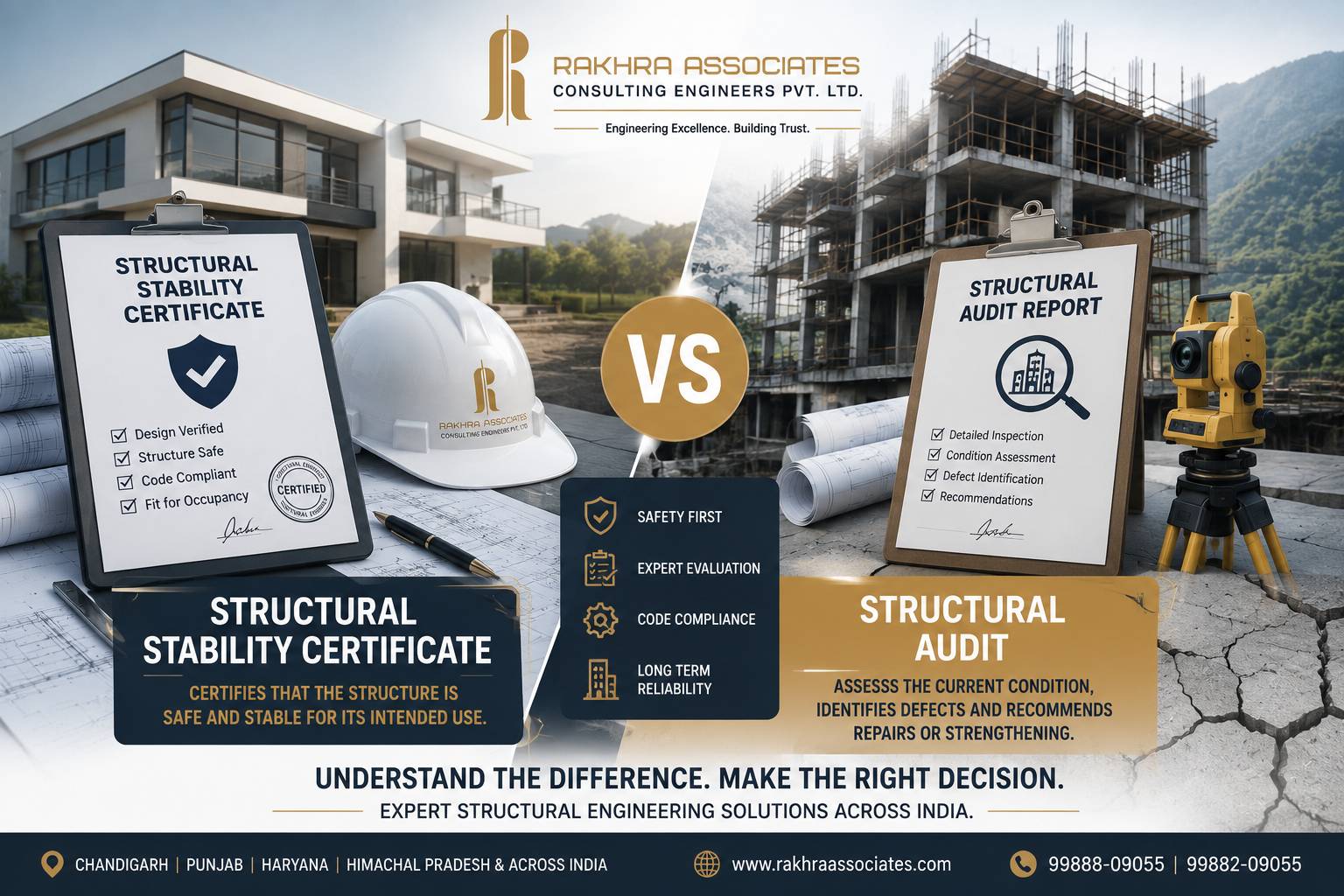
Everything You Need to Know About Structural Stability Certificates in Chandigarh & Punjab

Blog

Everything You Need to Know About Structural Stability Certificates in Chandigarh & Punjab


structure engineering mistakes

Introduction

In recent years, building safety has become a top priority for developers, housing societies, commercial property owners, and government agencies across India. Among the many legal and technical documents required during construction and post-construction, one of the most critical is the Structural Stability Certificate.

This document is not just a formality—it is a vital assurance of the structural integrity and safety of a building. In states like Punjab and union territories like Chandigarh, the demand for proper structural certification has grown significantly due to stricter compliance rules and increasing awareness of safety standards.

At Rakhra Associates, we specialize in issuing structural stability certificates in Chandigarh, Mohali, Panchkula, and across North India. In this blog, we explain what this certificate is, why it's required, who issues it, and how to obtain it.

What is a Structural Stability Certificate?

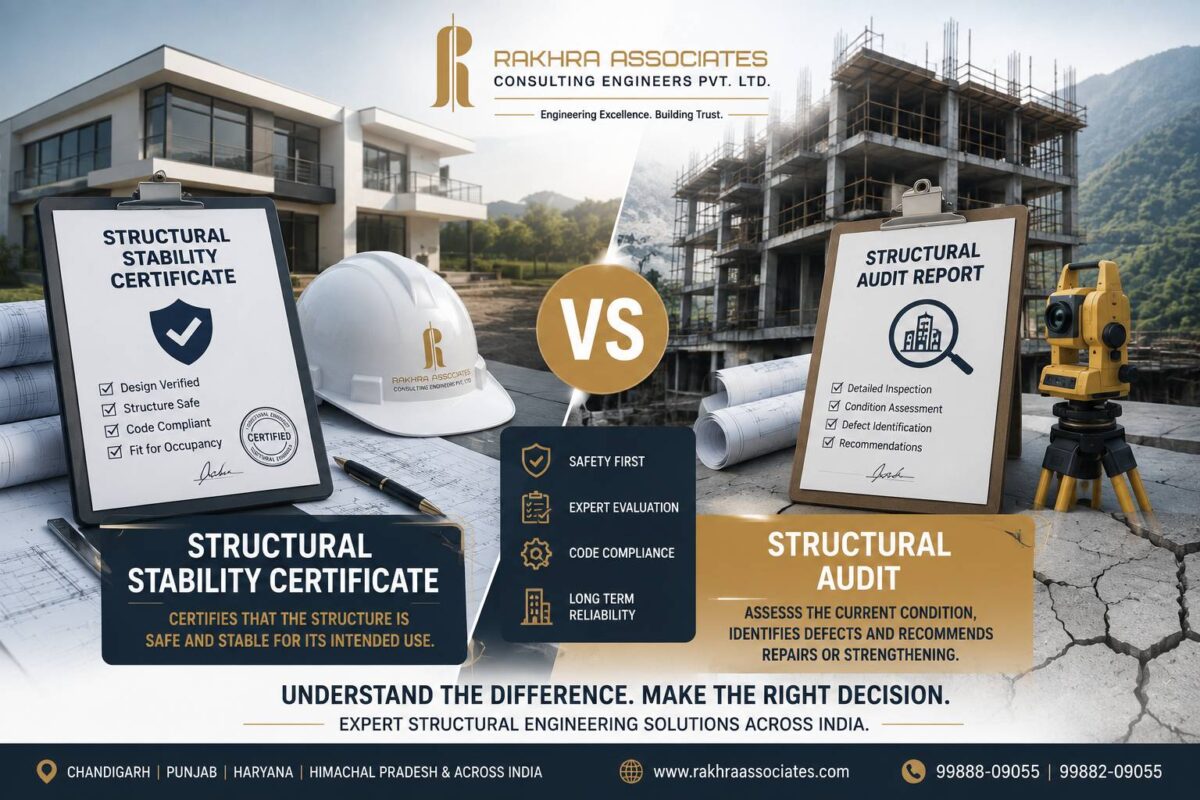
A Structural Stability Certificate is a formal document issued by a qualified structural engineer after thorough inspection and assessment of a building's structural elements. It certifies that the structure:

  • Has been designed and constructed as per the applicable Indian Standard Codes (IS Codes)
  • Is free from any structural defects or damages
  • Is safe for occupancy or continued use

The certificate applies to both new constructions and existing structures that need periodic safety audits.

Why is a Structural Stability Certificate Important?

The importance of this certificate cannot be overstated:

1. Ensures Occupant Safety
It verifies that the building will not collapse or suffer damage under regular loads or environmental conditions like wind, rain, or minor seismic activity.

2. Mandatory for Legal Approvals
In Chandigarh and Punjab, authorities require this certificate for:

  • Building plan approval
  • Completion/Occupancy certificate
  • Fire NOC (especially in high-rise or commercial buildings)
  • Renewal of factory licenses
  • Health and safety inspections

3. Risk Mitigation for Owners
It protects building owners and developers from liability in case of future structural failures.

4. Insurance and Financing
Insurance companies and financial institutions may demand this certificate before offering coverage or sanctioning loans for large properties.

When Do You Need a Structural Stability Certificate?
You may require this certificate at various stages of a building’s lifecycle:

  • During Construction – For high-rise, commercial, or government buildings
  • Post-Construction – For completion and occupancy certificates
  • Periodically – Factories and public buildings often require re-certification every 5 years
  • Before Renovation/Demolition – To assess the structural health of the existing structure
  • Change in Usage – e.g., converting a residential property to commercial use

In Chandigarh and Punjab, local authorities like the Municipal Corporation, PUDA, GMADA, and Fire Department insist on valid structural stability reports for all large-scale developments.

Who Can Issue a Structural Stability Certificate?

Only a licensed structural engineer or a firm registered with the local development authority (e.g., Chandigarh Administration, PUDA, GMADA, HSIIDC) can legally issue a structural stability certificate.

At Rakhra Associates, our team is empaneled and approved by multiple government agencies. We conduct structural audits and provide legally compliant certificates for:

  • Residential complexes
  • Commercial buildings
  • Hospitals and schools
  • Industrial buildings and factories
  • Hotels, malls, and mixed-use developments

What Does the Inspection Include?
Before issuing a certificate, the structural engineer conducts a detailed evaluation that may include:

  • âś… Visual Inspection
    Checking for cracks, deflection, corrosion, settlement, or visible distress.
  • âś… Document Review
    Verifying drawings, previous reports, materials used, and structural design parameters.
  • âś… Load Testing (if required)
    In older buildings or suspicious structures, load tests may be performed to confirm stability.
  • âś… Non-Destructive Testing (NDT)
    Techniques like rebound hammer test, ultrasonic pulse velocity, carbonation test, etc., are used to evaluate material integrity without damaging the structure.
  • âś… Soil & Foundation Evaluation
    In cases of settlement or foundational instability, engineers may review soil test reports and foundation design.
  • âś… Seismic Assessment
    Especially in areas like Chandigarh and Mohali (Zone IV), earthquake resistance is a key component.

What Does the Certificate Include?
A standard structural stability certificate typically includes:

  • Name & address of the property owner
  • Location and details of the building
  • Date of inspection
  • General structural condition of the building
  • Observations and test results (if any)
  • Confirmation that the structure complies with IS Codes
  • Validity period (generally 1 to 5 years)
  • Signature and license number of the structural engineer

Timeframe and Cost

  • Timeline: Usually issued within 7–10 working days after inspection, depending on the complexity
  • Cost: Varies based on size, type, and location of the structure

At Rakhra Associates, we offer transparent pricing, site visit schedules, and digital reports to ease the process for building owners and developers.

Validity and Renewal

  • For residential buildings: Up to 5 years
  • For commercial and industrial buildings: Typically 1 to 3 years
  • Factories under Factories Act: Mandatory renewal every 12 months or 5 years based on state regulations

Pro Tip: Keep track of your certificate’s expiry date—especially for government and compliance-heavy buildings like factories, hotels, and public-use facilities.

Common Reasons for Denial or Rejection

A certificate may not be issued (or may be revoked) under the following conditions:

  • Major cracks or foundation issues
  • Incomplete or unsafe construction
  • Non-compliance with original approved plans
  • Signs of corrosion, water leakage, or concrete spalling
  • Poor-quality construction materials

Rakhra Associates: Your Trusted Partner for Structural Certification in North India

With 20+ years of experience and a strong portfolio of successful projects, Rakhra Associates offers comprehensive structural assessment and certification services in Chandigarh, Mohali, Panchkula, Zirakpur, and other parts of Punjab and Haryana.

Why Choose Us?

  • Government-registered structural engineers
  • Expertise in RCC, steel, and composite structures
  • Use of latest NDT and audit tools
  • Fast turnaround and local authority compliance
  • Serving architects, builders, industries, and private owners

Final Thoughts

In today’s rapidly growing real estate and industrial sectors, structural safety should never be overlooked. A Structural Stability Certificate is more than a legal requirement—it is a commitment to the safety of every person who steps into your building.

Whether you're building from scratch, expanding, or just being proactive, let Rakhra Associates help you ensure long-term structural performance and regulatory peace of mind.

Categories
Uncategorized

Seismic-Resistant Building Design in India: Codes, Techniques, and Best Practices

Blog

Seismic-Resistant Building Design in India: Codes, Techniques, and Best Practices


structure engineering mistakes

Introduction

India’s geographical location places a significant portion of its landmass in zones that are vulnerable to seismic activity. From the devastating 2001 Bhuj earthquake to the tremors felt in the Himalayas, we’ve seen firsthand how critical seismic-resilient structures are for public safety. For developers, architects, and civil engineers, earthquake-resistant design is not a luxury—it is a legal and ethical necessity.

This blog serves as a comprehensive guide to seismic-resistant building design in India. It includes the latest Indian standards, structural techniques, and best practices followed by structural engineers, including those at Rakhra Associates, who serve across Chandigarh, Mohali, and North India.

Understanding Seismic Zones in India

The Bureau of Indian Standards (BIS) classifies India into four seismic zones under IS 1893 (Part 1):2016:

  • Zone II – Low intensity (e.g., parts of Karnataka, Maharashtra)
  • Zone III – Moderate intensity (e.g., Kerala, Punjab, Haryana)
  • Zone IV – Severe intensity (e.g., Delhi, Chandigarh, Bihar)
  • Zone V – Very severe intensity (e.g., Northeast India, Himachal Pradesh, Kashmir)

Most of North India—including Chandigarh and Mohali—falls under Zone IV, meaning buildings here must follow strict earthquake-resistant guidelines.

Key Indian Codes Governing Seismic Design

To ensure safety and performance during earthquakes, the following IS codes must be followed:

  • IS 1893 (Part 1): 2016 – Criteria for Earthquake Resistant Design of Structures
  • IS 13920:2016 – Ductile Detailing of Reinforced Concrete Structures
  • IS 456:2000 – General Code for Reinforced Cement Concrete Design
  • IS 4326:2013 – Earthquake Resistant Design and Construction of Buildings
  • IS 13828:1993 – For low-strength masonry buildings

These standards provide guidelines for calculating seismic forces, ductility requirements, detailing, and construction practices essential for resilience.

Principles of Earthquake-Resistant Design

Seismic-resistant design does not aim to prevent all damage, but it ensures that the building doesn’t collapse and people remain safe. The core design principles include:

  • Strength: Ensuring the structure can handle expected loads.
  • Stiffness: To minimize excessive deformation.
  • Ductility: So that structures can deform without failing suddenly.
  • Continuity: Creating a clear load path to transfer seismic forces to the ground.
  • Redundancy: Multiple load paths in case one fails.

Seismic Design Process: How Structural Engineers Approach It

  • Site Analysis
    Understanding the soil conditions and seismic zoning of the location.
  • Load Calculation
    Determining seismic loads as per IS 1893 using the building’s weight, occupancy, and importance factor.
  • Structural Configuration
    Preferably symmetric, regular shapes reduce torsional effects during earthquakes.
  • Structural System Selection
    Frames, shear walls, braced frames, or a combination, depending on the building type.
  • Material Selection
    High-strength concrete and ductile steel that meet IS standards.
  • Detailing for Ductility
    As per IS 13920 – includes closely spaced stirrups, lap splices, beam-column joint detailing.
  • Dynamic Analysis (for High-Rise Buildings)
    Time-history or response spectrum analysis is mandatory for buildings over a certain height.

Common Seismic-Resistant Structural Systems in RCC Construction

Moment Resisting Frames (MRF)

  • Offers flexibility and ductility
  • Used in residential and commercial buildings

Shear Walls

  • Vertical walls designed to resist lateral forces
  • Ideal for high-rise structures

Braced Frames

  • Diagonal steel members resist lateral loads
  • Common in steel buildings

Dual Systems

  • Combination of MRF and Shear Walls for enhanced safety

Best Practices in Seismic-Resistant Design and Construction

  • Soft Storey Avoidance: Avoid open parking on the ground floor without walls or bracing.
  • Foundation Design: Use raft or pile foundations where soil is weak.
  • Seismic Joints: Include separation joints between adjacent buildings to avoid pounding.
  • Staircase and Lift Core Anchoring: Secure to the main structure to prevent collapse.
  • Avoid Cantilevers & Projections: These increase torsion during quakes.
  • Quality Control: On-site supervision, material testing, and proper curing are essential.

Retrofitting Existing Buildings for Seismic Resistance

Many buildings in India were constructed before seismic codes were updated. These can be made safer through retrofitting techniques such as:

  • Adding shear walls
  • Base isolation systems
  • Jacketing columns and beams
  • FRP (Fiber Reinforced Polymer) wrapping
  • Steel bracing systems

Retrofitting is far more economical than rebuilding and can protect lives during future earthquakes.

Role of Structural Engineers in Seismic Design

Professional structural engineers play a pivotal role in ensuring that a building will withstand seismic forces. At Rakhra Associates, we combine advanced software tools (ETABS, STAAD Pro, SAP2000) with field experience to design RCC structures that adhere to Indian seismic codes.

Our approach includes:

  • Seismic vulnerability assessment
  • Soil-structure interaction studies
  • Dynamic analysis for complex structures
  • Vetting and rechecking architectural designs for seismic compatibility

We’ve worked on hospitals, schools, residential towers, and commercial complexes in Zone IV regions like Chandigarh and Mohali.

Cost Implications of Seismic-Resistant Design

Building to seismic standards may marginally increase the cost of construction—typically by 5–10%. However, this is negligible compared to the cost of repair or rebuilding after a quake.

Moreover, new government policies and local bylaws are now making seismic compliance mandatory in most urban development projects, especially in Zones III to V.

Final Thoughts

In a country like India, earthquake-resistant building design should be seen as a non-negotiable part of responsible construction. It’s not just about protecting structures—it’s about protecting people.

As leading structural engineers in Chandigarh and Mohali, Rakhra Associates is committed to delivering buildings that are safe, sustainable, and compliant with seismic norms. Whether you’re planning a new RCC structure or seeking to retrofit an existing one, our expertise ensures that seismic safety is built into your foundation—literally.

Categories
Uncategorized

Structural Retrofitting Methods for RCC Buildings in India: A Complete Guide

Blog

Structural Retrofitting Methods for RCC Buildings in India: A Complete Guide


structure engineering mistakes

Introduction

In India, where urbanization is accelerating rapidly, the integrity of existing RCC (Reinforced Cement Concrete) buildings is becoming a growing concern. Earthquakes, aging infrastructure, poor construction practices, and changing usage patterns often call for structural evaluation and strengthening. This is where structural retrofitting steps in—a crucial intervention to enhance the safety and longevity of buildings without complete demolition.

At Rakhra Associates, our team of experienced structural engineers in Chandigarh and structure engineers in Mohali specialize in providing practical and code-compliant retrofitting solutions to preserve, strengthen, and modernize existing RCC structures.

This blog will serve as a comprehensive guide to structural retrofitting in India—covering what it is, why it's needed, different retrofitting techniques, cost considerations, Indian standards, and more.

What is Structural Retrofitting?

Structural retrofitting is the process of strengthening an existing building to improve its resistance to seismic activity, load changes, material deterioration, and design deficiencies. Unlike new construction, retrofitting focuses on making changes to the existing structure, making it safer and extending its functional lifespan.

Why Retrofitting is Crucial in India

India is classified as a high seismic risk country, with zones IV and V highly vulnerable to earthquakes. Additionally, several buildings constructed in the last few decades suffer from outdated practices, poor-quality materials, and lack of proper load distribution design.

Common reasons why retrofitting becomes necessary:

  • Seismic vulnerability in earthquake-prone zones
  • Material degradation over time
  • Improper structural design or construction flaws
  • Increased load due to renovations or additions
  • Failure during structural audits or inspections

When Should You Consider Retrofitting a Building?

Here are key signs and situations that indicate the need for retrofitting:

  • Cracks in beams, columns, or slabs
  • Sagging floors or roof structures
  • Water leakage and corrosion of reinforcement
  • After a detailed structural audit recommends repairs
  • Compliance with new building codes (especially post-earthquake)
  • Change of building usage requiring higher load capacity
  • Heritage structures that must be preserved structurally

Structural Audits – The First Step

Before any retrofitting project begins, it’s vital to conduct a structural audit. This evaluation—done by certified structure engineers in Mohali and Chandigarh—assesses the current health of the building and identifies structural deficiencies.

The audit process includes:

  • Visual inspection
  • Non-destructive testing (NDT)
  • Load testing
  • Analysis of structural drawings
  • Material sampling

At Rakhra Associates, we provide in-depth structural audits and offer a full report detailing areas of concern, structural risks, and retrofitting recommendations.

Popular Structural Retrofitting Techniques for RCC Buildings

Retrofitting is not a one-size-fits-all solution. Based on the audit results and structural needs, engineers can choose from a variety of methods:


1. Jacketing

Column Jacketing / Beam Jacketing / Slab Jacketing

This involves encasing the structural elements (like columns or beams) with additional concrete and steel reinforcements. It is highly effective in improving load-bearing capacity.

  • Suitable for: Damaged or weak columns and beams
  • Materials used: High-strength concrete, rebars
  • Advantages: Improves ductility, restores section strength

2. Steel Plate Bonding

Steel plates are attached to structural elements using epoxy or bolts. These plates enhance strength without drastically increasing section dimensions.

  • Best for: Strengthening tension zones in beams and slabs
  • Cost-effective for mild strengthening

3. Fiber Reinforced Polymer (FRP) Wrapping

FRP composites like carbon or glass fiber are bonded externally to elements to enhance flexural and shear strength. This modern method is widely adopted in urban retrofitting projects.

  • Lightweight, corrosion-resistant
  • Minimal increase in section size
  • Quick installation

4. Section Enlargement

This involves increasing the cross-sectional area of structural members. It is more intensive than jacketing and requires detailed design.

  • Used when a significant increase in load-bearing is needed
  • Often implemented in industrial and commercial buildings

5. Base Isolation (Seismic Retrofitting)

A technique to decouple the building from ground motion using seismic isolators. Though cost-intensive, it’s ideal for high-rise buildings and hospitals in seismic zones.

  • Prevents direct earthquake force transmission
  • Requires expert design

6. External Post-Tensioning

Adding tension to existing structural members using high-strength steel tendons to counterbalance loads. Often used in bridge retrofitting.

  • Reduces deflections and cracking
  • Highly technical process

7. Grouting and Crack Injection

Used to restore monolithic behavior by filling cracks or voids in structural elements.

  • Epoxy injection for fine cracks
  • Cementitious grout for wider cracks

Challenges in Retrofitting

While retrofitting provides substantial benefits, it also involves challenges that must be addressed by expert engineers:

  • Compatibility of materials with existing structure
  • Accessibility and working space constraints
  • Minimizing disruption to occupants
  • Cost and time considerations
  • Selection of suitable retrofitting technique

Standards and Guidelines in India

In India, structural retrofitting practices are governed by multiple standards:

  • IS 15988:2013 – Seismic Evaluation and Strengthening of Existing RCC Buildings
  • IS 456:2000 – Code of Practice for Plain and Reinforced Concrete
  • IS 1893:2016 – Earthquake Resistant Design of Structures
  • NBC (National Building Code) – Guidelines for retrofitting and audits

Our team at Rakhra Associates strictly adheres to these standards to deliver safe, durable, and compliant retrofitting designs.

Cost Considerations

The cost of retrofitting depends on:

  • Type of retrofitting method used
  • Severity of damage or deficiency
  • Materials and manpower
  • Structural complexity

On average, retrofitting costs about 20-40% of new construction costs—but it often saves time, resources, and heritage value. It’s a smart investment for any aging or vulnerable building.

Case Studies: Rakhra Associates Projects

We’ve successfully executed retrofitting projects for:

  • Educational institutions
  • Multi-storey residential towers
  • Commercial buildings in Mohali and Chandigarh
  • Heritage structures in Punjab

Each project began with a structural audit and ended with a safe, code-compliant structure using tailored retrofitting techniques.

Conclusion: Retrofitting is Not Optional—It's Essential

In today's dynamic environment, the structural integrity of a building must be seen as a living, evolving responsibility. Retrofitting isn't just a repair—it's a proactive measure that protects life, property, and investment.

Whether your building is showing signs of distress, undergoing a usage change, or located in a high-risk zone, a structural audit followed by suitable retrofitting measures can make all the difference.

If you're searching for trusted structural engineers in Chandigarh or structure engineers in Mohali, Rakhra Associates brings decades of experience, expert evaluations, and reliable retrofitting solutions tailored to Indian conditions.