


Blog
Earthquake-Resistant Retrofitting: Learning from India’s Recent Disasters
Introduction: When the Ground Shakes, Engineering Speaks
India sits at the confluence of seismic zones IV and V, making vast parts of the country highly vulnerable to earthquakes. From Bhuj (2001) to Nepal (2015) and Sikkim (2011), each event has exposed the fragility of our building stock — particularly older structures built before modern seismic codes.
Earthquake-resistant retrofitting is the process of strengthening existing buildings to withstand seismic forces without complete reconstruction. It’s not just a repair — it’s a strategic reinforcement of safety, sustainability, and resilience.
At Rakhra Associates, one of Chandigarh’s leading structural engineering consultancies, retrofitting is viewed as a vital tool to preserve both life and investment in India’s rapidly urbanizing cities.
Understanding the Need for Retrofitting
While new buildings in seismic zones must comply with IS 1893:2016 and IS 13920:2016, millions of pre-2000 buildings do not.
These structures:
- Lack ductile detailing in RCC elements
- Were built using unreinforced masonry
- Ignore load transfer paths and seismic design principles
Retrofitting bridges this gap — enhancing the lateral strength, ductility, and stability of old structures to meet modern standards.
Major Earthquakes that Shaped India’s Retrofitting Practices
| Year | Earthquake Location | Magnitude | Key Lessons Learned |
| 1993 | Latur, Maharashtra | 6.4 | Masonry buildings without bands failed catastrophically |
| 2001 | Bhuj, Gujarat | 7.7 | Poor detailing and soft-story failures exposed urban vulnerabilities |
| 2011 | Sikkim | 6.9 | Need for better retrofitting in hilly terrains |
| 2015 | Nepal (affected N. India) | 7.8 | Importance of seismic joints and retrofitted infrastructure |
| 2023 | Joshimath, Uttarakhand | 6.3 | Foundation stability and soil-structure interaction crucial |
These disasters compelled authorities to emphasize structural audits and retrofitting for hospitals, schools, and government buildings.
Common Structural Weaknesses Found in Indian Buildings
- Soft Story Structures:
Ground floors with parking or open spaces lacking adequate lateral support. - Inadequate Reinforcement:
Use of undersized rebars or improper anchorage. - Weak Joints and Columns:
Poor load transfer between beams, columns, and slabs. - Unreinforced Masonry Walls:
Cracks under lateral forces lead to complete collapse. - Irregular Building Geometry:
L-shaped or asymmetrical buildings cause torsional stresses.
Retrofitting directly addresses these issues through engineering upgrades.
Techniques of Earthquake-Resistant Retrofitting
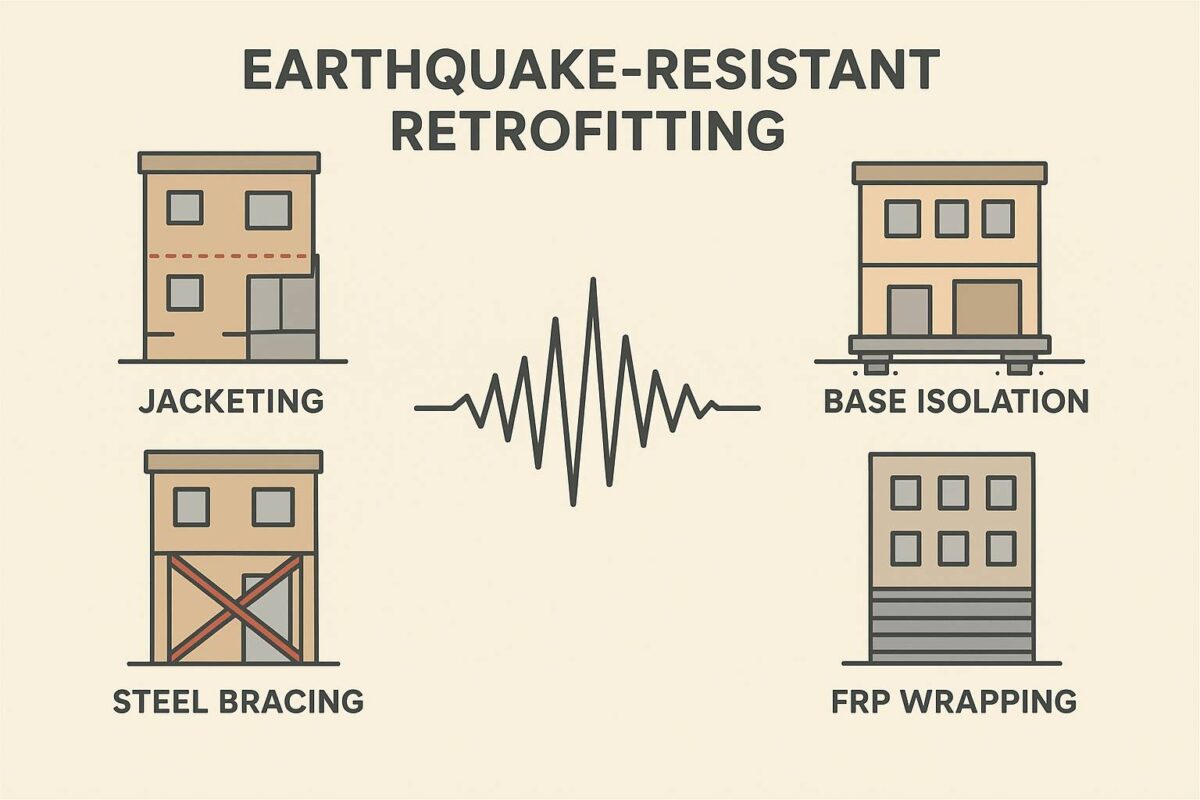
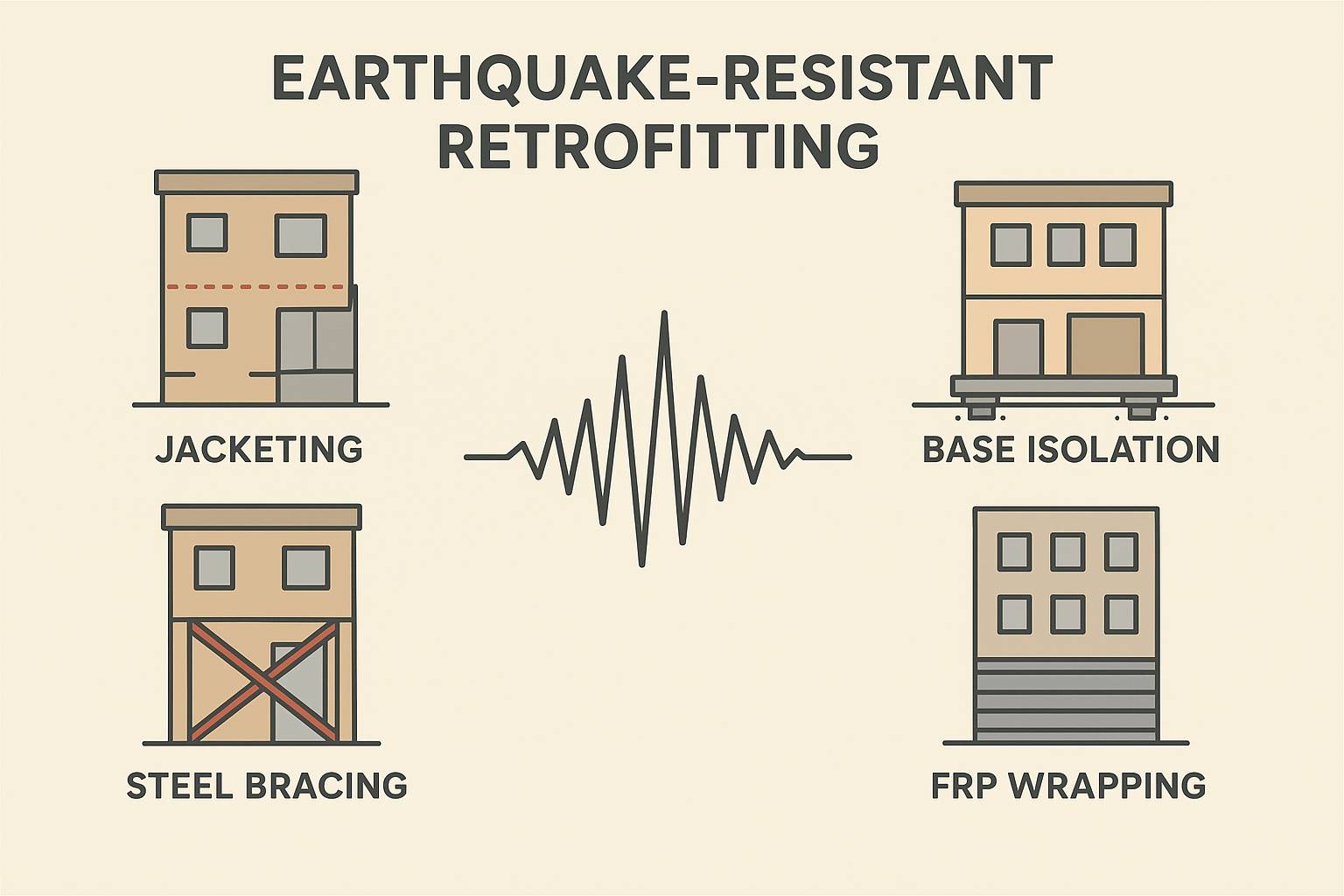
1. Jacketing of Structural Members
Adding reinforced concrete (RCC), steel, or fiber wraps around columns, beams, or joints to increase load-carrying capacity.
Used For:
Old RCC buildings, schools, and public offices.
Advantage:
Improves ductility and shear strength significantly.
2. Base Isolation
Installing isolators between the foundation and superstructure to absorb seismic energy.
Though expensive, it’s effective for critical infrastructure like hospitals or data centers.
3. Steel Bracing Systems
Adding diagonal steel braces within the frame enhances lateral stiffness.
Common in industrial and multi-story commercial retrofits.
4. FRP (Fiber Reinforced Polymer) Wrapping
Lightweight and non-corrosive, FRP wrapping is an advanced technique to strengthen columns and beams without adding much dead load.
Used in:
Historic buildings and seismic zone retrofits.
Bonus:
Aesthetic preservation with strong structural reinforcement.
5. Shear Wall Addition
Adding reinforced concrete shear walls significantly improves the lateral load capacity of existing frames.
This is the most common method in multi-storey residential retrofits.
6. Foundation Strengthening
Seismic forces often originate at the base. Strengthening foundations via underpinning or micro-piling improves building stability, especially in soft-soil areas like Chandigarh’s plains.
Case Study: Retrofitting Success in Gujarat Post-2001 Earthquake
After the Bhuj Earthquake, the Gujarat government initiated one of India’s largest retrofitting and reconstruction programs.
Key highlights included:
- Strengthening 18,000 school buildings
- Introducing ductile detailing in RCC
- Training over 10,000 masons and engineers in seismic retrofitting
As a result, subsequent moderate quakes in the region caused minimal casualties — a testament to effective retrofitting measures.
Case Study: Retrofitting Success in Gujarat Post-2001 Earthquake
After the Bhuj Earthquake, the Gujarat government initiated one of India’s largest retrofitting and reconstruction programs.
Key highlights included:
- Strengthening 18,000 school buildings
- Introducing ductile detailing in RCC
- Training over 10,000 masons and engineers in seismic retrofitting
As a result, subsequent moderate quakes in the region caused minimal casualties — a testament to effective retrofitting measures.
Retrofitting in North India: Rakhra Associates’ Perspective
The Shivalik and Himalayan foothill regions, including Chandigarh, Shimla, and Dehradun, are categorized under Seismic Zone IV and V.
Rakhra Associates focuses on:
- Seismic vulnerability assessments for public and private buildings
- Retrofitting design and detailing compliant with IS codes
- Performance-based design modeling using software like ETABS, STAAD.Pro, and SAP2000
They specialize in integrated retrofitting strategies combining traditional materials with modern technology — ensuring both safety and architectural preservation.
Economic Benefits of Retrofitting
While retrofitting seems costly upfront, it’s 5–10 times cheaper than post-earthquake rebuilding.
Cost comparison:
| Action | Cost (approx.) | Outcome |
| Retrofitting | ₹600–₹1,200 per sq. ft. | Strengthened, reusable building |
| Rebuilding after collapse | ₹3,000–₹4,500 per sq. ft. | Complete reconstruction |
Conclusion: Prevention is far more economical than recovery.
Government Initiatives and Retrofitting Codes
The National Disaster Management Authority (NDMA) and Bureau of Indian Standards (BIS) have developed extensive frameworks for seismic safety.
Key Indian Codes:
- IS 1893:2016 – Criteria for Earthquake Resistant Design of Structures
- IS 13920:2016 – Ductile Detailing of Reinforced Concrete Structures
- IS 4326:2013 – Earthquake Resistant Design and Construction of Buildings
- IS 15988:2013 – Seismic Evaluation and Strengthening of Existing Buildings
These standards guide engineers like Rakhra Associates to evaluate, design, and implement retrofit solutions with precision.
Challenges in Retrofitting Implementation
- Lack of awareness among building owners
- High initial costs for large buildings
- Limited trained professionals in smaller towns
- Difficulty in retrofitting occupied buildings
However, with technological advancements and government incentives, these challenges are being rapidly overcome.
Future of Earthquake-Resistant Infrastructure in India
India’s rapid urbanization demands resilient infrastructure capable of withstanding natural calamities.
Smart Cities like Chandigarh are now incorporating structural audits and retrofitting in their master plans.
Future trends include:
- AI-driven structural health monitoring
- Self-healing materials
- Hybrid retrofitting systems combining steel and FRP
- IoT-based vibration sensors for real-time damage detection
These innovations signal a future where buildings don’t just resist earthquakes — they adapt to them.
FAQs on Earthquake-Resistant Retrofitting
Q1. What is earthquake-resistant retrofitting?
It’s the process of upgrading an existing structure to improve its performance during an earthquake.
Q2. How do I know if my building needs retrofitting?
A structural audit by qualified engineers like Rakhra Associates can assess seismic vulnerability.
Q3. Can old RCC buildings be retrofitted effectively?
Yes, through methods like jacketing, FRP wrapping, and shear wall addition.
Q4. What’s the difference between strengthening and retrofitting?
Strengthening focuses on increasing capacity; retrofitting targets both capacity and ductility for seismic forces.
Q5. Are there government subsidies for retrofitting?
Some states under NDMA and Smart City Missions offer incentives for critical infrastructure retrofits.
Q6. What’s the lifespan of a retrofitted structure?
Properly retrofitted buildings can safely perform for 30–50 more years.
Conclusion: Building Safety, Not Just Structures
Retrofitting is more than an engineering process — it’s an act of preparedness.
With earthquakes becoming increasingly unpredictable, every old building in seismic zones must undergo evaluation and retrofitting.
Rakhra Associates, with decades of expertise in structural design and retrofitting in Chandigarh, ensures that structures not only meet seismic codes but exceed them — creating buildings that stand tall, even when the earth doesn’t.