

Categories
Structural Engineering

Structural Health Monitoring

Blog

Key Indicators Your Industrial Building Needs Retrofitting


Industrial buildings are designed for long service life, but age, loading changes, environmental exposure, and material degradation gradually reduce structural performance. Structural Health Monitoring (SHM) helps identify early warning signs—long before visible failure occurs.

What Is Structural Health Monitoring (SHM)?

Structural Health Monitoring is the process of:

  • Observing structural behavior over time
  • Measuring performance under real loads
  • Identifying distress before failure

It combines engineering assessment with data-driven evaluation.

Why SHM Is Critical for Industrial Buildings

Industrial structures face:

  • Heavy dynamic loads
  • Machinery vibrations
  • Chemical and thermal exposure

Without monitoring, deterioration often remains unnoticed until it becomes critical.

Visible Cracking Beyond Design Expectations

Cracks that indicate concern include:

  • Diagonal shear cracks
  • Widening flexural cracks
  • Repeated cracking at the same location

These often signal overstress or material fatigue.

Excessive Deflection or Sagging Members

Warning signs include:

  • Sagging beams or slabs
  • Uneven floors
  • Misaligned roof elements

Excessive deflection suggests loss of stiffness or increased loading.

Corrosion of Reinforcement or Structural Steel

Corrosion indicators:

  • Rust stains
  • Concrete spalling
  • Section loss in steel members

Corrosion reduces load-carrying capacity and accelerates failure.

Abnormal Vibrations in Floors or Frames

Vibration issues may result from:

  • Machinery upgrades
  • Structural weakening
  • Resonance conditions

Persistent vibration affects both safety and equipment performance.

Change in Structural Usage or Load Patterns

Buildings originally designed for:

  • Light manufacturing
  • Storage

May later carry heavier equipment or stacked loads—often without structural upgrades.

Settlement and Foundation Distress

Key indicators include:

  • Uneven floor levels
  • Wall separation
  • Cracks near columns or footings

Foundation movement directly impacts superstructure stability.

Water Seepage and Moisture Ingress

Moisture exposure leads to:

  • Reinforcement corrosion
  • Concrete strength reduction
  • Loss of durability

Water-related damage is often slow but progressive.

Deterioration Due to Environmental Exposure

Industrial buildings may be exposed to:

  • Chemicals
  • High humidity
  • Temperature cycling

These conditions accelerate material degradation beyond design assumptions.

Ageing Structures Beyond Design Life

Many industrial buildings operate:

  • Beyond their original design life
  • Without periodic structural evaluation

Ageing alone is a valid reason for SHM and retrofitting assessment.

Damage from Seismic or Wind Events

Even moderate events can cause:

  • Microcracking
  • Joint distress
  • Connection weakening

Post-event monitoring is essential even when damage appears minor.

Instrument-Based Structural Monitoring

SHM tools may include:

  • Crack gauges
  • Strain sensors
  • Vibration monitors

These help quantify structural behavior instead of relying only on visual inspection.

When Monitoring Indicates the Need for Retrofitting

Retrofitting becomes necessary when:

  • Structural capacity reduces below demand
  • Progressive deterioration is detected
  • Safety margins are compromised

Early intervention minimizes cost and downtime.

Benefits of Early Retrofitting Decisions

Proactive retrofitting results in:

  • Lower repair costs
  • Improved safety
  • Extended service life

Delayed action increases structural and financial risk.

Role of Structural Engineers in SHM

Structural engineers:

  • Interpret monitoring data
  • Assess residual strength
  • Recommend appropriate strengthening methods

Engineering judgment is critical for correct decision-making.

Conclusion

Structural Health Monitoring provides objective insight into the real condition of industrial buildings. Recognizing early indicators—such as cracking, deflection, corrosion, and vibration—allows timely retrofitting and prevents unexpected failures.

For industrial facilities, SHM is not a reactive measure but a preventive engineering practice that safeguards safety, performance, and long-term asset value.

Categories
Structural Engineering

How Precise Structural Design Optimization Reduces Steel Consumption in PEB

Blog

How Precise Structural Design Optimization Reduces Steel Consumption in PEB


In steel construction, especially in Pre-Engineered Buildings (PEB), the difference between an average design and an optimized design is often measured not in millimeters—but in tons of steel.

Steel is one of the most expensive and carbon-intensive materials used in construction. As project costs rise and sustainability becomes a priority, precise structural design optimization has emerged as one of the most powerful tools to reduce steel consumption—without compromising safety or performance.

At Rakhra Associates – Structural Engineers in Chandigarh, optimization is treated as a core engineering responsibility, not an optional enhancement. This blog explains how structural optimization works in PEB systems, why it reduces steel usage, and what engineering decisions truly make the difference.

Understanding Steel Consumption in PEB Structures

Steel consumption in PEB buildings is influenced by:

  • Structural system selection
  • Load assumptions
  • Member sizing
  • Connection detailing
  • Span and bay planning

Even small inefficiencies in these areas can result in significant excess steel usage.

What Is Structural Design Optimization?

Structural design optimization is the process of:

  • Achieving required structural performance
  • Using the minimum amount of material
  • Ensuring code compliance and safety

In PEB structures, optimization focuses on:

  • Member geometry
  • Stress distribution
  • Load paths
  • Fabrication efficiency

Why PEB Is Naturally Suited for Optimization

PEB systems are ideal for optimization because:

  • They rely on software-driven analysis
  • Members can be tapered or variable
  • Loads are predictable
  • Repetition allows refinement

Unlike conventional steel structures, PEB does not depend on uniform sections—every member is designed for actual demand.

Key Areas Where Optimization Reduces Steel Consumption

1. Tapered Built-Up Sections

Unlike hot-rolled uniform sections:

  • PEB columns and rafters vary in depth
  • Steel is provided only where stress demands it

This alone can reduce steel weight by 15–30%.

2. Accurate Load Assessment

Overestimated loads are the biggest cause of steel wastage.

Optimization ensures:

  • Realistic live load values
  • Correct wind load calculations
  • Accurate seismic coefficients

Every unnecessary load increases member size and steel quantity.

3. Efficient Load Path Design

A clear load path:

  • Reduces force concentration
  • Eliminates redundant members
  • Improves force distribution

Optimized load paths directly reduce steel tonnage.

4. Optimized Bay Spacing

Bay spacing affects:

  • Member length
  • Bending moments
  • Steel quantity 

Proper bay optimization balances:

  • Structural efficiency
  • Fabrication economy
  • Architectural requirements

5. Bracing System Optimization

Efficient bracing:

  • Reduces frame forces
  • Minimizes column sizes
  • Improves lateral stability

Choosing the right bracing configuration significantly reduces steel usage.

Role of Advanced Structural Analysis Software

Modern PEB optimization relies on:

  • Finite element analysis
  • Load combination automation
  • Iterative member sizing

However, software alone does not optimize—engineering judgment does.

Connection Design and Steel Savings

Overdesigned connections lead to:

  • Excess plate thickness
  • Unnecessary stiffeners
  • Increased fabrication cost

Optimized connection design:

  • Matches force demand
  • Reduces welding
  • Improves constructability

Foundation Interaction and Steel Reduction

Reducing superstructure steel:

  • Lowers foundation loads
  • Reduces base plate sizes
  • Optimizes anchor bolts

Optimization cascades benefits through the entire structure.

Optimization vs Overdesign

Aspect Overdesign Optimization
Safety Artificially high Code-compliant
Steel usage Excessive Minimal
Cost High Efficient
Performance Average Improved

Optimization does not reduce safety margins—it removes inefficiency.

Impact on Project Cost and Sustainability

Economic Benefits

  • Lower steel procurement cost
  • Reduced transportation and erection cost
  • Smaller foundations

Environmental Benefits

  • Reduced embodied carbon
  • Lower resource extraction
  • Sustainable construction practices

Common Mistakes That Increase Steel Consumption

  • Conservative load assumptions
  • Uniform section usage
  • Ignoring secondary load paths
  • Poor coordination between design and fabrication

Awareness of these mistakes is key to optimization.

Role of Structural Engineers in Steel Optimization

Structural engineers:

  • Define load assumptions
  • Control member sizing
  • Ensure code compliance
  • Balance safety and efficiency

At Rakhra Associates, optimization is driven by engineering clarity—not cost pressure.

Importance of Structural Audits in Optimized PEBs

Structural audits help:

  • Verify design assumptions
  • Identify overdesign
  • Ensure long-term performance

Audits support optimization throughout the building’s lifecycle.

Indian Codes Supporting Optimized Steel Design

  • IS 800 – Limit state design
  • IS 875 – Accurate loading
  • IS 1893 – Seismic efficiency
  • NBC 2016 – Performance-based design

Codes allow optimization when applied correctly.

Future of Steel Optimization in PEB

By 2026 and beyond:

  • AI-assisted optimization tools will increase
  • Performance-based design will dominate
  • Sustainability metrics will influence steel usage

Optimized steel design is becoming industry standard, not exception.

FAQs: Steel Optimization in PEB Structures

1. What is steel optimization in PEB?

Designing PEB structures using minimum steel without compromising safety.

2. How much steel can optimization save?

Typically 15–30%, depending on design.

3. Does optimization reduce safety?

No, it maintains code-required safety levels.

4. Is optimization only software-based?

No, engineering judgment is essential.

5. Why is overdesign common in steel structures?

Due to conservative assumptions and lack of optimization.

6. Can optimization reduce foundation size?

Yes, significantly.

7. Are tapered sections stronger?

They are more efficient, not weaker.

8. Does bay spacing affect steel quantity?

Yes, greatly.

9. Are optimized PEBs earthquake resistant?

Yes, when designed as per IS 1893.

10. Can optimization reduce erection time?

Yes, lighter members are easier to erect.

11. Is optimization suitable for industrial buildings?

Yes, especially industrial PEBs.

12. Does optimization increase design time?

Slightly, but saves construction time.

13. Can existing PEBs be optimized?

Through structural audits and retrofitting.

14. Is optimization sustainable?

Yes, it reduces embodied carbon.

15. Do Indian codes allow optimization?

Yes, under limit state design.

16. Can optimization affect architectural layout?

Usually no, structural changes are internal.

17. Is optimization useful for small PEBs?

Yes, every ton saved matters.

18. Does optimization reduce connection cost?

Yes, through accurate force design.

19. Is optimization different from value engineering?

Optimization is a key part of value engineering.

20. Who should perform steel optimization?

Qualified structural engineers.

Conclusion

Precise structural design optimization is the single most effective method to reduce steel consumption in Pre-Engineered Buildings. By focusing on accurate load assessment, efficient member design, and clear load paths, engineers can deliver structures that are safe, economical, and environmentally responsible.

At Rakhra Associates – Structural Engineers in Chandigarh, optimization is not viewed as an option—it is an essential part of responsible structural engineering, contributing to better performance, reduced costs, and sustainable construction practices.

Categories
Structural Engineering

Value Engineering

Blog

Maximizing Structural Integrity While Minimizing Project Costs


In modern construction, one of the biggest misconceptions is that lower cost means lower quality. From a structural engineering perspective, this belief is not only incorrect—it is inefficient.

The real challenge in today’s construction environment is not cutting costs blindly, but optimizing them intelligently. This is where Value Engineering (VE) plays a critical role.

At Rakhra Associates – Structural Engineers in Chandigarh, value engineering is viewed as a technical discipline, not a cost-cutting shortcut. This blog explains what value engineering truly means, how it improves structural integrity, and why it is essential for sustainable and economically viable construction projects.

What Is Value Engineering in Structural Design?

Value Engineering is a systematic approach that aims to:

  • Improve functional performance
  • Optimize material usage
  • Reduce unnecessary costs
  • Maintain or enhance safety and durability

In structural engineering, value engineering focuses on:

  • Load efficiency
  • Material optimization
  • Design rationalization
  • Lifecycle cost reduction

It is not about reducing safety margins, but about eliminating inefficiencies.

Core Principle of Value Engineering

The fundamental equation of value engineering is:

Value = Function Ă· Cost

Improving value can be achieved by:

  • Enhancing function without increasing cost

  • Maintaining function while reducing cost

  • Improving function and reducing cost simultaneously

Why Value Engineering Is Essential in Today’s Construction Industry

Rising Challenges in Construction

  • Escalating material prices
  • Skilled labor shortages
  • Tight project timelines
  • Increasing regulatory compliance
  • Sustainability requirements

Value engineering addresses these challenges by making structures economically efficient without compromising performance.

Value Engineering vs Cost Cutting

Aspect Cost Cutting Value Engineering
Focus Reduce expense Improve efficiency
Safety Often compromised Never compromised
Approach Reactive Analytical
Outcome Short-term savings Long-term value

Value engineering is a design philosophy, not a budget reaction.

Role of Structural Engineers in Value Engineering

Structural engineers are central to value engineering because:

  • They understand load behavior
  • They control material selection
  • They define structural systems
  • They ensure code compliance

At Rakhra Associates, value engineering begins at the conceptual design stage, not after drawings are finalized.

Key Areas Where Value Engineering Applies

1. Structural System Selection

Choosing the right system:

  • RCC vs Steel vs Hybrid
  • PEB vs Conventional steel
  • Framed vs shear wall systems

Correct system selection alone can reduce costs by 10–25%.

2. Material Optimization

  • Optimizing concrete grades
  • Reducing over-reinforcement
  • Using high-strength steel strategically
  • Eliminating unnecessary safety margins

Material optimization improves both cost and sustainability.

3. Load Rationalization

Overestimation of loads leads to:

  • Heavier sections
  • Higher foundation costs
  • Increased material usage

Value engineering ensures realistic and code-compliant load assumptions.

4. Member Size Optimization

Using:

  • Tapered sections
  • Variable beam depths
  • Optimized column spacing 

Results in:

  • Reduced steel tonnage
  • Efficient force transfer

5. Foundation Design Optimization

  • Matching foundation type to soil conditions
  • Avoiding blanket foundation designs
  • Using geotechnical data effectively

Foundations often account for 20–30% of project cost, making them a major value engineering opportunity.

Value Engineering Across Project Stages

Concept Stage

  • System selection
  • Grid planning
  • Preliminary load assessment

Design Development Stage

  • Section optimization
  • Reinforcement detailing
  • Structural modeling

Construction Stage

  • Constructability improvements
  • Reduced wastage
  • Faster execution

Structural Integrity and Value Engineering

A well-executed value engineering process:

  • Improves load flow clarity
  • Reduces stress concentrations
  • Enhances seismic performance
  • Minimizes long-term maintenance

Structural integrity is strengthened, not compromised.

Value Engineering and Seismic Safety

In seismic zones:

  • Reducing dead load improves seismic response
  • Proper ductility detailing saves material and lives
  • Efficient lateral load systems reduce cost

Value engineering directly contributes to earthquake resilience.

Lifecycle Cost Perspective

True project cost is not just construction cost.

Lifecycle cost includes:

  • Maintenance
  • Repairs
  • Retrofits
  • Operational downtime

Value engineering focuses on long-term economic performance, not just initial savings.

Sustainability Through Value Engineering

  • Reduced material usage
  • Lower embodied carbon
  • Efficient resource utilization
  • Minimal wastage

Value engineering supports green construction goals naturally.

Common Misunderstandings About Value Engineering

  • ❌ It compromises safety
  • ❌ It is done after design approval
  • ❌ It only applies to large projects

In reality, value engineering:

  • Enhances safety
  • Works best early
  • Benefits projects of all sizes

Importance of Structural Audits in Value Engineering

Structural audits:

  • Validate design assumptions
  • Identify overdesign
  • Ensure performance compliance

Audits help maintain value throughout a structure’s life.

Indian Codes Supporting Value Engineering

  • IS 456 – Rational concrete design
  • IS 800 – Steel optimization
  • IS 1893 – Seismic efficiency
  • IS 875 – Load rationalization
  • NBC 2016 – Performance-based design

Codes allow flexibility—engineering judgment applies value.

FAQs: Value Engineering in Structural Design

1. What is value engineering in construction?

A method to optimize cost while maintaining performance and safety.

2. Is value engineering the same as cost cutting?

No, it focuses on efficiency, not compromise.

3. When should value engineering be done?

Ideally at the conceptual design stage.

4. Can value engineering improve safety?

Yes, by improving load paths and detailing.

5. Does value engineering reduce material quality?

No, it optimizes usage.

6. Who performs value engineering?

Structural engineers and design professionals.

7. Is value engineering suitable for small projects?

Yes, even more impactful in smaller budgets.

8. How does value engineering reduce foundation cost?

By matching design to soil behavior.

9. Can value engineering delay projects?

No, it often speeds them up.

10. Does value engineering affect approvals?

No, designs remain code-compliant.

11. Is value engineering useful in seismic zones?

Yes, it improves seismic efficiency.

12. Can value engineering reduce steel quantity?

Yes, significantly.

13. Does it apply to RCC structures?

Absolutely.

14. Is value engineering allowed under Indian codes?

Yes, codes encourage optimization.

15. Can value engineering reduce maintenance costs?

Yes, by improving durability.

16. Does value engineering affect aesthetics?

No, structural changes are usually invisible.

17. Can value engineering be done after construction starts?

Limited benefits compared to early stages.

18. Is value engineering sustainable?

Yes, it reduces resource consumption.

19. Does value engineering apply to retrofitting projects?

Yes, very effectively.

20. Is value engineering a one-time process?

No, it continues through the project lifecycle.

Conclusion

Value engineering is not about building cheaper—it is about building smarter. By focusing on function, efficiency, and long-term performance, value engineering ensures that structural integrity is preserved while unnecessary costs are eliminated.

At Rakhra Associates – Structural Engineers in Chandigarh, value engineering is approached as a responsibility toward safe, sustainable, and economically sound construction, contributing to better-built environments and informed decision-making across the industry.

Categories
Structural Engineering

The Evolution of Multi-Storey Pre-Engineered Buildings in Urban Industrial Spaces

Blog

The Evolution of Multi-Storey Pre-Engineered Buildings in Urban Industrial Spaces


Urban India is facing a fundamental challenge: how to accommodate industrial growth within shrinking land parcels. As cities expand vertically and land prices rise, traditional single-storey industrial sheds are no longer viable in many urban and semi-urban zones.

This challenge has driven a major shift in structural engineering—the rise of multi-storey Pre-Engineered Buildings (PEB) in urban industrial environments.

At Rakhra Associates – Structural Engineers in Chandigarh, understanding how structural systems evolve is central to responsible engineering. This blog explores how multi-storey PEBs developed, why they are gaining acceptance, how they perform structurally, and what role they play in modern urban industrial planning.

Understanding Pre-Engineered Buildings (PEB)

A Pre-Engineered Building is a steel structure where components are:

  • Designed using advanced structural software
  • Fabricated in controlled factory environments
  • Assembled at site using bolted connections

Originally, PEBs were limited to:

  • Single-storey warehouses
  • Storage sheds
  • Large-span industrial halls

However, engineering advancements have pushed PEBs far beyond these limits.

Why Urban Industrial Spaces Needed a New Structural Approach

Key Urban Challenges

  • Limited land availability
  • High land acquisition costs
  • Zoning restrictions
  • Increased demand for vertical industrial facilities
  • Faster project delivery requirements

Traditional RCC structures, while robust, often result in:

  • Longer construction timelines
  • Higher dead loads
  • Reduced adaptability

Multi-storey PEBs emerged as a structural solution to urban constraints.

The Early Limitations of PEB in Multi-Storey Construction

Initially, PEB systems faced resistance due to:

  • Concerns over lateral stability
  • Limited understanding of seismic behavior
  • Lack of hybrid design knowledge
  • Dependence on conventional RCC for vertical loads

Early designs lacked:

  • Adequate moment-resisting frames
  • Advanced connection detailing
  • Integrated seismic systems

Engineering Innovations That Enabled Multi-Storey PEBs

1. Advanced Structural Analysis Software

Modern software allows engineers to:

  • Analyze dynamic loads
  • Model seismic behavior
  • Optimize member sizes for multi-level structures

2. Hybrid Structural Systems

Multi-storey PEBs often combine:

  • RCC foundations and cores
  • Steel superstructures
  • Composite floors

This hybrid approach ensures:

  • Stability
  • Ductility
  • Load efficiency

3. Improved Connection Design

Bolted moment connections and:

  • Base plate optimization
  • Braced frame systems
  • Rigid joint detailing

have significantly improved multi-storey performance.

Structural Behavior of Multi-Storey PEBs

Load Distribution

  • Vertical loads flow through steel columns to RCC foundations
  • Lateral loads are resisted by bracing systems or RCC cores

Seismic Performance

When properly designed:

  • Steel provides ductility
  • Bracing dissipates energy
  • Hybrid cores enhance stiffness

This combination is especially relevant in North Indian seismic zones, including Chandigarh and Punjab.

Advantages of Multi-Storey PEBs in Urban Industrial Use

1. Efficient Land Utilization

  • More floor area on limited land
  • Vertical expansion without footprint increase

2. Faster Construction Timelines

  • Parallel fabrication and site preparation
  • Reduced wet works

3. Reduced Structural Dead Load

  • Lighter steel structures
  • Smaller foundation requirements

4. Operational Flexibility

  • Column-free interior layouts
  • Easy future expansion or modification

Common Applications in Urban Industrial Zones

  • Manufacturing units
  • Logistics hubs
  • Cold storage facilities
  • Urban warehouses
  • Data centers
  • Multi-level industrial parks

Fire Safety Considerations

Multi-storey PEBs require:

  • Fire-resistant coatings
  • Fire compartmentalization
  • Compliance with NBC norms

Fire engineering has become a design priority, not an afterthought.

Sustainability and Environmental Benefits

  • Reduced material wastage
  • Lower embodied carbon
  • Recyclable steel components
  • Faster construction reduces site emissions

Multi-storey PEBs align with India’s green building goals.

Cost Perspective: Long-Term vs Initial

While initial costs may be comparable to RCC:

  • Faster completion improves ROI
  • Lower foundation costs
  • Reduced maintenance over lifecycle

Urban industrial developers increasingly consider time value of money, where PEBs offer a clear advantage.

Challenges and Engineering Responsibilities

Common Challenges

  • Connection detailing
  • Vibration control
  • Fireproofing
  • Coordination with MEP systems

These challenges reinforce the importance of experienced structural engineers.

Role of Structural Engineers in Multi-Storey PEBs

Structural engineers are responsible for:

  • System selection
  • Load path clarity
  • Seismic detailing
  • Code compliance
  • Structural audits

At Rakhra Associates, the focus is always on engineering integrity and long-term performance.

Indian Codes Relevant to Multi-Storey PEB Design

  • IS 800 – Steel structures
  • IS 1893 – Earthquake resistance
  • IS 875 – Load calculations
  • IS 456 – RCC integration
  • NBC 2016 – Fire and safety norms

Future of Multi-Storey PEBs in India

By 2030:

  • Urban industrial parks will rely heavily on vertical steel structures
  • Modular + PEB systems will merge
  • Performance-based design will dominate

Multi-storey PEBs are no longer experimental—they are a structural necessity.

FAQs: Multi-Storey Pre-Engineered Buildings

1. What is a multi-storey PEB?

A steel building designed for multiple levels using PEB principles.

2. Are PEBs suitable for urban industrial areas?

Yes, especially where land is limited.

3. How many floors can a PEB have?

Multiple floors, depending on design and load requirements.

4. Are multi-storey PEBs earthquake resistant?

Yes, when designed as per IS 1893.

5. Do PEBs require RCC?

Often for foundations and cores.

6. Is fire safety a concern?

Fire safety must be addressed through design and protection systems.

7. Are PEBs faster to construct than RCC?

Yes, significantly.

8. Can PEBs support heavy industrial loads?

Yes, with proper design.

9. Are PEBs cost-effective long term?

Yes, due to reduced construction time and maintenance.

10. Do PEBs allow future expansion?

Yes, vertical and horizontal expansion is easier.

11. What role does bracing play?

Bracing provides lateral stability.

12. Are composite floors used in PEBs?

Yes, very commonly.

13. Is vibration control important?

Yes, especially for machinery floors.

14. Can PEBs be used for data centers?

Yes, they are well suited.

15. Are multi-storey PEBs common in India?

They are increasingly adopted.

16. Do PEBs comply with Indian codes?

Yes, when properly designed.

17. Is structural audit important for PEB buildings?

Absolutely.

18. Can old industrial buildings be converted to PEBs?

In some cases, yes.

19. Are PEBs environmentally sustainable?

Yes, due to steel recyclability.

20. Who should design multi-storey PEBs?

Qualified structural engineers with steel expertise.

Conclusion

The evolution of multi-storey Pre-Engineered Buildings marks a significant shift in how urban industrial spaces are planned and constructed. By combining engineering efficiency, speed, sustainability, and adaptability, PEB systems have transformed from simple sheds into complex vertical industrial structures.

At Rakhra Associates – Structural Engineers in Chandigarh, understanding and sharing such structural advancements is part of our commitment to safe, informed, and future-ready construction practices.

Categories
Structural Engineering

PEB vs. Conventional Steel Buildings

Blog

The Integration of PEB and RCC in Modern Construction

As India’s construction sector evolves, steel structures are increasingly replacing traditional RCC-only systems—especially in industrial, commercial, and large-span projects. However, a critical question continues to shape design decisions:

Should one choose Pre-Engineered Buildings (PEB) or Conventional Steel Buildings?

This decision is not only about initial cost but also about long-term performance, construction speed, adaptability, and lifecycle economics. In 2026, with rising material prices, stricter regulations, and sustainability goals, understanding the true cost-benefit difference is more important than ever.

At Rakhra Associates – Structural Engineers in Chandigarh, this blog is written to create awareness, clarify misconceptions, and help stakeholders understand how each system performs under real-world conditions.

Understanding the Two Systems

A PEB is a steel structure designed using optimized software, where most components are:

  • Factory-fabricated
  • Standardized and modular
  • Designed for minimal material usage

Key features:

  • Tapered built-up sections
  • Bolted site connections
  • Lightweight roofing systems

What Is a Conventional Steel Building?

A conventional steel structure is typically:

  • Designed using hot-rolled steel sections
  • Fabricated based on manual or semi-optimized calculations
  • Welded extensively on site

Key features:

  • Uniform section sizes
  • Higher steel consumption
  • Greater on-site fabrication

Design Philosophy: Optimization vs Flexibility

Aspect PEB Conventional Steel
Design Approach Software-optimized Engineer-driven
Section Usage Variable (tapered) Uniform
Overdesign Minimal Common
Design Speed Faster Slower

PEB systems are highly optimized for standard loads, while conventional steel offers greater flexibility for irregular structures.

Cost Comparison: 2026 Perspective

1. Material Cost

  • PEB uses 15–30% less steel due to tapered members
  • Conventional steel often uses heavier sections

âś… Advantage: PEB

2. Fabrication Cost

  • PEB components are machine-fabricated with precision
  • Conventional steel requires manual welding and cutting

âś… Advantage: PEB

3. Transportation Cost

  • PEB components are lighter and compact
  • Conventional steel increases logistics costs

âś… Advantage: PEB

4. Erection & Labor Cost

  • PEB structures use bolted connections and faster assembly
  • Conventional steel involves extensive site welding

âś… Advantage: PEB

5. Foundation Cost

  • PEB structures exert lower dead load
  • Conventional steel requires heavier foundations

âś… Advantage: PEB

Construction Time Comparison

Stage PEB Conventional Steel
Design Faster Moderate
Fabrication Parallel with site work Sequential
Erection Rapid Slower
Total Time 30–40% less Longer

Time savings directly translate into financial savings, especially for commercial projects.

Structural Performance Comparison

Load Behavior

  • PEB performs efficiently under gravity and wind loads
  • Conventional steel handles complex loads better

Seismic Performance

  • Both systems perform well if designed correctly
  • Conventional steel allows easier customization in high seismic zones

Neither system is inherently unsafe—engineering quality defines performance.

Maintenance and Lifecycle Cost

PEB

  • Factory-applied coatings
  • Lower corrosion risk
  • Predictable maintenance

Conventional Steel

  • Site-applied coatings
  • Higher dependency on workmanship
  • Slightly higher long-term maintenance

âś… Advantage: PEB

Architectural Flexibility

Requirement Better Choice
Large clear spans PEB
Complex geometry Conventional Steel
Future expansion PEB
Heavy equipment loads Conventional Steel

Sustainability & Environmental Impact (2026 Focus)

PEB systems align better with:

  • Reduced material wastage
  • Lower embodied carbon
  • Faster construction = reduced site emissions

With India moving toward green building norms, PEB adoption is increasing.

Where Conventional Steel Still Makes Sense

Despite PEB’s advantages, conventional steel is preferred for:

  • Irregular architectural designs
  • Heavy industrial plants
  • Bridge components
  • Structures requiring frequent modifications

Common Myths Explained

  • ❌ “PEB is only for sheds”
  • ❌ “Conventional steel is outdated”
  • ❌ “PEB cannot handle seismic loads”

All are misconceptions. Engineering design, not system type, determines safety.

Role of Structural Engineers in Decision-Making

Structural engineers assess:

  • Load requirements
  • Span and height
  • Usage and occupancy
  • Seismic zone
  • Budget and timeline

At Rakhra Associates, the focus remains on choosing the right system—not the popular one.

FAQs: PEB vs Conventional Steel Buildings

1. What is the main difference between PEB and conventional steel buildings?

PEB is optimized and prefabricated, while conventional steel is more customizable.

2. Which is cheaper in 2026?

PEB is generally more cost-effective overall.

3. Is PEB suitable for multi-storey buildings?

Yes, especially when combined with RCC cores.

4. Which system is faster to construct?

PEB.

5. Are PEB buildings durable?

Yes, with proper coatings and maintenance.

6. Can conventional steel handle higher loads?

Yes, especially for complex industrial structures.

7. Which system is better for seismic zones?

Both, when properly designed.

8. Is PEB environmentally friendly?

Yes, due to reduced steel usage.

9. Does PEB limit architectural creativity?

To some extent, compared to conventional steel.

10. What is the lifespan of a PEB structure?

Comparable to conventional steel structures.

11. Are PEB structures fire resistant?

Fire resistance depends on protection systems.

12. Which requires more maintenance?

Conventional steel generally requires more.

13. Can PEB structures be expanded later?

Yes, very easily.

14. Is conventional steel obsolete?

No, it remains essential for specialized projects.

15. Which system needs heavier foundations?

Conventional steel.

16. Is fabrication quality better in PEB?

Yes, due to controlled factory conditions.

17. Can PEB be used in residential buildings?

Yes, in hybrid systems.

18. What role do structural audits play?

They ensure long-term safety for both systems.

19. Which system is better for warehouses?

PEB.

20. Who should decide between PEB and conventional steel?

Qualified structural engineers.

Conclusion

In 2026, the debate between PEB and Conventional Steel Buildings is no longer about which system is “better”—but which system is more appropriate.

PEB offers speed, economy, and sustainability, while conventional steel provides flexibility and customization. The smartest projects are those where decisions are driven by engineering logic, site conditions, and long-term performance.

At Rakhra Associates – Structural Engineers in Chandigarh, the emphasis remains on educating stakeholders and promoting structurally sound decisions, ensuring that buildings are not just constructed—but engineered responsibly.

Categories
Structural Engineering

Hybrid Structural Systems

Blog

The Integration of PEB and RCC in Modern Construction


Modern construction is no longer limited to choosing between one structural system over another. Today’s buildings demand speed, strength, flexibility, cost efficiency, and long-term durability—all at the same time. This is where Hybrid Structural Systems, particularly the integration of Pre-Engineered Buildings (PEB) and Reinforced Cement Concrete (RCC), are reshaping the future of construction.

At Rakhra Associates – Structural Engineers in Chandigarh, we believe awareness and technical clarity are as important as execution. This blog aims to explain what hybrid structural systems are, why they are increasingly used, how PEB and RCC work together, and where this approach makes the most sense, all in a simple, practical manner.

What Are Hybrid Structural Systems?

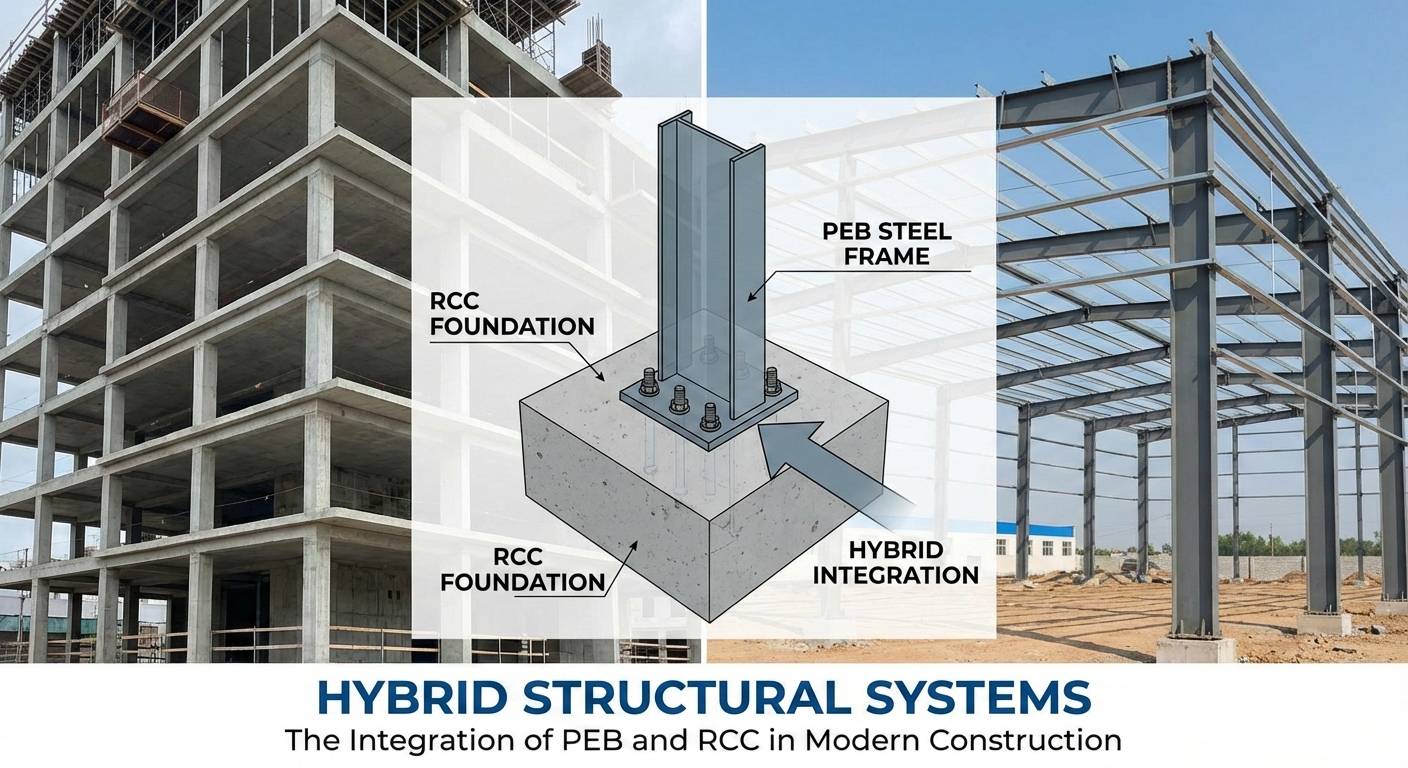
A hybrid structural system is a construction approach that combines two or more structural systems to utilize the best properties of each. In the Indian context, the most widely adopted hybrid combination is:

  • RCC (Reinforced Cement Concrete) for foundations, cores, shear walls, and podiums
  • PEB (Pre-Engineered Steel Structures) for superstructures, roofing, large spans, and lightweight framing

Instead of forcing one system to do everything, hybrid structures assign the right material to the right job.

Understanding RCC and PEB Individually

What is RCC (Reinforced Cement Concrete)?

RCC is a composite material made of concrete and steel reinforcement. It is known for:

  • High compressive strength
  • Durability and fire resistance

Excellent performance in foundations and vertical load systems


RCC is commonly used in:

  • Foundations
  • Columns and beams
  • Shear walls
  • Staircases and lift cores

What is PEB (Pre-Engineered Building)?

PEB structures are factory-fabricated steel components designed using software and assembled at site. They offer:

  • Lightweight construction
  • Fast execution
  • Large column-free spans

PEB is widely used for:

  • Industrial sheds
  • Warehouses
  • Roof structures
  • Auditoriums and hangars

Why Combine PEB and RCC?

No single structural system is perfect for all conditions. Hybrid systems emerge from engineering practicality, not trends.

Key Reasons for Integration

  • Structural efficiency
  • Cost optimization
  • Speed of construction
  • Seismic performance
  • Architectural flexibility
  • Load optimization

Hybrid systems allow engineers to balance strength and speed without compromising safety.

How Hybrid PEB–RCC Systems Work

A typical hybrid structure follows this logic:

  • RCC foundation and substructure
    Handles soil pressure, heavy loads, and long-term durability
  • RCC cores or shear walls
    Resist seismic and lateral forces
  • PEB superstructure
    Supports roofing, long spans, and lightweight floors
  • Steel–concrete connections
    Carefully detailed to manage differential movement

This integration requires precise structural analysis and detailing, which is where experienced structural engineers play a critical role.

Structural Behavior of Hybrid Systems

Load Transfer Mechanism

  • Vertical loads transfer from PEB members to RCC columns and foundations
  • Lateral loads are shared between RCC shear elements and steel bracing
  • Differential settlement is controlled through foundation design

Seismic Performance

Hybrid systems perform well in seismic zones when:

  • RCC cores provide stiffness
  • Steel frames provide ductility
  • Connections are designed for energy dissipation

This balance is especially relevant for North Indian seismic zones, including Chandigarh and surrounding regions.

Where Hybrid Structural Systems Are Commonly Used

Industrial Buildings

  • RCC foundations + PEB sheds
  • Heavy machinery loads with wide clear spans

Commercial Complexes

  • RCC basements + steel upper floors
  • Faster construction with parking stability

Educational Institutions

  • RCC cores + steel roof trusses
  • Cost-effective expansion

Hospitals

  • RCC for critical areas
  • Steel for non-load-critical spaces

Mixed-Use Developments

  • RCC podiums
  • Steel upper structures

Advantages of Hybrid PEB–RCC Construction

Structural Advantages

  • Improved seismic resistance
  • Reduced dead load
  • Better load distribution

Construction Advantages

  • Faster project timelines
  • Parallel fabrication and site work
  • Reduced formwork requirements

Economic Advantages

  • Optimized material usage
  • Reduced foundation sizes
  • Lower long-term maintenance

Architectural Advantages

  • Large column-free spaces
  • Flexible layouts
  • Easier future modifications

Challenges in Hybrid Structural Systems

Despite their benefits, hybrid systems require careful planning.

Common Challenges

  • Complex connection detailing

  • Differential thermal expansion

  • Coordination between civil and steel teams

  • Quality control at interfaces

These challenges highlight the importance of experienced structural engineers and independent structural audits.

Role of Structural Engineers in Hybrid Design

Structural engineers are responsible for:

  • System selection
  • Load path clarity
  • Connection design
  • Seismic detailing
  • Compliance with IS codes

At Rakhra Associates, hybrid systems are approached with engineering logic, not assumptions.

Indian Codes Relevant to Hybrid Structures

  • IS 456 – RCC design
  • IS 800 – Steel structures
  • IS 1893 – Seismic analysis
  • IS 875 – Load calculations
  • NBC 2016 – Integrated safety provisions

Hybrid design demands cross-code compatibility, not isolated design.

Sustainability and Hybrid Construction

Hybrid systems contribute to sustainable construction by:

  • Reducing concrete volume
  • Minimizing material wastage
  • Lowering embodied carbon
  • Allowing reuse and dismantling

Steel recyclability and optimized RCC usage make hybrid buildings environmentally responsible.

Future of Hybrid Structural Systems in India

With increasing urban density and land costs:

  • Hybrid systems will dominate commercial and industrial construction
  • Modular + hybrid construction will grow
  • Performance-based design will replace prescriptive approaches

Hybrid engineering is not a compromise—it is evolution.

FAQs – Hybrid Structural Systems (PEB + RCC)

1. What is a hybrid structural system in construction?

A system that combines RCC and steel structures to optimize performance.

2. Why are hybrid structures used instead of only RCC?

They improve speed, reduce weight, and enhance design flexibility.

3. Is PEB safe for multi-storey buildings?

Yes, when integrated properly with RCC cores and foundations.

4. Are hybrid buildings earthquake resistant?

They can perform very well when designed as per seismic codes.

5. What types of buildings benefit most from hybrid systems?

Industrial, commercial, hospitals, and large-span structures.

6. How does load transfer work in hybrid structures?

Loads move from steel to RCC elements through designed connections.

7. Is hybrid construction cost-effective?

Yes, due to optimized material usage and faster timelines.

8. Do hybrid structures require special foundations?

Foundations are usually RCC but optimized for lighter superstructures.

9. What is the lifespan of a hybrid building?

Comparable to RCC buildings when properly designed and maintained.

10. Are hybrid structures fire resistant?

Fire safety depends on fireproofing of steel and RCC protection.

11. Can hybrid systems be used in residential projects?

Yes, especially for villas, podiums, and community structures.

12. Do hybrid structures need more maintenance?

No, maintenance is comparable when detailing is done correctly.

13. What are common mistakes in hybrid construction?

Poor connection detailing and lack of coordination.

14. Is structural audit important for hybrid buildings?

Yes, audits ensure long-term safety and performance.

15. How does steel expansion affect RCC?

Expansion joints and detailing manage thermal effects.

16. Are hybrid systems approved by Indian codes?

Yes, when designed using relevant IS codes together.

17. Can old RCC buildings be converted to hybrid systems?

In many cases, yes—with proper structural evaluation.

18. Does hybrid construction reduce project time?

Significantly, due to off-site steel fabrication.

19. Is hybrid construction suitable for Chandigarh region?

Yes, especially considering seismic and soil conditions.

20. Who should design hybrid structural systems?

Qualified structural engineers with RCC and steel expertise.

Conclusion

Hybrid structural systems represent intelligent engineering, not trend-driven construction. By integrating PEB and RCC, modern buildings achieve the perfect balance of strength, speed, economy, and resilience.

At Rakhra Associates – Structural Engineers in Chandigarh, the focus remains on engineering awareness, safety, and long-term performance, ensuring that structures are not just built—but engineered responsibly.
Categories
Structural Engineering

Structural Proof Checking: Why Every Project Needs an Independent Expert Review

Blog

Structural Proof Checking: Why Every Project Needs an Independent Expert Review


Structural Proof Checking in Chandigarh
structural proof checking in chandigarh

Introduction: The Hidden Guardian of Structural Safety

Behind every skyscraper, bridge, or industrial shed lies a complex network of design calculations, material specifications, and safety checks. Yet, even the most seasoned structural engineers can overlook subtle errors due to workload, time constraints, or human oversight.

This is where structural proof checking plays a life-saving role.

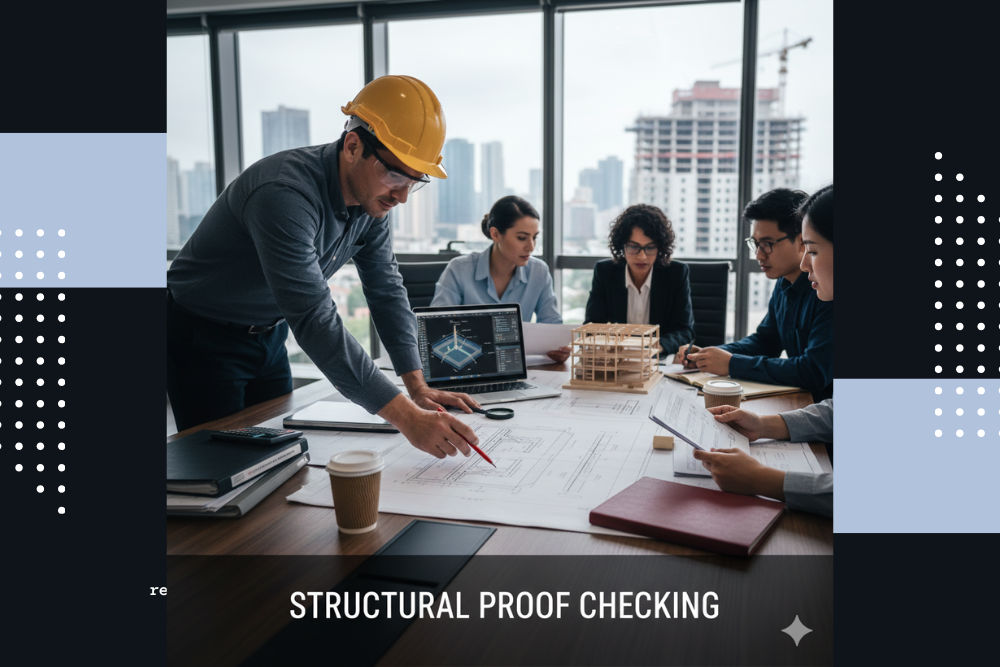
It’s the process of having an independent structural engineer or consultancy review design drawings, calculations, and assumptions made by the primary designer. For firms like Rakhra Associates, based in Chandigarh, proof checking ensures that buildings stand strong — both on paper and in reality.

What is Structural Proof Checking?

Structural Proof Checking is an independent verification of structural design and analysis to ensure that the structure:

  • Meets national codes and safety standards
  • Is optimized for load, material, and cost efficiency
  • Eliminates design errors before construction begins

This process is mandatory for public infrastructure, institutional, and government projects, as per guidelines by CPWD, PWD, and BIS.

Why Proof Checking Matters More Than Ever

1. Eliminates Design Errors Early

Even a small miscalculation in load paths or reinforcement detailing can cause:

  • Structural cracks
  • Uneven settlement
  • Catastrophic failures

Independent proof checkers use advanced tools like STAAD.Pro, ETABS, and Tekla to cross-verify calculations and detect inconsistencies early.

2. Ensures Code Compliance

Every structure must comply with the Bureau of Indian Standards (BIS) design codes such as:

  • IS 456:2000 – RCC Design
  • IS 800:2007 – Steel Design
  • IS 875 (Part 1–5):1987 – Load Calculations
  • IS 1893:2016 – Earthquake Resistance
  • IS 3370:2009 – Liquid Retaining Structures

Proof checking ensures zero deviation from these standards — a must for project approvals and safety audits.

3. Reduces Long-Term Maintenance Costs

Errors in design often lead to higher maintenance and retrofitting costs later.
Proof checking:

  • Identifies over- or under-designed sections
  • Suggests cost-effective alternatives
  • Improves service life and structural durability

In short, a little extra time in review can save years of repair.

4. Prevents Structural Failures

From flyover collapses to roof failures, design errors have been root causes of many tragedies.
Independent review ensures:

  • Redundancy in load paths
  • Safety under extreme wind or seismic conditions
  • Proper reinforcement detailing

A second expert opinion can literally save lives.

5. Adds Professional Accountability

When two independent engineering teams collaborate on the same design, it ensures transparency, credibility, and shared responsibility.

Proof checking is not criticism — it’s collaboration for safety.

6. Ensures Client Confidence and Faster Approvals

For clients and government departments, proof checking:

  • Builds trust in the design integrity
  • Eases project approval from authorities like Municipal Corporations, Smart City Missions, and RERA
  • Improves project documentation and traceability

Rakhra Associates provides digitally verified proof-checking reports, accelerating the approval workflow for Chandigarh-based projects.

7. Encourages Structural Optimization

Proof checking isn’t only about finding mistakes — it also promotes design optimization.
Independent reviewers often suggest:

  • Better load distribution systems
  • Efficient column-beam alignment
  • Lighter yet safer steel or RCC configurations

This leads to reduced material use, saving up to 10–15% in cost without compromising safety.

The Proof Checking Process: Step-by-Step

Stage Activity Performed By
1. Design Submission Structural drawings, models, and reports submitted by design consultant Design Engineer
2. Independent Review Verification of design assumptions, loading criteria, and code compliance Proof Consultant
3. Cross-Checking of Calculations Review of manual and software calculations Structural Reviewer
4. Drawing Verification Checking rebar details, load paths, and connections Structural Checker
5. Site Feasibility Audit Matching design intent with actual site conditions Proof Engineer
6. Final Certification Issuance of proof-checking certificate for authorities Authorized Proof Checker

Rakhra Associates follows a stringent 6-stage quality verification protocol to ensure absolute design reliability.

Who Requires Structural Proof Checking in India?

  • Government and Public Infrastructure Projects (CPWD, PWD, MES, NHAI)
  • Institutional Buildings – Schools, colleges, hospitals
  • High-rise Buildings and Apartments
  • Industrial Sheds and PEB Structures
  • Commercial Complexes and Malls
  • Heritage Structures undergoing retrofitting

Even private developers in Chandigarh, Mohali, and Panchkula increasingly seek proof checking for insurance and RERA compliance.

Key Benefits of Independent Proof Checking

Aspect Without Proof Checking With Proof Checking
Safety Prone to hidden errors Verified for stability
Cost Possible overdesign or underdesign Optimized material use
Approval Delays in authority clearance Faster compliance certification
Longevity Reduced service life Extended durability
Accountability Single-point responsibility Dual expert validation

Case Example: Structural Review Saves Time and Cost

In a recent industrial project in Punjab, Rakhra Associates performed proof checking of a 4,000 sq. m. steel structure.
Findings included:

  • Overdesigned trusses leading to excess steel use (~18%)
  • Missing bracing connections compromising lateral stability
  • Revised design saved ₹12 lakhs and improved safety margins

The project achieved both cost-efficiency and IS code compliance — showcasing the tangible value of proof checking.

Role of Rakhra Associates in Structural Proof Checking

As a leading structural consultancy in Chandigarh, Rakhra Associates provides:

  • Comprehensive proof checking services for RCC, steel, and composite structures
  • Detailed design verification reports with corrective recommendations
  • Seismic and wind load validations using advanced software
  • Value engineering suggestions to improve cost-performance ratio

Their clients include government departments, private developers, and architects across North India.

When Should Proof Checking Be Conducted?

  • Before Construction Begins: To verify design accuracy
  • During Design Stage: To correct miscalculations early
  • Post Structural Audit: For old or retrofitted buildings
  • Before Tendering: To finalize BOQs and specifications

Early involvement ensures smoother project flow and risk-free execution.

Common Mistakes Found During Proof Checking

  1. Ignoring lateral load combinations in high-rises
  2. Incorrect modeling of slab-to-beam connections
  3. Neglecting foundation settlement in soil design
  4. Overlooking ductile detailing in seismic zones
  5. Misalignment between architectural and structural drawings

Each of these can lead to delays, rework, or structural distress — all preventable through expert review.

FAQs on Structural Proof Checking

Q1. What’s the difference between design checking and proof checking?
Design checking is internal; proof checking is an independent third-party review ensuring unbiased verification.

Q2. Is proof checking mandatory for private buildings?
Not legally mandatory for all, but strongly recommended for multi-storey and high-risk structures.

Q3. How long does the proof-checking process take?
Typically 5–10 working days, depending on complexity and documentation.

Q4. What documents are needed for proof checking?
Structural drawings, design reports, STAAD/ETABS files, and soil investigation reports.

Q5. Can proof checking reduce project cost?
Yes — by identifying overdesign, material wastage, and suggesting optimized alternatives.

Q6. Who can perform proof checking?
Licensed and experienced structural engineers or firms with government accreditation, like Rakhra Associates.

Conclusion: The Silent Safety Net of Engineering

In construction, the cost of a mistake is always higher than the cost of prevention.
Structural proof checking serves as the final line of defense between design and disaster.

By engaging experts like Rakhra Associates, project owners not only secure their structures but also gain peace of mind — knowing that every calculation, beam, and joint has been validated by trusted professionals.