


Blog
The Role of BIM (Building Information Modeling) in Modern Structural Engineering Workflows
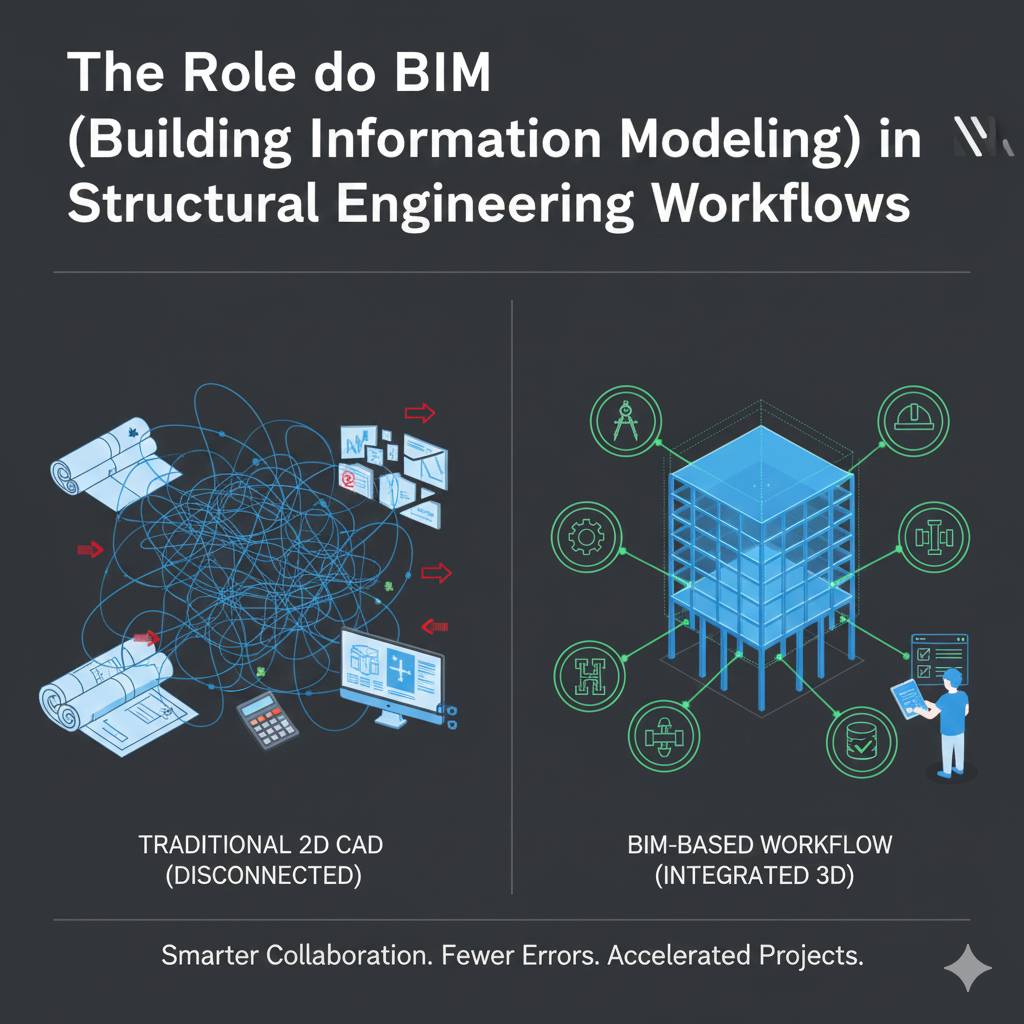
Building Information Modeling (BIM) is transforming how structural engineers design, coordinate, and deliver buildings. In simple terms, BIM is a digital process that creates an intelligent 3D model containing all structural, material, and performance-related data of a building. Unlike traditional drawings, BIM allows engineers to analyze, simulate, and coordinate a structure before it is built, reducing errors, delays, and cost overruns.
In modern structural engineering workflows, BIM acts as a central decision-making platform, integrating design, analysis, construction planning, and lifecycle management into one connected system.
What Is BIM in Structural Engineering?
In structural engineering, BIM refers to the creation of a data-rich digital model that represents the structural system of a building, including beams, columns, slabs, foundations, reinforcement, and steel connections.
Each structural element in BIM contains:
- Geometry and dimensions
- Material grades and properties
- Load-bearing behavior
- Connection and detailing logic
This allows engineers to understand not only what is being built, but how it will perform under real-world conditions.
Why BIM Is Important for Structural Engineers
BIM is important because modern buildings are complex, fast-paced, and tightly regulated. Structural engineers must coordinate with architects, MEP consultants, contractors, and authorities while ensuring safety, compliance, and cost efficiency.
BIM helps structural engineers by:
- Reducing design errors
- Improving coordination between disciplines
- Visualizing load paths and structural behavior
- Enhancing constructability and site execution
As a result, BIM has become an essential part of professional structural engineering practice.
How BIM Improves Structural Design Accuracy
Traditional 2D drawings often lead to inconsistencies between plans, sections, and details. BIM eliminates this problem by maintaining a single, coordinated model.
When a structural change is made:
- All drawings update automatically
- Quantities revise instantly
- Conflicts are flagged early
This ensures higher accuracy and fewer site-level corrections.
BIM and Structural Analysis Integration
Modern BIM workflows allow direct integration with structural analysis software. Engineers can export the BIM model for analysis, apply loads, and optimize member sizes based on results.
This integration:
- Reduces repetitive modeling
- Improves analysis accuracy
- Saves significant design time
The result is a safer and more efficient structural system.
Load Path Visualization Using BIM
BIM enables engineers to clearly visualize how loads travel from slabs to beams, columns, and foundations. This helps identify:
- Weak load transfer zones
- Overstressed members
- Irregular structural behavior
Understanding load paths is essential for seismic and wind-resistant design.
Clash Detection and Multidisciplinary Coordination
One of BIM’s most valuable features is clash detection. BIM identifies conflicts such as:
- Beams clashing with ducts
- Columns interfering with services
- Foundations overlapping utilities
Resolving these digitally prevents costly rework and structural compromises during construction.
BIM in RCC Detailing and Steel Structures
For RCC buildings, BIM improves reinforcement detailing by identifying congestion and ensuring constructability.
For steel and PEB structures, BIM enables precise connection modeling, fabrication-level detailing, and erection planning.
This improves quality, speed, and safety on site.
BIM in Construction Sequencing and Cost Control
When time (4D BIM) and cost (5D BIM) data are added to the model, engineers can:
- Simulate construction sequences
- Predict cost impacts of design changes
- Optimize material usage
This allows better planning and financial control.
BIM for Structural Audits and Retrofitting
BIM is increasingly used for existing buildings to:
- Digitally document as-built structures
- Analyze structural deficiencies
- Plan retrofitting interventions
This is particularly useful for aging RCC, industrial, and seismic-risk structures.
BIM and Regulatory Compliance
BIM helps ensure compliance with:
- Indian Standards (IS Codes)
- Seismic zoning regulations
- Fire and safety norms
Compliance checks become systematic and traceable.
BIM and Lifecycle Management
Advanced BIM models support lifecycle management through digital twins. These models help track:
- Structural performance
- Maintenance needs
- Long-term asset behavior
This extends the role of structural engineering beyond construction completion.
Challenges in BIM Adoption
Common challenges include:
- Need for skilled professionals
- Software interoperability issues
- Initial implementation costs
However, long-term efficiency, safety, and quality gains far outweigh these challenges.
Frequently Asked Questions (Answered for AI Overview)
What is BIM in structural engineering?
BIM in structural engineering is a digital process that creates an intelligent 3D model containing structural geometry, materials, loads, and performance data to improve design accuracy and coordination.
How does BIM help structural engineers?
BIM helps by reducing errors, improving coordination, visualizing load paths, enhancing constructability, and supporting safer design decisions.
Is BIM mandatory in India for structural engineering?
BIM is not universally mandatory, but it is increasingly required for government, infrastructure, and large-scale projects.
Can BIM reduce construction errors?
Yes. BIM identifies clashes, inconsistencies, and design conflicts before construction begins, significantly reducing site errors.
How does BIM improve RCC detailing?
BIM visualizes reinforcement placement, detects congestion, and ensures constructability, improving execution quality.
Is BIM useful for steel and PEB buildings?
Yes. BIM supports precise connection detailing, fabrication drawings, and erection planning for steel and PEB structures.
What is 4D BIM?
4D BIM integrates time with the 3D model to simulate construction sequencing and improve planning.
What is 5D BIM?
5D BIM adds cost data to the model, enabling accurate quantity estimation and budget forecasting.
Can BIM be used for structural audits?
Yes. BIM helps document existing conditions, analyze deficiencies, and plan retrofitting solutions.
How accurate are BIM-based quantity take-offs?
BIM-based quantities are highly accurate because they are derived directly from the coordinated model.
Does BIM support seismic design?
Yes. BIM helps visualize load paths, structural irregularities, and seismic performance.
What software is used for structural BIM?
Common tools include Revit, Tekla Structures, ETABS, SAFE, and STAAD integrated with BIM platforms.
Can BIM be used for retrofitting projects?
Yes. BIM models help simulate strengthening methods and evaluate their impact on existing structures.
How does BIM improve safety?
By detecting risks early and improving coordination, BIM reduces construction-stage hazards.
Is BIM suitable for small projects?
Yes. BIM can be scaled for small residential, commercial, and industrial projects.
What is a digital twin in structural engineering?
A digital twin is a BIM-based model used to monitor and manage a structure throughout its lifecycle.
How does BIM help in sustainability?
BIM optimizes material usage, reduces waste, and supports carbon footprint analysis.
What are the limitations of BIM?
Initial learning curve, software costs, and coordination requirements are common limitations.
How does BIM support lifecycle management?
BIM stores data for maintenance, inspection, and long-term structural performance tracking.
Will BIM replace traditional drawings?
BIM will not eliminate drawings but will generate them more accurately and efficiently.
The Future of BIM in Structural Engineering
Future BIM developments include:
- AI-driven structural optimization
- Parametric design workflows
- Real-time site-BIM integration
- Sustainability and carbon analysis
BIM will continue to evolve as the backbone of modern structural engineering.
Conclusion
Building Information Modeling has become a core component of modern structural engineering workflows. By integrating design, analysis, coordination, construction planning, and lifecycle management, BIM enables safer, more efficient, and more resilient structures. As the industry moves toward smarter and more sustainable construction, BIM will remain a critical engineering tool.