
Categories
Uncategorized

Understanding Load Path and Load Transfer in Structural Design

Blog

Everything You Need to Know About Structural Stability Certificates in Chandigarh & Punjab

Understanding Load Path and Load Transfer in Structural Design

Introduction

In structural engineering, the load path and load transfer mechanisms are fundamental concepts that define the safety, strength, and functionality of any structure—from residential homes to multi-storey commercial towers. Yet, these terms are often misunderstood or overlooked, leading to design flaws, construction delays, or even structural failures.

At Rakhra Associates, one of the leading structural engineering consultancies in Chandigarh and North India, we believe in educating our clients, contractors, and fellow engineers about the critical principles that govern a building’s stability.

In this blog, we’ll walk you through what load path and load transfer mean, how they work, why they are crucial in design and construction, and how to ensure an efficient load transfer system in your project.

What is a Load Path in Structural Design?

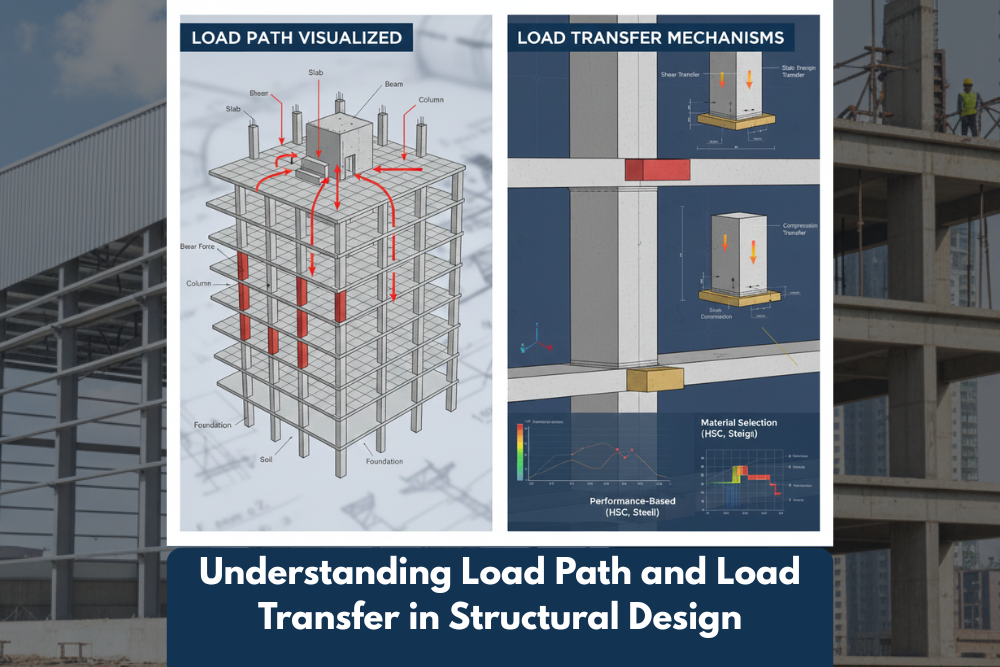
A load path is the route through which loads (forces or weights) move from the point of application (e.g., roof, floor, or occupancy) through various structural components and eventually down to the foundation and soil.

Think of it as the roadmap that guides how gravity, wind, seismic, or live loads travel through the structure.

Example:

For a multi-storey RCC building, the typical vertical load path is:
Slab → Beams → Columns → Foundation → Soil
For lateral loads (wind, seismic), the path may involve:
Roof → Bracings/Walls → Shear Walls/Frames → Foundation

Types of Loads in Structural Design

To understand load transfer, we must understand the types of loads structures are designed to resist:

  • Dead Load (DL): Permanent static loads like self-weight of the structure, walls, finishes, etc.
  • Live Load (LL): Temporary or movable loads like occupants, furniture, traffic, etc.
  • Wind Load (WL): Lateral pressure due to wind.
  • Seismic Load (EL): Earthquake-induced forces.
  • Snow Load (SL), Thermal Loads, and Impact Loads in special structures.

Each of these loads follows a different load path depending on its direction, intensity, and point of application.

What is Load Transfer?

Load transfer refers to the actual process of transferring these loads from one structural component to the next until they safely reach the foundation.

It’s not just about direction but also how effectively and uniformly each member handles the load without failure, deflection, or overloading.

Load Transfer Mechanisms

1. Gravity Load Transfer (Vertical)

  • Roof/Floor slab → Beam
  • Beam → Column
  • Column → Footing
  • Footing → Soil

2. Lateral Load Transfer (Horizontal)

  • Diaphragm (slabs) → Shear walls / Frames / Bracing
  • Shear walls or braced frames → Foundation

3. Load Distribution Mechanisms

  • One-way slabs: Load goes in one direction (to two beams)
  • Two-way slabs: Load is shared in two perpendicular directions
  • RCC Frame: Load is distributed to multiple members, offering redundancy

Understanding these mechanisms is crucial to ensure no member is overloaded or under-designed.

Importance of Load Path in Structural Design

A well-defined and uninterrupted load path is the backbone of a stable structure. Here's why it matters:

Prevents Structural Failure
An unclear or broken load path can lead to progressive collapse, especially in earthquakes or extreme events.

Optimizes Design Efficiency
Knowing how loads flow helps in material optimization, resulting in cost-effective designs.

Compliance with IS Codes
Indian Standard Codes (IS 456 for RCC, IS 800 for Steel, IS 875 for loads, IS 1893 for seismic) require clear load transfer paths in design validation.

Aids in Retrofitting and Modifications
In renovation or extension projects, engineers must understand existing load paths to prevent redistribution failures.

Load Path Disruptions: What Can Go Wrong?

Even small errors can severely disrupt load flow:

  • Misaligned columns or beams
  • Overcutting or coring in slabs for plumbing or HVAC
  • Removal of a load-bearing wall
  • Improperly placed openings near supports
  • Inadequate lateral load resisting systems in seismic zones

At Rakhra Associates, we conduct detailed structural audits to ensure that the load path integrity remains intact in new and existing buildings.

Design Strategies to Ensure Efficient Load Transfer

1. Early Load Path Visualization
Structural engineers should map load paths during conceptual design, not just detailed engineering.

2. Vertical Alignment of Columns
Ensure that upper-storey columns align with lower ones to avoid transfer beams and reduce complexity.

3. Diaphragm Action in Floor Slabs
Design slabs to act as diaphragms to transfer lateral loads effectively.

4. Incorporate Redundancy
Design with alternative paths in mind—especially in seismic zones, where one path may fail.

5. Check Connection Details
Steel-to-concrete joints, bolted or welded connections, and rebar anchorage must be verified for effective transfer.

6. Use of Shear Walls or Bracing
For tall buildings, incorporate shear walls, moment frames, or bracings to resist lateral forces and distribute loads safely.

Indian Code Guidelines Relevant to Load Transfer

IS 875 (Part 1 to 5) – Loads on Buildings and Structures

IS 456:2000Design and construction of RCC elements

IS 1893:2016 – Criteria for Earthquake Resistant Design

IS 800:2007 – General construction in steel

Our team at Rakhra Associates ensures compliance with these codes while tailoring designs to local soil, climate, and seismic zone conditions in Punjab, Chandigarh, and adjoining states.

Load Transfer in Different Building Systems

System Load Path Feature
RCC Frame Direct load transfer through beams and columns
Load-bearing Walls Loads pass directly to walls and then foundations
Steel Frame Relies on bolted/welded connections and bracings
PEB Structures Load flows through frames, purlins, columns to anchor bolts
Composite Structures Load transfer between different materials needs detailing

Real-World Example from Rakhra Associates

In one of our multi-storey residential projects in Mohali, we encountered a design error from an earlier consultant where a key column was misaligned by 500 mm across three floors. Our team redesigned the load path using transfer beams and post-tensioned slabs, saving the client demolition costs while maintaining structural safety.

This is why understanding load path is not optional—it’s essential.

Conclusion

An uninterrupted, well-designed load path is fundamental to safe, cost-effective, and code-compliant construction. Whether you’re an architect, builder, or property owner, knowing how loads travel through your structure empowers better decisions at every stage—from design to construction and retrofitting.

At Rakhra Associates, we blend engineering expertise with cutting-edge tools to ensure your building is not just beautiful—but structurally sound from the ground up.

Categories
Uncategorized

Everything You Need to Know About Structural Stability Certificates in Chandigarh & Punjab

Blog

Everything You Need to Know About Structural Stability Certificates in Chandigarh & Punjab


structure engineering mistakes

Introduction

In recent years, building safety has become a top priority for developers, housing societies, commercial property owners, and government agencies across India. Among the many legal and technical documents required during construction and post-construction, one of the most critical is the Structural Stability Certificate.

This document is not just a formality—it is a vital assurance of the structural integrity and safety of a building. In states like Punjab and union territories like Chandigarh, the demand for proper structural certification has grown significantly due to stricter compliance rules and increasing awareness of safety standards.

At Rakhra Associates, we specialize in issuing structural stability certificates in Chandigarh, Mohali, Panchkula, and across North India. In this blog, we explain what this certificate is, why it's required, who issues it, and how to obtain it.

What is a Structural Stability Certificate?

A Structural Stability Certificate is a formal document issued by a qualified structural engineer after thorough inspection and assessment of a building's structural elements. It certifies that the structure:

  • Has been designed and constructed as per the applicable Indian Standard Codes (IS Codes)
  • Is free from any structural defects or damages
  • Is safe for occupancy or continued use

The certificate applies to both new constructions and existing structures that need periodic safety audits.

Why is a Structural Stability Certificate Important?

The importance of this certificate cannot be overstated:

1. Ensures Occupant Safety
It verifies that the building will not collapse or suffer damage under regular loads or environmental conditions like wind, rain, or minor seismic activity.

2. Mandatory for Legal Approvals
In Chandigarh and Punjab, authorities require this certificate for:

  • Building plan approval
  • Completion/Occupancy certificate
  • Fire NOC (especially in high-rise or commercial buildings)
  • Renewal of factory licenses
  • Health and safety inspections

3. Risk Mitigation for Owners
It protects building owners and developers from liability in case of future structural failures.

4. Insurance and Financing
Insurance companies and financial institutions may demand this certificate before offering coverage or sanctioning loans for large properties.

When Do You Need a Structural Stability Certificate?
You may require this certificate at various stages of a building’s lifecycle:

  • During Construction – For high-rise, commercial, or government buildings
  • Post-Construction – For completion and occupancy certificates
  • Periodically – Factories and public buildings often require re-certification every 5 years
  • Before Renovation/Demolition – To assess the structural health of the existing structure
  • Change in Usage – e.g., converting a residential property to commercial use

In Chandigarh and Punjab, local authorities like the Municipal Corporation, PUDA, GMADA, and Fire Department insist on valid structural stability reports for all large-scale developments.

Who Can Issue a Structural Stability Certificate?

Only a licensed structural engineer or a firm registered with the local development authority (e.g., Chandigarh Administration, PUDA, GMADA, HSIIDC) can legally issue a structural stability certificate.

At Rakhra Associates, our team is empaneled and approved by multiple government agencies. We conduct structural audits and provide legally compliant certificates for:

  • Residential complexes
  • Commercial buildings
  • Hospitals and schools
  • Industrial buildings and factories
  • Hotels, malls, and mixed-use developments

What Does the Inspection Include?
Before issuing a certificate, the structural engineer conducts a detailed evaluation that may include:

  • Visual Inspection
    Checking for cracks, deflection, corrosion, settlement, or visible distress.
  • Document Review
    Verifying drawings, previous reports, materials used, and structural design parameters.
  • Load Testing (if required)
    In older buildings or suspicious structures, load tests may be performed to confirm stability.
  • Non-Destructive Testing (NDT)
    Techniques like rebound hammer test, ultrasonic pulse velocity, carbonation test, etc., are used to evaluate material integrity without damaging the structure.
  • Soil & Foundation Evaluation
    In cases of settlement or foundational instability, engineers may review soil test reports and foundation design.
  • Seismic Assessment
    Especially in areas like Chandigarh and Mohali (Zone IV), earthquake resistance is a key component.

What Does the Certificate Include?
A standard structural stability certificate typically includes:

  • Name & address of the property owner
  • Location and details of the building
  • Date of inspection
  • General structural condition of the building
  • Observations and test results (if any)
  • Confirmation that the structure complies with IS Codes
  • Validity period (generally 1 to 5 years)
  • Signature and license number of the structural engineer

Timeframe and Cost

  • Timeline: Usually issued within 7–10 working days after inspection, depending on the complexity
  • Cost: Varies based on size, type, and location of the structure

At Rakhra Associates, we offer transparent pricing, site visit schedules, and digital reports to ease the process for building owners and developers.

Validity and Renewal

  • For residential buildings: Up to 5 years
  • For commercial and industrial buildings: Typically 1 to 3 years
  • Factories under Factories Act: Mandatory renewal every 12 months or 5 years based on state regulations

Pro Tip: Keep track of your certificate’s expiry date—especially for government and compliance-heavy buildings like factories, hotels, and public-use facilities.

Common Reasons for Denial or Rejection

A certificate may not be issued (or may be revoked) under the following conditions:

  • Major cracks or foundation issues
  • Incomplete or unsafe construction
  • Non-compliance with original approved plans
  • Signs of corrosion, water leakage, or concrete spalling
  • Poor-quality construction materials

Rakhra Associates: Your Trusted Partner for Structural Certification in North India

With 20+ years of experience and a strong portfolio of successful projects, Rakhra Associates offers comprehensive structural assessment and certification services in Chandigarh, Mohali, Panchkula, Zirakpur, and other parts of Punjab and Haryana.

Why Choose Us?

  • Government-registered structural engineers
  • Expertise in RCC, steel, and composite structures
  • Use of latest NDT and audit tools
  • Fast turnaround and local authority compliance
  • Serving architects, builders, industries, and private owners

Final Thoughts

In today’s rapidly growing real estate and industrial sectors, structural safety should never be overlooked. A Structural Stability Certificate is more than a legal requirement—it is a commitment to the safety of every person who steps into your building.

Whether you're building from scratch, expanding, or just being proactive, let Rakhra Associates help you ensure long-term structural performance and regulatory peace of mind.

Categories
Uncategorized

Seismic-Resistant Building Design in India: Codes, Techniques, and Best Practices

Blog

Seismic-Resistant Building Design in India: Codes, Techniques, and Best Practices


structure engineering mistakes

Introduction

India’s geographical location places a significant portion of its landmass in zones that are vulnerable to seismic activity. From the devastating 2001 Bhuj earthquake to the tremors felt in the Himalayas, we’ve seen firsthand how critical seismic-resilient structures are for public safety. For developers, architects, and civil engineers, earthquake-resistant design is not a luxury—it is a legal and ethical necessity.

This blog serves as a comprehensive guide to seismic-resistant building design in India. It includes the latest Indian standards, structural techniques, and best practices followed by structural engineers, including those at Rakhra Associates, who serve across Chandigarh, Mohali, and North India.

Understanding Seismic Zones in India

The Bureau of Indian Standards (BIS) classifies India into four seismic zones under IS 1893 (Part 1):2016:

  • Zone II – Low intensity (e.g., parts of Karnataka, Maharashtra)
  • Zone III – Moderate intensity (e.g., Kerala, Punjab, Haryana)
  • Zone IV – Severe intensity (e.g., Delhi, Chandigarh, Bihar)
  • Zone V – Very severe intensity (e.g., Northeast India, Himachal Pradesh, Kashmir)

Most of North India—including Chandigarh and Mohali—falls under Zone IV, meaning buildings here must follow strict earthquake-resistant guidelines.

Key Indian Codes Governing Seismic Design

To ensure safety and performance during earthquakes, the following IS codes must be followed:

  • IS 1893 (Part 1): 2016 – Criteria for Earthquake Resistant Design of Structures
  • IS 13920:2016 – Ductile Detailing of Reinforced Concrete Structures
  • IS 456:2000 – General Code for Reinforced Cement Concrete Design
  • IS 4326:2013 – Earthquake Resistant Design and Construction of Buildings
  • IS 13828:1993 – For low-strength masonry buildings

These standards provide guidelines for calculating seismic forces, ductility requirements, detailing, and construction practices essential for resilience.

Principles of Earthquake-Resistant Design

Seismic-resistant design does not aim to prevent all damage, but it ensures that the building doesn’t collapse and people remain safe. The core design principles include:

  • Strength: Ensuring the structure can handle expected loads.
  • Stiffness: To minimize excessive deformation.
  • Ductility: So that structures can deform without failing suddenly.
  • Continuity: Creating a clear load path to transfer seismic forces to the ground.
  • Redundancy: Multiple load paths in case one fails.

Seismic Design Process: How Structural Engineers Approach It

  • Site Analysis
    Understanding the soil conditions and seismic zoning of the location.
  • Load Calculation
    Determining seismic loads as per IS 1893 using the building’s weight, occupancy, and importance factor.
  • Structural Configuration
    Preferably symmetric, regular shapes reduce torsional effects during earthquakes.
  • Structural System Selection
    Frames, shear walls, braced frames, or a combination, depending on the building type.
  • Material Selection
    High-strength concrete and ductile steel that meet IS standards.
  • Detailing for Ductility
    As per IS 13920 – includes closely spaced stirrups, lap splices, beam-column joint detailing.
  • Dynamic Analysis (for High-Rise Buildings)
    Time-history or response spectrum analysis is mandatory for buildings over a certain height.

Common Seismic-Resistant Structural Systems in RCC Construction

Moment Resisting Frames (MRF)

  • Offers flexibility and ductility
  • Used in residential and commercial buildings

Shear Walls

  • Vertical walls designed to resist lateral forces
  • Ideal for high-rise structures

Braced Frames

  • Diagonal steel members resist lateral loads
  • Common in steel buildings

Dual Systems

  • Combination of MRF and Shear Walls for enhanced safety

Best Practices in Seismic-Resistant Design and Construction

  • Soft Storey Avoidance: Avoid open parking on the ground floor without walls or bracing.
  • Foundation Design: Use raft or pile foundations where soil is weak.
  • Seismic Joints: Include separation joints between adjacent buildings to avoid pounding.
  • Staircase and Lift Core Anchoring: Secure to the main structure to prevent collapse.
  • Avoid Cantilevers & Projections: These increase torsion during quakes.
  • Quality Control: On-site supervision, material testing, and proper curing are essential.

Retrofitting Existing Buildings for Seismic Resistance

Many buildings in India were constructed before seismic codes were updated. These can be made safer through retrofitting techniques such as:

  • Adding shear walls
  • Base isolation systems
  • Jacketing columns and beams
  • FRP (Fiber Reinforced Polymer) wrapping
  • Steel bracing systems

Retrofitting is far more economical than rebuilding and can protect lives during future earthquakes.

Role of Structural Engineers in Seismic Design

Professional structural engineers play a pivotal role in ensuring that a building will withstand seismic forces. At Rakhra Associates, we combine advanced software tools (ETABS, STAAD Pro, SAP2000) with field experience to design RCC structures that adhere to Indian seismic codes.

Our approach includes:

  • Seismic vulnerability assessment
  • Soil-structure interaction studies
  • Dynamic analysis for complex structures
  • Vetting and rechecking architectural designs for seismic compatibility

We’ve worked on hospitals, schools, residential towers, and commercial complexes in Zone IV regions like Chandigarh and Mohali.

Cost Implications of Seismic-Resistant Design

Building to seismic standards may marginally increase the cost of construction—typically by 5–10%. However, this is negligible compared to the cost of repair or rebuilding after a quake.

Moreover, new government policies and local bylaws are now making seismic compliance mandatory in most urban development projects, especially in Zones III to V.

Final Thoughts

In a country like India, earthquake-resistant building design should be seen as a non-negotiable part of responsible construction. It’s not just about protecting structures—it’s about protecting people.

As leading structural engineers in Chandigarh and Mohali, Rakhra Associates is committed to delivering buildings that are safe, sustainable, and compliant with seismic norms. Whether you’re planning a new RCC structure or seeking to retrofit an existing one, our expertise ensures that seismic safety is built into your foundation—literally.

Categories
Uncategorized

Structural Retrofitting Methods for RCC Buildings in India: A Complete Guide

Blog

Structural Retrofitting Methods for RCC Buildings in India: A Complete Guide


structure engineering mistakes

Introduction

In India, where urbanization is accelerating rapidly, the integrity of existing RCC (Reinforced Cement Concrete) buildings is becoming a growing concern. Earthquakes, aging infrastructure, poor construction practices, and changing usage patterns often call for structural evaluation and strengthening. This is where structural retrofitting steps in—a crucial intervention to enhance the safety and longevity of buildings without complete demolition.

At Rakhra Associates, our team of experienced structural engineers in Chandigarh and structure engineers in Mohali specialize in providing practical and code-compliant retrofitting solutions to preserve, strengthen, and modernize existing RCC structures.

This blog will serve as a comprehensive guide to structural retrofitting in India—covering what it is, why it's needed, different retrofitting techniques, cost considerations, Indian standards, and more.

What is Structural Retrofitting?

Structural retrofitting is the process of strengthening an existing building to improve its resistance to seismic activity, load changes, material deterioration, and design deficiencies. Unlike new construction, retrofitting focuses on making changes to the existing structure, making it safer and extending its functional lifespan.

Why Retrofitting is Crucial in India

India is classified as a high seismic risk country, with zones IV and V highly vulnerable to earthquakes. Additionally, several buildings constructed in the last few decades suffer from outdated practices, poor-quality materials, and lack of proper load distribution design.

Common reasons why retrofitting becomes necessary:

  • Seismic vulnerability in earthquake-prone zones
  • Material degradation over time
  • Improper structural design or construction flaws
  • Increased load due to renovations or additions
  • Failure during structural audits or inspections

When Should You Consider Retrofitting a Building?

Here are key signs and situations that indicate the need for retrofitting:

  • Cracks in beams, columns, or slabs
  • Sagging floors or roof structures
  • Water leakage and corrosion of reinforcement
  • After a detailed structural audit recommends repairs
  • Compliance with new building codes (especially post-earthquake)
  • Change of building usage requiring higher load capacity
  • Heritage structures that must be preserved structurally

Structural Audits – The First Step

Before any retrofitting project begins, it’s vital to conduct a structural audit. This evaluation—done by certified structure engineers in Mohali and Chandigarh—assesses the current health of the building and identifies structural deficiencies.

The audit process includes:

  • Visual inspection
  • Non-destructive testing (NDT)
  • Load testing
  • Analysis of structural drawings
  • Material sampling

At Rakhra Associates, we provide in-depth structural audits and offer a full report detailing areas of concern, structural risks, and retrofitting recommendations.

Popular Structural Retrofitting Techniques for RCC Buildings

Retrofitting is not a one-size-fits-all solution. Based on the audit results and structural needs, engineers can choose from a variety of methods:


1. Jacketing

Column Jacketing / Beam Jacketing / Slab Jacketing

This involves encasing the structural elements (like columns or beams) with additional concrete and steel reinforcements. It is highly effective in improving load-bearing capacity.

  • Suitable for: Damaged or weak columns and beams
  • Materials used: High-strength concrete, rebars
  • Advantages: Improves ductility, restores section strength

2. Steel Plate Bonding

Steel plates are attached to structural elements using epoxy or bolts. These plates enhance strength without drastically increasing section dimensions.

  • Best for: Strengthening tension zones in beams and slabs
  • Cost-effective for mild strengthening

3. Fiber Reinforced Polymer (FRP) Wrapping

FRP composites like carbon or glass fiber are bonded externally to elements to enhance flexural and shear strength. This modern method is widely adopted in urban retrofitting projects.

  • Lightweight, corrosion-resistant
  • Minimal increase in section size
  • Quick installation

4. Section Enlargement

This involves increasing the cross-sectional area of structural members. It is more intensive than jacketing and requires detailed design.

  • Used when a significant increase in load-bearing is needed
  • Often implemented in industrial and commercial buildings

5. Base Isolation (Seismic Retrofitting)

A technique to decouple the building from ground motion using seismic isolators. Though cost-intensive, it’s ideal for high-rise buildings and hospitals in seismic zones.

  • Prevents direct earthquake force transmission
  • Requires expert design

6. External Post-Tensioning

Adding tension to existing structural members using high-strength steel tendons to counterbalance loads. Often used in bridge retrofitting.

  • Reduces deflections and cracking
  • Highly technical process

7. Grouting and Crack Injection

Used to restore monolithic behavior by filling cracks or voids in structural elements.

  • Epoxy injection for fine cracks
  • Cementitious grout for wider cracks

Challenges in Retrofitting

While retrofitting provides substantial benefits, it also involves challenges that must be addressed by expert engineers:

  • Compatibility of materials with existing structure
  • Accessibility and working space constraints
  • Minimizing disruption to occupants
  • Cost and time considerations
  • Selection of suitable retrofitting technique

Standards and Guidelines in India

In India, structural retrofitting practices are governed by multiple standards:

  • IS 15988:2013 – Seismic Evaluation and Strengthening of Existing RCC Buildings
  • IS 456:2000 – Code of Practice for Plain and Reinforced Concrete
  • IS 1893:2016 – Earthquake Resistant Design of Structures
  • NBC (National Building Code) – Guidelines for retrofitting and audits

Our team at Rakhra Associates strictly adheres to these standards to deliver safe, durable, and compliant retrofitting designs.

Cost Considerations

The cost of retrofitting depends on:

  • Type of retrofitting method used
  • Severity of damage or deficiency
  • Materials and manpower
  • Structural complexity

On average, retrofitting costs about 20-40% of new construction costs—but it often saves time, resources, and heritage value. It’s a smart investment for any aging or vulnerable building.

Case Studies: Rakhra Associates Projects

We’ve successfully executed retrofitting projects for:

  • Educational institutions
  • Multi-storey residential towers
  • Commercial buildings in Mohali and Chandigarh
  • Heritage structures in Punjab

Each project began with a structural audit and ended with a safe, code-compliant structure using tailored retrofitting techniques.

Conclusion: Retrofitting is Not Optional—It's Essential

In today's dynamic environment, the structural integrity of a building must be seen as a living, evolving responsibility. Retrofitting isn't just a repair—it's a proactive measure that protects life, property, and investment.

Whether your building is showing signs of distress, undergoing a usage change, or located in a high-risk zone, a structural audit followed by suitable retrofitting measures can make all the difference.

If you're searching for trusted structural engineers in Chandigarh or structure engineers in Mohali, Rakhra Associates brings decades of experience, expert evaluations, and reliable retrofitting solutions tailored to Indian conditions.

Categories
Uncategorized

Structural Retrofitting Using Steel Members

Blog

Structural Retrofitting Using Steel Members


Introduction

Steel retrofitting is a widely used technique to strengthen and rehabilitate aging or structurally compromised buildings. This method involves integrating steel components with existing structures to enhance load-bearing capacity, improve seismic resistance, and extend service life. Steel retrofitting is particularly effective for buildings requiring immediate reinforcement without major structural modifications.

Key Benefits

  • High Strength-to-Weight Ratio: Provides significant reinforcement without adding excessive weight.
  • Quick Installation: Faster execution compared to concrete-based methods.
  • Versatility: Adaptable to various structural elements (beams, columns, connections).
  • Durability: Properly treated steel offers long-term resistance to corrosion and fatigue.
  • Minimal Disruption: Often implemented without requiring building evacuation.

Common Steel Retrofitting Techniques

1. Steel Jacketing

  • Process: Encasing existing columns or beams with steel plates.
  • Applications:
    • Strengthening concrete columns
    • Improving seismic resistance
    • Repairing corrosion-damaged sections
  • Advantages:
    • Provides uniform confinement
    • Enhances axial and shear capacity

2. External Steel Bracing

  • Process: Adding diagonal steel members to structural frames.
  • Applications:
    • Seismic retrofitting of buildings
    • Stabilizing weak or damaged frames
  • Advantages:
    • Improves lateral load resistance
    • Reduces deflection during earthquakes

3. Bonded Steel Plating

  • Process: Attaching steel plates to tension zones using epoxy adhesives.
  • Applications:
    • Strengthening reinforced concrete beams
    • Repairing cracked or overloaded sections
  • Advantages:
    • Minimal increase in member size
    • Preserves architectural aesthetics

4. Steel Beam Splice Reinforcement

  • Process: Adding steel plates or sections to existing beam connections.
  • Applications:
    • Upgrading beam-column joints
    • Repairing damaged connections
  • Advantages:
    • Restores moment and shear capacity
    • Prevents progressive collapse

Implementation Process

  1. Structural Assessment
    • Evaluate existing conditions (cracks, corrosion, load capacity).
    • Identify critical areas requiring reinforcement.
  2. Design & Fabrication
    • Calculate required steel thickness and connection details.
    • Fabricate precision-cut steel components.
  3. Surface Preparation
    • Clean existing surfaces (remove rust, loose concrete).
    • Apply protective coatings if needed.
  4. Installation
    • Secure steel members using bolts, welding, or adhesives.
    • Ensure proper alignment and load transfer.
  5. Quality Checks
    • Verify weld integrity and bolt tightness.
    • Conduct non-destructive testing if required.

When is Steel Retrofitting Preferred?

  • Urgent Repairs: When immediate reinforcement is needed.
  • Space Constraints: Where minimal section enlargement is required.
  • Seismic Upgrades: For improving earthquake resistance.
  • Corrosion-Damaged Structures: To restore lost strength.

Limitations

  • Requires corrosion protection in humid environments.
  • May need fireproofing treatments in some applications.
  • Not always suitable for heritage structures where aesthetics are critical.

Conclusion

Steel retrofitting offers a reliable and efficient solution for strengthening buildings, bridges, and industrial structures. Its adaptability, speed of installation, and proven performance make it a preferred choice for structural rehabilitation projects. The selection of specific techniques depends on structural requirements, existing conditions, and performance objectives. Proper design and execution ensure enhanced safety and extended service life of retrofitted structures.

Categories
Uncategorized

Structural Retrofitting of Beams with High-Strength Concrete Jacketing

Blog

Structural Retrofitting of Beams with High-Strength Concrete Jacketing


Introduction

High-strength concrete jacketing is an effective method for strengthening existing beams that show signs of structural distress. This technique involves adding a layer of high-performance concrete around the beam to restore and enhance its load-carrying capacity. It is particularly useful for aging structures or buildings requiring capacity upgrades.

Key Benefits

  • Increased Strength: Improves load capacity by reinforcing weak sections.
  • Durability: Extends the service life of beams with minimal maintenance.
  • Fire Resistance: Concrete provides better fire protection compared to other materials.
  • Minimal Disruption: Can often be completed without major demolition.

When is Beam Jacketing Needed?

  • Visible cracks in tension zones
  • Excessive deflection or sagging
  • Corrosion of reinforcement bars
  • Spalling or crumbling concrete

The Process

  1. Assessment: Evaluate beam condition and reinforcement requirements.
  2. Surface Preparation: Remove loose concrete and clean exposed steel.
  3. Reinforcement: Install additional rebars or shear connectors if needed.
  4. Formwork & Pouring: Apply high-strength concrete (M60-M80 grade).
  5. Curing: Maintain moisture for optimal strength development.

Structural Retrofitting Using Steel Members

Introduction
Steel retrofitting is a versatile method for strengthening structural elements such as beams, columns, and connections. It is commonly used when immediate load transfer or significant capacity enhancement is required.

Key Benefits

  • High Strength-to-Weight Ratio: Provides reinforcement without excessive bulk.
  • Quick Installation: Faster than concrete-based methods in many cases.
  • Adaptability: Suitable for complex geometries and tight spaces.
  • Long-Term Performance: Properly treated steel resists corrosion and fatigue.

Common Techniques

  • Steel Jacketing: Encasing structural members in steel plates for added strength.
  • External Bracing: Adding steel frames or diagonal supports for stability.
  • Bonded Steel Plates: Attaching steel plates to tension zones with epoxy.

The Process

  1. Evaluation: Determine load requirements and steel specifications.
  2. Fabrication: Cut and shape steel components for precise fit.
  3. Installation: Secure steel members using bolts, welding, or adhesives.
  4. Protection: Apply anti-corrosion coatings for longevity.

Both methods provide reliable solutions for structural reinforcement, with selection depending on project requirements and existing conditions.

Categories
Uncategorized

Structural Retrofitting of Columns with High-Strength Concrete Jacketing

Blog

Structural Retrofitting of Columns with High-Strength Concrete Jacketing


By Rakhra Associates – Chandigarh’s Premier Structural Engineering Firm

Introduction

When building columns show signs of distress – from cracking to strength degradation – high-strength concrete jacketing emerges as one of the most reliable and durable retrofitting solutions. This technique has become our go-to method for strengthening critical vertical load-bearing elements across Chandigarh’s aging infrastructure.

This comprehensive guide covers:
✔ When column jacketing becomes necessary
✔ 3 types of concrete jacketing we use
✔ Step-by-step execution process
✔ 5 key advantages over other retrofitting methods
✔ Real-world case studies from Chandigarh projects

1. Signs Your Columns Need Jacketing

Visible Warning Signs

  • Spalling concrete exposing reinforcement
  • Vertical cracks wider than 0.3mm
  • Corroded rebar visible through cracks
  • Bulging or buckling of column surface

Structural Indicators

  • Load capacity reduced by >25%
  • Failed hammer test (hollow sounds)
  • Seismic vulnerability assessments

2. Types of High-Strength Concrete Jacketing

Conventional Reinforced Concrete Jacketing

  • Materials: M60+ concrete + additional rebar
  • Thickness: 75-150mm
  • Best for: Severely damaged columns

② Fiber-Reinforced Polymer (FRP) Confined Jacketing

  • Materials: Concrete + FRP wraps
  • Thickness: 50-100mm
  • Best for: Moderate damage in tight spaces

③ Steel-Confined Jacketing

  • Materials: Concrete + steel angles/wire mesh
  • Thickness: 100-200mm
  • Best for: Earthquake-prone structures

3. Our 7-Step Column Jacketing Process

Step 1: Damage Assessment

  • Core testing → Rebar scanning → Load capacity analysis

Step 2: Surface Preparation

  • Remove loose concrete → Clean rebar → Apply bonding agent

Step 3: Reinforcement Addition

  • Install new longitudinal bars + spiral ties

Step 4: Formwork Installation

  • Custom shuttering for perfect fit

Step 5: Concrete Pouring

  • High-strength concrete (M60-M80) with superplasticizers

Step 6: Curing

  • 14-day wet curing for maximum strength gain

Step 7: Quality Testing

  • Ultrasonic pulse velocity tests → Load testing

4. Why Choose Concrete Jacketing?

5 Competitive Advantages

  1. 50-100% strength increase possible
  2. Fire resistance superior to FRP methods
  3. 40+ year service life with proper execution
  4. Cost-effective for large-scale projects
  5. Minimal maintenance required

5. Case Studies: Successful Implementations

🏢 Sector-35 Commercial Complex

  • Challenge: 30% strength loss in ground floor columns
  • Solution: 100mm M65 jacketing with additional rebars
  • Result: Restored full capacity in 2 weeks

🏥 PGI Hospital Auxiliary Building

  • Challenge: Seismic vulnerability in critical care wing
  • Solution: FRP-confined jacketing (75mm)
  • Result: Achieved Zone-IV seismic compliance

🏛️ Heritage Building in Sector-17

  • Challenge: Corrosion damage in 70-year-old columns
  • Solution: 125mm jacketing with corrosion inhibitors
  • Result: Preserved heritage while doubling strength

6. Cost Comparison

Method Cost per Column Duration Lifespan
Concrete Jacketing ₹25,000-50,000 2-3 weeks 40+ years
Steel Plating ₹35,000-70,000 3-4 weeks 25 years
CFRP Wrapping ₹40,000-80,000 3-5 days 30 years

Note: Costs vary based on column size and damage severity

7. When is Jacketing the Best Solution?

✅ Ideal For:

  • Heavily damaged columns
  • Seismic retrofitting projects
  • Heritage structures needing preservation
  • High-load environments

❌ Not Recommended For:

  • Minimal damage (consider CFRP instead)
  • Extremely tight spaces
  • Temporary structures

Conclusion: Building Column Resilience for Decades

High-strength concrete jacketing remains one of the most dependable solutions for column retrofitting, combining proven technology with long-term performance.

Categories
Uncategorized

CFRP Laminates Explained: Why Engineers Prefer Them

Blog

CFRP Laminates Explained: Why Engineers Prefer Them


The Science Behind CFRP Laminates

  • Thin, flexible strips of carbon fibers embedded in polymer resin
  • Tensile strength 3x greater than steel at just 20% the weight
  • Available in various widths (50mm-200mm) and thicknesses (1.2mm-3mm)

Key Advantages Over Steel Plates:

✅ No corrosion – Ideal for humid environments
✅ Minimal weight addition – Doesn’t overload existing structures
✅ Easy installation – No heavy welding or machinery required
✅ Versatile bonding – Adheres to concrete, steel, and masonry

2. Top 5 Applications of CFRP Laminates

① Beam & Column Strengthening

  • Increases load capacity by up to 70%
  • Common in: Parking structures, industrial buildings

② Slab & Floor Upgrades

  • Reduces deflection in concrete slabs
  • Allows for additional floor loads

③ Seismic Retrofitting

  • Improves ductility in earthquake zones
  • Used in: Schools, hospitals, government buildings

④ Bridge Rehabilitation

  • Extends service life of deteriorating girders
  • No traffic disruption during installation

⑤ Heritage Building Preservation

  • Strengthens without altering aesthetics
  • Perfect for Chandigarh’s historic structures

3. Installation Process: How We Apply CFRP Laminates

Step 1: Surface Preparation

  • Grind uneven surfaces → Remove contaminants → Apply primer

Step 2: Laminate Cutting

  • Precision-cut to required dimensions
  • Special shapes for corners/curves

Step 3: Epoxy Application

  • High-strength structural adhesive
  • Ensures 100% bond strength

Step 4: Curing & Inspection

  • 24-48 hour cure time
  • Non-destructive testing for quality assurance

4. Case Studies: CFRP Success Stories

🏗️ Project 1: Commercial Complex in Mohali

  • Challenge: Cracking in transfer beams
  • Solution: Vertical CFRP laminate reinforcement
  • Result: Restored full load capacity in 3 days

🏢 Project 2: Residential Tower in Sector-34

  • Challenge: Additional floor load requirements
  • Solution: Bottom-face laminate bonding to slabs
  • Result: Achieved 40% increased capacity

🌉 Project 3: Pedestrian Bridge Repair

  • Challenge: Corrosion in steel girders
  • Solution: Hybrid CFRP laminate system
  • Result: Extended lifespan by 15+ years

5. Cost-Benefit Analysis

Factor CFRP Laminates Steel Plates
Installation Time 3-5 days 2-3 weeks
Weight Added 5-10 kg/m² 50-80 kg/m²
Lifespan 25+ years 15-20 years
Maintenance None Anti-corrosion needed

*While slightly more expensive upfront, CFRP saves 30-40% in long-term costs*

6. When to Choose CFRP Laminates

✅ Ideal For:

  • Structures needing quick reinforcement
  • Weight-sensitive retrofits
  • Corrosive environments
  • Architecturally sensitive buildings

❌ Not Recommended For:

  • Structures with >80% damage
  • Fire-rated applications (without special coating)

Conclusion: The Smart Choice for Modern Retrofitting

CFRP laminates represent the future of structural strengthening – offering unparalleled strength-to-weight ratios, corrosion resistance, and installation efficiency. At Rakhra Associates, we’ve successfully implemented CFRP solutions across 150+ projects in Chandigarh, helping clients achieve safer, more durable structures with minimal disruption.

Categories
Uncategorized

Carbon Fibre Reinforced Plastic Wrapping (CFRP): The Future of Structural Retrofitting

Blog

Carbon Fibre Reinforced Plastic Wrapping (CFRP): The Future of Structural Retrofitting


By Rakhra Associates – Chandigarh’s Leading Structural Engineering Experts

Introduction

Is your building showing cracks, corrosion, or strength loss? CFRP wrapping offers a modern, non-invasive solution to strengthen structures without bulky steel plates or concrete jackets. At Rakhra Associates, we’ve successfully used CFRP to restore bridges, heritage buildings, and industrial structures across Chandigarh.

This guide covers:
✔ What is CFRP wrapping? (Science simplified)
✔ 5 key benefits over traditional methods
✔ Step-by-step retrofitting process
✔ 3 real-world case studies from Chandigarh
✔ When to choose CFRP vs. other techniques

1. What is CFRP Wrapping?

Carbon Fibre Reinforced Polymer (CFRP) is a high-strength, lightweight composite material used to reinforce aging or damaged structures.

How It Works:

  1. Carbon fibre sheets are bonded to concrete/steel surfaces using epoxy resin.
  2. The wrap acts as an external reinforcement layer, sharing structural loads.
  3. No heavy machinery needed – ideal for tight spaces.

Key Properties:

  • 10x stronger than steel (by weight)
  • Corrosion-proof (unlike steel plates)
  • Just 1-3mm thick – preserves aesthetics

2. 5 Reasons to Choose CFRP Over Traditional Retrofitting

Minimal Disruption

  • No demolition or heavy drilling
  • Work continues inside the building during wrapping

② Faster Execution

  • 50-70% quicker than concrete jacketing
  • Example: A bridge column wrapped in 2 days vs. 2 weeks for conventional methods

③ Lightweight Solution

  • Adds <1% extra weight to the structure
  • Critical for earthquake-prone zones

④ Longevity

  • Resists moisture, chemicals, and UV rays
  • 25+ year lifespan with proper installation

⑤ Cost-Effective

  • Saves 30% on labor/material costs vs. steel plating

3. Step-by-Step CFRP Retrofitting Process

Step 1: Damage Assessment

  • Our engineers inspect cracks, spalling, or rust using:
    • Rebar scanners
    • Ultrasonic testing

Step 2: Surface Preparation

  • Grind uneven areas → Clean with air jets → Apply primer

Step 3: CFRP Application

  1. Cut carbon fibre sheets to size
  2. Saturate with epoxy resin
  3. Layer sheets in cross-ply patterns for maximum strength

Step 4: Curing & Quality Check

  • 24-48 hours curing time
  • Tap testing to detect voids

4. Case Studies: CFRP Success Stories in Chandigarh

🛠️ Project 1: Heritage Building in Sector 17

  • Issue: Cracks in 100-year-old load-bearing walls
  • Solution: CFRP grid wrapping + lime mortar preservation
  • Result: Restored strength without altering heritage aesthetics

🌉 Project 2: Industrial Girders (Mohali Factory)

  • Issue: Corroded steel beams
  • Solution: Hybrid CFRP-steel wrapping
  • Result: 40% load capacity boost

🏢 Project 3: Apartment Balcony Repair

  • Issue: Concrete spalling due to water seepage
  • Solution: U-shaped CFRP jacketing
  • Result: Zero demolition, residents stayed during work

5. When is CFRP the Right Choice?

✅ Best For:

  • Seismic retrofitting (Earthquake-prone zones)
  • Corrosion-damaged structures
  • Heritage conservation (No visual impact)

❌ Not Ideal For:

  • Structures with >70% strength loss
  • Fire-risk zones (Requires additional fireproofing)

Conclusion: Strengthen Your Structures Smarter with CFRP Wrapping

At Rakhra Associates, we combine cutting-edge CFRP technology with decades of structural expertise to deliver faster, lighter, and longer-lasting retrofitting solutions across Chandigarh. Whether you’re restoring a heritage building, reinforcing industrial infrastructure, or preparing for seismic risks, CFRP wrapping offers a cost-effective, non-invasive alternative to traditional methods.

Ready to future-proof your property?
📞 Contact our team today for a free structural assessment and discover how CFRP can extend your building’s lifespan without disruption or excessive costs.

“Innovation in every wrap – Building resilience for Chandigarh’s tomorrow.”

Categories
Uncategorized

PEB Building Design: Innovative, Efficient, and Engineered

Blog

Green Structural Engineering: How to Design Sustainable and Eco-Friendly Buildings


Introduction

Pre-Engineered Buildings (PEBs) have revolutionized modern construction with their speed, economy, and design flexibility. Whether you’re planning a warehouse, industrial shed, showroom, or institutional structure, PEB building design in Chandigarh is rapidly becoming the go-to solution. With its strategic location and rising infrastructure needs, Chandigarh is witnessing a surge in demand for high-performance steel structures.

Rakhra Associates, a leading name in structural engineering across Chandigarh, Mohali, and Punjab, offers cutting-edge PEB design services tailored to your project’s scale and purpose.

What is a PEB Building?
A Pre-Engineered Building (PEB) is a steel structure built using pre-designed and factory-fabricated components. The parts are transported to the site and assembled using high-precision engineering practices. These buildings are ideal for:

  • Warehouses & Logistics Parks
  • Industrial Factories
  • Aircraft Hangars
  • Commercial Showrooms
  • Community Halls & Sports Arenas
  • Cold Storages & Retail Chains

Why Opt for PEB Building Design in Chandigarh?

  1. Speed of Construction: Fabrication and erection are significantly faster than conventional construction.
  2. Cost-Effectiveness: Lower material wastage, reduced labour, and minimal delays help cut costs.
  3. Design Flexibility: PEBs can be customized for any dimension or architectural style.
  4. Lightweight yet Durable: Despite being lightweight, steel frames offer superior strength and seismic resilience.
  5. Environmentally Friendly: Prefabrication reduces pollution and waste, making PEBs a sustainable solution.

Ideal for Seismic Zones: Chandigarh falls under Seismic Zone IV, and well-designed PEBs can absorb shocks efficiently.

PEB Building Design Services by Rakhra Associates

As experienced structural engineers in Chandigarh, Rakhra Associates offers:

✅ Complete architectural and structural PEB design
✅ Load calculations, member sizing, and optimization
✅ Connection design (bolted/welded) and detailing
✅ Foundation design suited to local soil conditions
✅ Integration with HVAC, fire, and utility systems
✅ Cost estimation and BOQ support

Our Process:

  1. Client Consultation & Space Planning
  2. Design Concept & Feasibility Study
  3. Structural Analysis & Steel Detailing
  4. Final PEB Drawings & Construction Support

We use advanced software like STAAD Pro, Tekla, AutoCAD, and Revit to ensure accurate and efficient designs.

Industries We Serve:

  • Manufacturing & Industrial Units
  • E-commerce & Logistics Hubs
  • Retail Chains & Malls
  • Agriculture & Cold Storage
  • Educational & Institutional Buildings

Why Rakhra Associates?
With years of experience and a portfolio of successful projects across Punjab, we understand local regulatory norms, environmental challenges, and client expectations. Our PEB solutions are engineered not just for today but designed to perform for decades.

Contact the Experts in PEB Building Design in Chandigarh
Looking to design a pre-engineered steel structure that’s fast, flexible, and future-ready?

📞 Call Now: +91 99888-09055
📍 Office: #2500, Sector 40C, Chandigarh – 160036
🌐 Website: www.rakhraassociates.com
✉️ Email: rakhra.associates@gmail.com

Rakhra Associates – Strength in Design, Speed in Execution.