


Blog
Foundation Failures in Hilly Areas: Causes, Warning Signs, and Structural Solutions for Himachal Projects
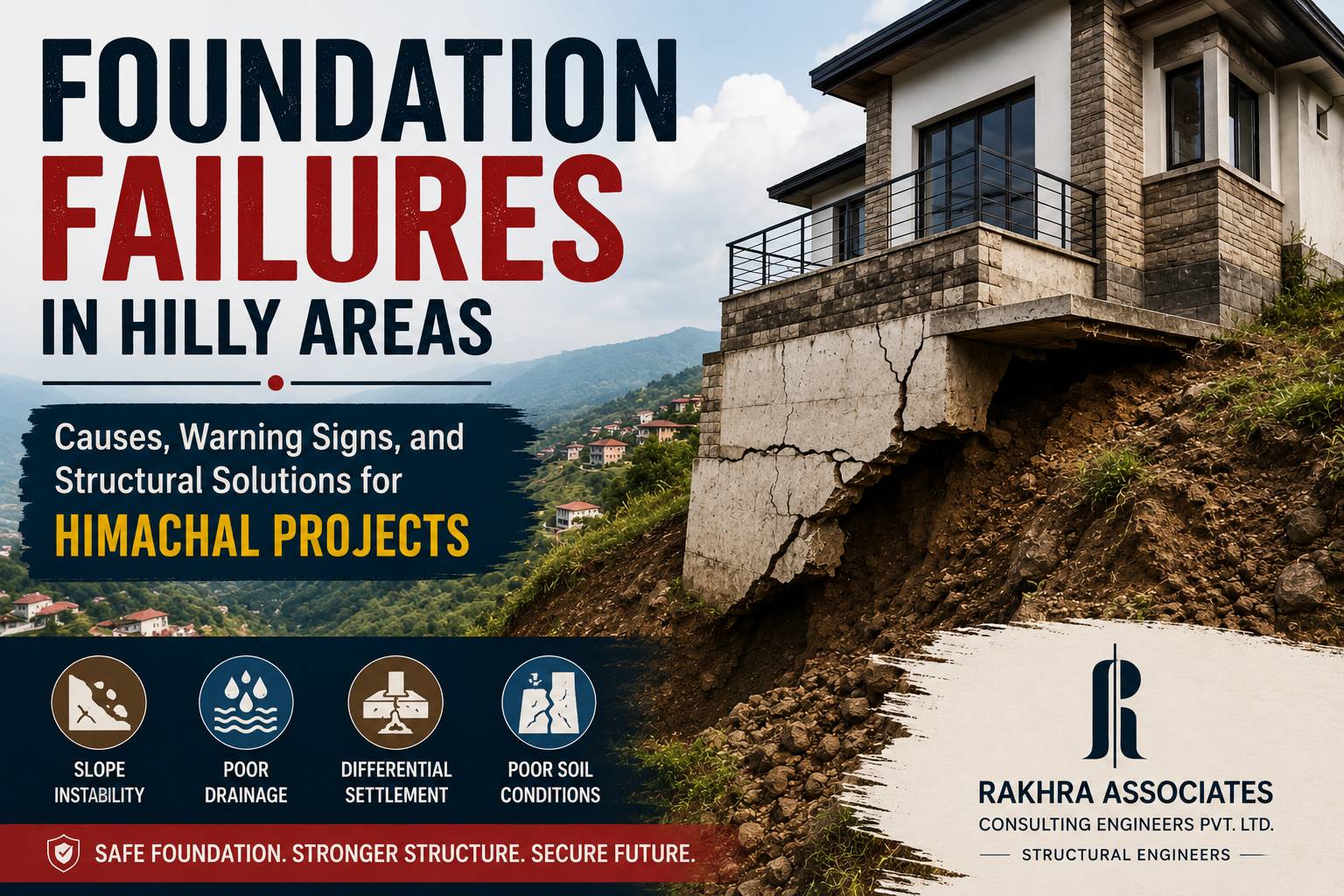
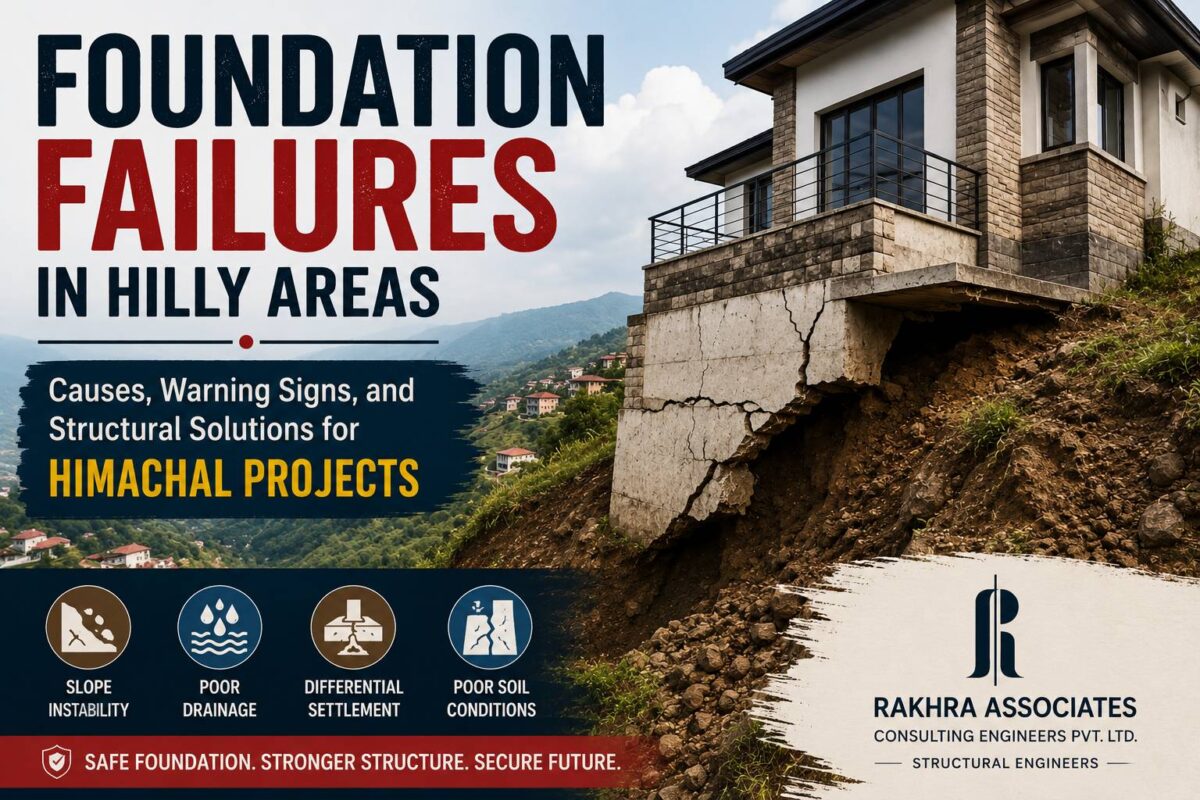
Construction in Himachal Pradesh presents unique engineering challenges that are significantly different from construction in flat regions. Cities and hill towns such as Shimla, Mashobra, Solan, Dharamshala, Kullu, Manali, and surrounding areas often involve sloping terrain, variable soil conditions, rainfall exposure, seismic activity, and difficult site accessibility. While these regions offer scenic locations and growing residential opportunities, they also increase the importance of proper structural planning from the very beginning.
One of the most critical issues affecting buildings in hill regions is foundation failure. A structure may appear strong above ground, but if its foundation system is not designed according to site conditions, serious problems can emerge over time. Cracks in walls, uneven floors, structural tilting, water seepage, and settlement-related damage are often early indicators of underlying foundation problems.
As Rakhra Associates Consulting Engineers Pvt. Ltd., projects and observations across Himachal Pradesh continue to show one important lesson: strong buildings start with strong foundations.
For homeowners, builders, architects, and developers, understanding why foundation failures occur can help prevent costly structural issues in the future.
Construction in Himachal Pradesh presents unique engineering challenges that are significantly different from construction in flat regions. Cities and hill towns such as Shimla, Mashobra, Solan, Dharamshala, Kullu, Manali, and surrounding areas often involve sloping terrain, variable soil conditions, rainfall exposure, seismic activity, and difficult site accessibility. While these regions offer scenic locations and growing residential opportunities, they also increase the importance of proper structural planning from the very beginning.
One of the most critical issues affecting buildings in hill regions is foundation failure. A structure may appear strong above ground, but if its foundation system is not designed according to site conditions, serious problems can emerge over time. Cracks in walls, uneven floors, structural tilting, water seepage, and settlement-related damage are often early indicators of underlying foundation problems.
As Rakhra Associates Consulting Engineers Pvt. Ltd., projects and observations across Himachal Pradesh continue to show one important lesson: strong buildings start with strong foundations.
For homeowners, builders, architects, and developers, understanding why foundation failures occur can help prevent costly structural issues in the future.
Quick Answer
Foundation failures in hilly areas commonly occur due to poor soil investigation, slope instability, water seepage, inadequate drainage, improper excavation practices, and incorrect foundation selection. Site-specific structural design, geotechnical studies, and proper engineering planning help reduce these risks.
What You Will Learn in This Blog
This guide covers:
- Why foundations behave differently in hilly regions
- Major causes of foundation failures in Himachal projects
- Early warning signs homeowners should recognize
- Structural solutions used by engineers
- Soil investigation and slope considerations
- Preventive strategies before construction begins
- Frequently asked questions about foundation problems
Why Foundation Design Is More Complex in Hilly Areas
Flat-land projects often follow predictable ground conditions. In contrast, hill construction introduces multiple engineering variables.
Hilly terrain may involve:
- Uneven ground elevations
- Variable soil layers
- Slope movement potential
- Water flow through hillsides
- Cut-and-fill construction zones
- Retaining structures
- Earthquake considerations
Because of these conditions, foundations in Himachal projects cannot rely on standard assumptions.
Every site behaves differently.
A foundation design suitable for one hill project may be unsuitable only a few kilometers away.
What Is Foundation Failure?
Foundation failure occurs when the foundation can no longer safely transfer structural loads to the soil beneath it.
This can result in:
- Excessive settlement
- Structural movement
- Cracking
- Tilting
- Loss of stability
- Structural distress over time
Foundation problems usually develop gradually and become visible through changes in the structure.
Major Causes of Foundation Failures in Hilly Areas
Understanding the root causes is important before discussing solutions.
Major Causes of Foundation Failures in Hilly Areas
1. Poor Soil Investigation
Many residential projects begin without proper geotechnical analysis.
This becomes one of the biggest mistakes in hill construction.
Soil properties can vary dramatically across short distances in hilly regions.
Without soil studies, engineers may not accurately determine:
- Bearing capacity
- Settlement behavior
- Water conditions
- Soil layer variations
- Slope stability conditions
Incorrect assumptions during design increase long-term structural risk.
Major Causes of Foundation Failures in Hilly Areas
2. Slope Instability
Hillsides naturally experience forces acting downward due to gravity.
Excavation, additional loading, and water movement can disturb slope equilibrium.
Unstable slopes may create:
- Soil movement
- Differential settlement
- Retaining wall distress
- Foundation shifting
Slope stability becomes a major factor during structural planning.
Major Causes of Foundation Failures in Hilly Areas
3. Excessive Hill Cutting
In many projects, large portions of hillsides are cut to create level construction areas.
Improper excavation practices can disturb natural ground behavior.
Problems may include:
- Loss of soil support
- Increased erosion
- Slope movement
- Foundation instability
Balanced excavation planning is essential.
Major Causes of Foundation Failures in Hilly Areas
4. Water Seepage and Poor Drainage
Water is one of the most underestimated threats in hillside construction.
Poor drainage can lead to:
- Soil softening
- Increased hydrostatic pressure
- Reduced bearing capacity
- Erosion beneath foundations
- Settlement issues
Heavy rainfall in Himachal regions increases these risks.
Major Causes of Foundation Failures in Hilly Areas
5. Inadequate Foundation Selection
Foundation systems must respond to actual site conditions.
Common foundation types include:
- Isolated footings
- Combined footings
- Raft foundations
- Stepped foundations
- Specialized systems for slope conditions
Choosing an unsuitable foundation type can create long-term performance issues.
Major Causes of Foundation Failures in Hilly Areas
6. Differential Settlement
Differential settlement occurs when one portion of a structure settles more than another.
This commonly results from:
- Non-uniform soil conditions
- Varying moisture levels
- Uneven loading conditions
- Foundation depth differences
Differential settlement is one of the most common causes of structural cracking.
Major Causes of Foundation Failures in Hilly Areas
7. Seismic Activity
Himachal Pradesh lies within significant seismic zones.
Earthquakes can increase foundation stress by creating:
- Horizontal movement
- Soil instability
- Additional structural forces
- Settlement changes
Proper earthquake-resistant structural planning becomes important.
Early Warning Signs of Foundation Problems
Many homeowners ignore small signs that appear before larger issues develop.
Watch for these indicators:
Cracks in walls
Diagonal cracks often require investigation.
Early Warning Signs of Foundation Problems
Uneven floors
Sloping floors may indicate settlement.
Early Warning Signs of Foundation Problems
Doors and windows becoming difficult to close
Movement in structural elements can affect alignment.
Early Warning Signs of Foundation Problems
Gaps near columns or walls
Visible separations should not be ignored.
Early Warning Signs of Foundation Problems
Water accumulation around foundations
Persistent moisture can weaken soil conditions.
Early Warning Signs of Foundation Problems
Retaining wall movement
Bulging or leaning retaining systems may indicate soil pressure problems.
How Structural Engineers Investigate Foundation Problems
Professional structural evaluations typically include:
Visual inspection
Engineers assess visible signs of distress.
How Structural Engineers Investigate Foundation Problems
Soil evaluation
Geotechnical information helps understand subsurface behavior.
How Structural Engineers Investigate Foundation Problems
Crack pattern analysis
Cracks often reveal structural movement patterns.
How Structural Engineers Investigate Foundation Problems
Settlement assessment
Measurements determine whether movement continues.
How Structural Engineers Investigate Foundation Problems
Drainage assessment
Water flow patterns are evaluated.
How Structural Engineers Investigate Foundation Problems
Structural load review
Changes in building usage may affect loading conditions.
Structural Solutions for Foundation Problems
Different problems require different engineering responses.
Foundation strengthening
Existing foundations may require enhancement.
Possible approaches include:
- Structural reinforcement
- Underpinning techniques
- Load redistribution systems
Drainage improvement
Managing water movement remains critical.
Solutions may include:
- Surface drainage planning
- Controlled water flow systems
- Site grading improvements
Retaining structure strengthening
Retaining systems may require reinforcement where soil pressures increase.
Soil improvement methods
Weak soil conditions may require stabilization strategies.
Structural retrofitting
Older buildings sometimes require strengthening measures to improve performance.
Why Soil Testing Matters Before Construction
Many homeowners search:
Do I really need soil testing before house construction?
The answer is yes—especially in Himachal Pradesh.
Soil investigations help determine:
- Foundation requirements
- Bearing capacity
- Water table conditions
- Settlement risk
- Site suitability
Skipping this step can create expensive long-term problems.
How Early Structural Consultation Saves Construction Costs
Many projects involve structural engineers after architecture and excavation decisions are already finalized.
This often creates:
- Redesign costs
- Material wastage
- Site delays
- Construction modifications
Early structural consultation helps optimize:
- Foundation systems
- Excavation planning
- Structural layouts
- Material use
Good engineering reduces future uncertainty.
Why Specialized Structural Engineers Matter in Himachal Pradesh
Hill construction differs significantly from ordinary projects.
Structural engineers working in Himachal Pradesh often consider:
- Slope behavior
- Soil variability
- Retaining requirements
- Drainage conditions
- Earthquake resistance
- Load transfer behavior
This makes site-specific structural planning extremely important.
For readers looking to understand broader engineering practices, exploring guidance from experienced structural engineers in Himachal Pradesh can provide additional insights into safe construction strategies across hill regions.
Frequently Asked Questions
Common causes include poor soil investigation, water seepage, slope instability, improper excavation, and incorrect foundation selection.
Yes. Differential settlement often creates visible cracks in walls and structural elements.
Soil testing helps determine foundation design requirements and site conditions.
Yes. Water can weaken soil strength and increase settlement risks.
Structural engineers analyze soil conditions, drainage behavior, crack patterns, and settlement indicators.
Foundation issues may occur if hill-specific engineering considerations are ignored.
Foundation selection depends on soil, slope conditions, loading requirements, and project constraints.
Cracks, uneven floors, alignment problems, and visible movement may indicate settlement.
Yes. Retaining failures can influence nearby soil stability.
Yes. Seismic activity creates additional structural forces that must be considered.
Absolutely. Poor drainage contributes significantly to soil instability.
Yes. Early intervention is important before structural movement increases.
Visible cracking, settlement signs, retaining movement, or unusual structural behavior should be evaluated.
In many situations, strengthening and rehabilitation methods can improve performance.
Yes. Early planning often prevents expensive construction errors.
Final Thoughts
Foundation failures in hill regions are rarely caused by a single issue. Most problems develop from a combination of soil conditions, drainage deficiencies, slope behavior, and inadequate planning decisions. As residential development continues expanding across regions such as Mashobra, Shimla, Solan, and surrounding areas, structurally informed planning becomes increasingly important.
Safe construction begins below ground level. Understanding foundation behavior today can prevent major structural challenges tomorrow.