


Blog
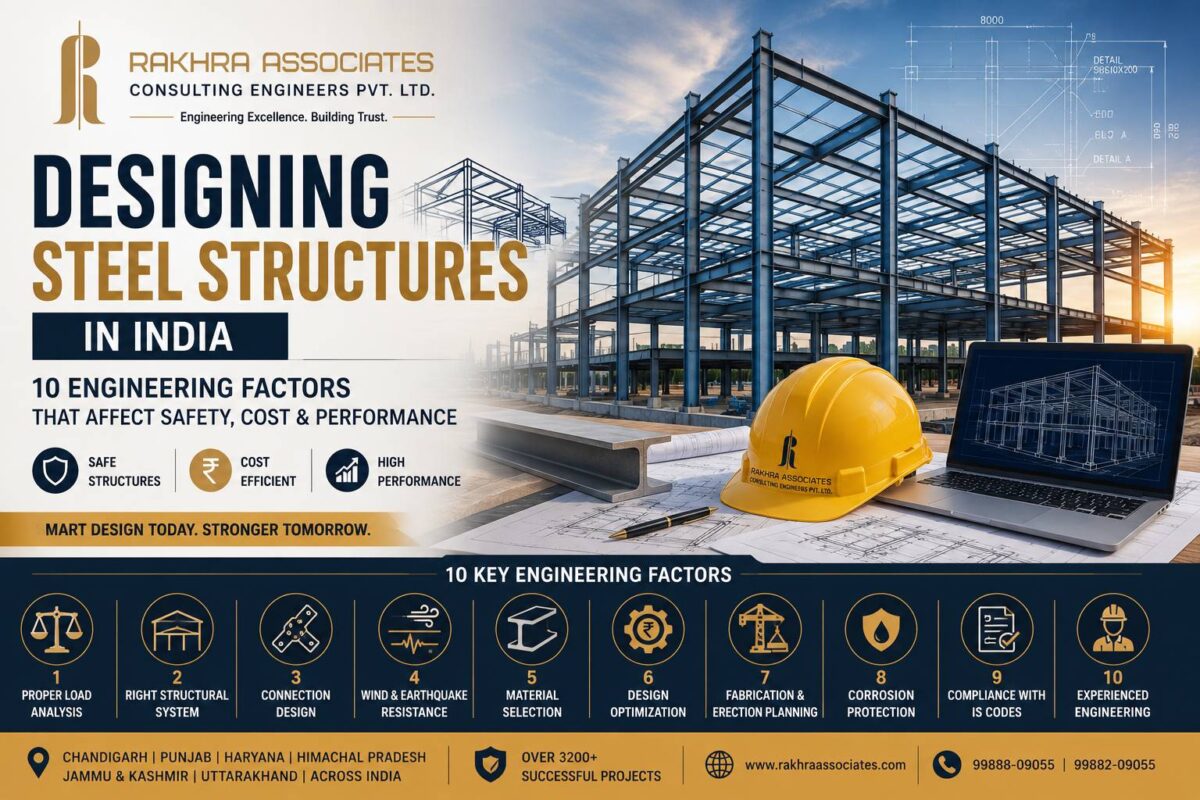
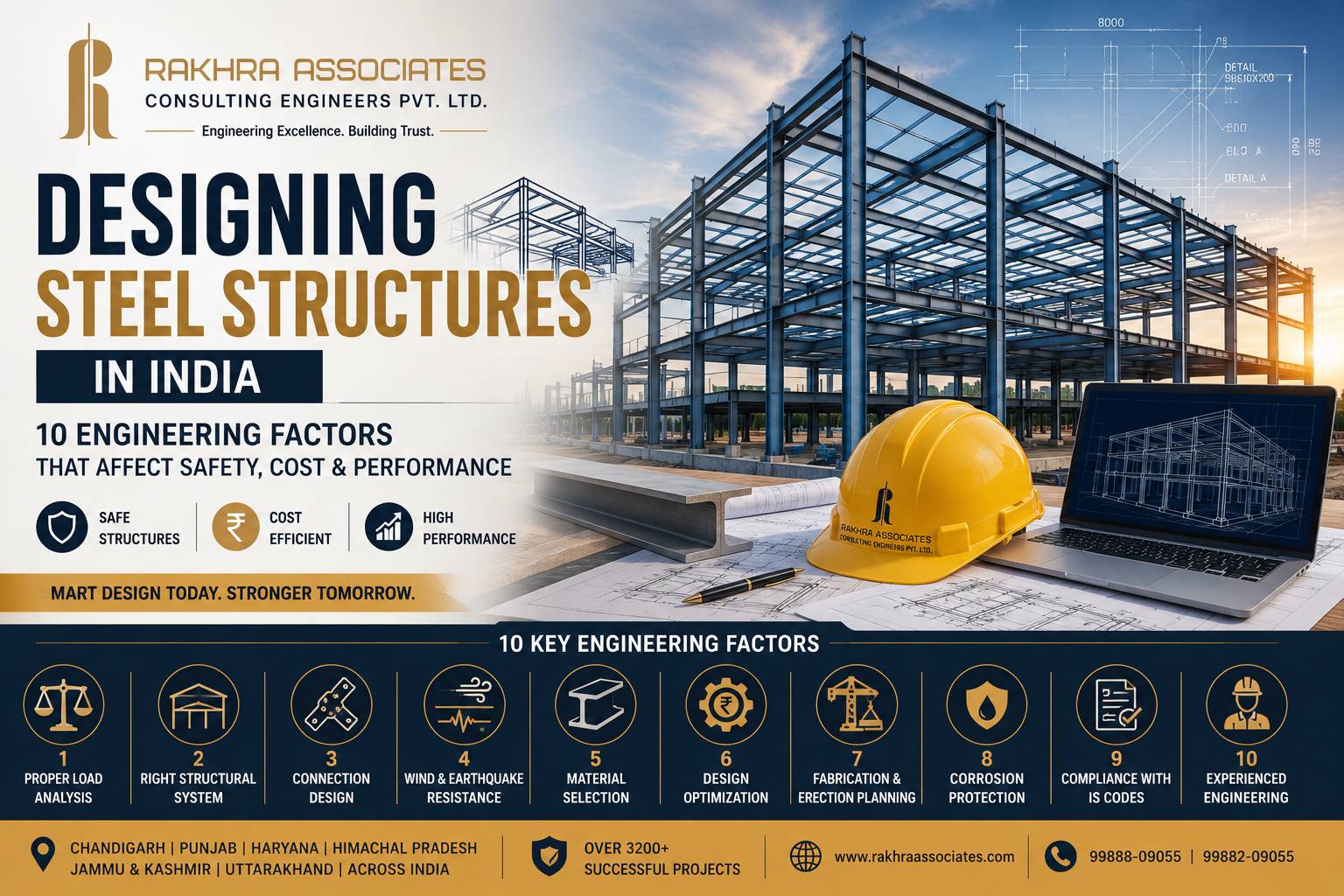
Designing Steel Structures in India: 10 Engineering Factors That Affect Safety, Cost & Performance
Steel structures have become one of the most preferred construction systems in India due to their exceptional strength, speed of construction, flexibility, and long service life. From industrial warehouses and manufacturing plants to commercial complexes, airports, stadiums, educational institutions, hospitals, and high-rise buildings, steel is now an integral part of modern infrastructure.
However, the success of any steel building depends far more on engineering than on the quantity of steel used. A properly engineered steel structure delivers superior safety, durability, and cost efficiency, while poor structural planning can lead to excessive material consumption, construction delays, expensive modifications, and long-term maintenance issues.
Every steel structure must be designed by experienced structural engineers who understand load behaviour, structural analysis, fabrication constraints, Indian Standards (IS Codes), and practical construction techniques.
At Rakhra Associates Consulting Engineers Pvt. Ltd., we provide professional steel structure design consultancy for projects across Chandigarh, Punjab, Haryana, Himachal Pradesh, Jammu & Kashmir, Uttarakhand, Delhi NCR, Rajasthan, and throughout India. With experience spanning more than 3200 completed projects, our team delivers safe, economical, and construction-friendly structural solutions for projects of every scale.
This article explains the ten most important engineering factors that influence the safety, cost, and long-term performance of steel structures.
Why Steel Structures Are Becoming Increasingly Popular in India
Rapid urbanization and industrial growth have significantly increased the demand for steel buildings.
Steel structures offer several advantages:
- Faster construction
- Longer spans with fewer columns
- Lower dead load
- Greater flexibility in design
- Easier future expansion
- Better seismic performance
- Improved construction quality
- Faster project completion
- Sustainable and recyclable materials
- Reduced foundation loads
These benefits make steel an excellent choice for industrial, commercial, institutional, and infrastructure projects.
1. Proper Structural Load Analysis
Every steel structure begins with accurate load calculations.
The engineer evaluates multiple types of loads, including:
- Dead Loads
- Live Loads
- Wind Loads
- Earthquake Loads
- Crane Loads
- Equipment Loads
- Snow Loads (where applicable)
- Impact Loads
- Dynamic Loads
Accurate load estimation ensures that every beam, column, connection, and foundation performs safely throughout the building's service life.
Incorrect load assumptions can increase construction costs or compromise structural safety.
2. Selection of the Right Structural System
Choosing the correct structural framing system is one of the most important engineering decisions.
Depending on the project, engineers may recommend:
- Portal Frames
- Pre-Engineered Buildings (PEB)
- Conventional Steel Frames
- Composite Structures
- Truss Systems
- Space Frames
- Braced Frames
- Moment Resisting Frames
Each system has unique advantages depending on span length, building height, intended use, and architectural requirements.
Selecting the most suitable system can significantly reduce project costs while improving performance.
3. Connection Design
Steel members are only as strong as their connections.
Connection design includes:
- Bolted Connections
- Welded Connections
- Moment Connections
- Shear Connections
- Base Plate Design
- Anchor Bolt Design
- Gusset Plates
Well-designed connections ensure that forces are safely transferred throughout the structural system.
Poor connection detailing often becomes the weakest point of a structure.
4. Wind and Earthquake Resistance
India experiences varying wind speeds and seismic conditions depending on geographical location.
Steel structures must be designed according to:
- IS 875 (Wind Loads)
- IS 1893 (Earthquake Resistant Design)
- IS 800 (Steel Design)
- IS 13920 (where applicable)
This becomes even more important in regions such as:
- Himachal Pradesh
- Jammu & Kashmir
- Uttarakhand
- North-East India
- Coastal Areas
Proper lateral load analysis prevents excessive building movement and structural damage during extreme events.
5. Material Selection
Not all structural steel is identical.
Engineers carefully select steel grades based on:
- Yield Strength
- Tensile Strength
- Weldability
- Ductility
- Corrosion Resistance
- Availability
- Fabrication Requirements
Proper material selection improves structural performance while optimizing project costs.
6. Design Optimization
One of the biggest misconceptions is that adding more steel automatically creates a safer building.
In reality, experienced structural engineers focus on optimization.
Design optimization includes:
- Efficient beam sizing
- Optimized column spacing
- Member utilization
- Reduced steel tonnage
- Better load distribution
- Improved structural efficiency
A well-optimized design reduces unnecessary material consumption without compromising safety.
This ultimately lowers overall construction costs.
7. Fabrication and Erection Considerations
Excellent structural drawings alone are not sufficient.
Engineers must also consider:
- Fabrication tolerances
- Transportation limitations
- Site accessibility
- Crane positioning
- Assembly sequence
- Welding accessibility
- Bolt installation
- Temporary stability during erection
Construction-friendly detailing minimizes site errors and accelerates project execution.
8. Corrosion Protection and Durability
Steel structures require proper protection against environmental exposure.
Depending on project conditions, engineers may recommend:
- Protective Paint Systems
- Hot Dip Galvanizing
- Weather Resistant Steel
- Fire Protective Coatings
- Protective Cladding Systems
Regular maintenance further extends the service life of steel buildings.
Proper corrosion protection is especially important for industrial plants, coastal projects, and humid environments.
9. Compliance with Indian Standards
Professional structural engineering requires strict compliance with Indian Standards.
Common design standards include:
- IS 800
- IS 875
- IS 1893
- IS 456 (where composite structures are involved)
- IS 806
- IS 808
Compliance ensures structural safety, regulatory acceptance, and long-term reliability.
10. Experienced Structural Engineering Consultancy
Perhaps the most important factor is selecting an experienced structural engineering consultant.
Steel structures involve far more than software analysis.
Professional engineers combine:
- Structural behaviour
- Engineering judgement
- Practical construction experience
- Material optimization
- Site coordination
- Code compliance
- Safety considerations
- Cost control
Experienced consultants can identify practical solutions that reduce project costs while improving structural performance.
Types of Steel Structures We Design
At Rakhra Associates Consulting Engineers Pvt. Ltd., our expertise covers a wide range of steel projects.
These include:
Industrial Buildings
- Manufacturing Plants
- Production Facilities
- Processing Units
- Heavy Engineering Structures
Warehouses
- Distribution Centres
- Logistics Parks
- Cold Storage Facilities
- Storage Buildings
Commercial Buildings
- Office Complexes
- Business Parks
- Retail Developments
- Exhibition Centres
Hospitality Projects
- Hotels
- Resorts
- Convention Centres
- Banquet Facilities
Institutional Buildings
- Schools
- Universities
- Healthcare Facilities
- Government Buildings
Infrastructure Projects
- Airports
- Bus Terminals
- Railway Structures
- Bridges
- Utility Buildings
Specialized Structures
- Steel Chimneys
- Industrial Platforms
- Pipe Racks
- Equipment Support Structures
- Large Span Roof Systems
Structural Design Software Used for Steel Structures
Modern steel engineering relies on advanced analysis and design software.
Our engineering team utilizes:
- ETABS
- STAAD.Pro
- SAFE
- AutoCAD
- CYPECAD
- BIM-Based Design Platforms
These tools enable accurate structural analysis, optimization, detailed documentation, and coordination with architects and project teams.
Why Choose Rakhra Associates for Steel Structure Design?
Choosing the right structural engineering consultant has a direct impact on project success.
Clients trust Rakhra Associates because we offer:
Extensive Project Experience
More than 3200 successfully completed projects across India.
Technical Excellence
Comprehensive expertise in RCC, steel, composite, industrial, and infrastructure structures.
Cost-Efficient Engineering
Optimized structural designs that reduce unnecessary steel consumption while maintaining safety.
Construction-Friendly Solutions
Practical engineering that simplifies fabrication and site execution.
Multi-Sector Expertise
Residential, commercial, industrial, hospitality, healthcare, educational, government, and infrastructure projects.
Pan-India Consultancy
We provide steel structure design consultancy throughout:
- Chandigarh
- Mohali
- Panchkula
- Punjab
- Haryana
- Himachal Pradesh
- Jammu & Kashmir
- Uttarakhand
- Delhi NCR
- Rajasthan
- Across India
Frequently Asked Questions
Steel structure design is the engineering process of designing beams, columns, trusses, connections, and foundations to safely support all expected loads.
Steel buildings offer faster construction, longer spans, lower maintenance, better earthquake performance, and future expansion flexibility.
Steel structures are generally designed in accordance with IS 800, IS 875, IS 1893, IS 806, and other applicable Indian Standards.
Yes. Properly designed steel structures perform exceptionally well in seismic zones due to their ductility and strength.
Yes. Optimized engineering minimizes material consumption, accelerates construction, and lowers overall project costs.
Yes. We design factories, warehouses, manufacturing plants, logistics parks, and industrial facilities.
Professional structural engineers use ETABS, STAAD.Pro, SAFE, AutoCAD, CYPECAD, and BIM-based platforms.
Yes. Regular inspections and protective coatings help ensure long-term durability and performance.
Yes. One of the major advantages of steel construction is its flexibility for future modifications and extensions.
An experienced consultant delivers safe, economical, code-compliant, and construction-friendly designs that reduce risks and optimize project performance.
Conclusion
Steel structures have transformed modern construction by offering exceptional strength, speed, flexibility, and long-term value. However, achieving these advantages depends on sound structural engineering rather than simply selecting steel as the construction material. From accurate load analysis and efficient structural systems to connection detailing, seismic design, corrosion protection, and compliance with Indian Standards, every engineering decision influences the safety, cost, and performance of the finished structure.
At Rakhra Associates Consulting Engineers Pvt. Ltd., we combine advanced structural engineering expertise, practical construction knowledge, and modern design technology to deliver optimized steel structure solutions for industrial, commercial, institutional, hospitality, healthcare, infrastructure, and specialized projects. With over 3200 successfully completed projects, we are committed to helping clients build stronger, safer, and more efficient steel structures across Chandigarh, Punjab, Himachal Pradesh, North India, and throughout India. Whether you are planning a warehouse, factory, commercial building, or complex steel infrastructure, our team provides engineering solutions that are built for performance, economy, and long-term reliability.