

Blog
Structural Stability Certificate vs Structural Audit: What's the Difference and When Do You Need Each?
Every building owner wants one thing above all else—confidence that their structure is safe, stable, and capable of serving its intended purpose for years to come. Whether it is a residential home, commercial building, hospital, hotel, educational institution, industrial facility, or high-rise development, structural safety should never be left to assumption.
However, many property owners, builders, architects, and even developers often confuse two important engineering services: a Structural Stability Certificate and a Structural Audit. Although both relate to the structural integrity of a building, they serve different purposes and are required at different stages of a building's life cycle.
Understanding the distinction between these services can help you comply with local regulations, protect occupants, extend the life of your property, and avoid costly structural failures.
At Rakhra Associates Consulting Engineers Pvt. Ltd., we provide professional structural engineering consultancy, structural audits, proof checking, structural stability certification, and structural design services across Chandigarh, Punjab, Haryana, Himachal Pradesh, Jammu & Kashmir, Uttarakhand, and throughout India. With experience spanning more than 3200 completed projects, our team assists clients in making informed engineering decisions backed by technical expertise and Indian Standard (IS) Codes.
What Is a Structural Stability Certificate?
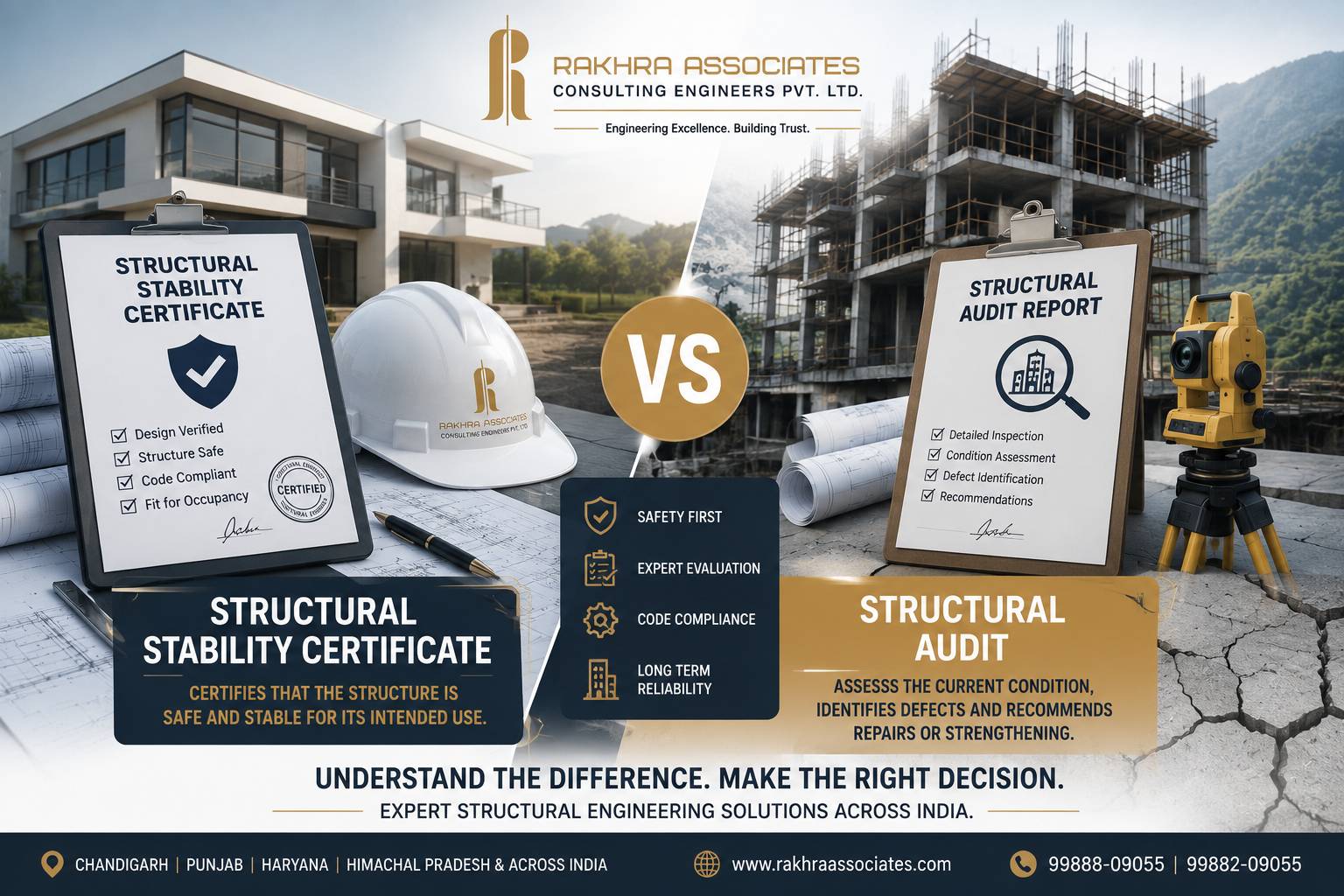
A Structural Stability Certificate is a professional declaration issued by a qualified structural engineer after evaluating whether a building or structure is safe and structurally stable for its intended use.
The certificate confirms that the structural system has been assessed and found capable of safely resisting anticipated loads under normal operating conditions.
Depending on project requirements, the evaluation may include:
- Review of structural drawings
- Verification of design calculations
- Visual inspection of structural components
- Assessment of construction quality
- Evaluation of foundations where applicable
- Compliance with relevant Indian Standards (IS Codes)
A Structural Stability Certificate is commonly required by government authorities, municipal corporations, educational institutions, hospitals, industrial facilities, hotels, commercial complexes, and residential societies for approvals, licensing, occupancy, or operational compliance.
What Is a Structural Audit?
A Structural Audit is a comprehensive engineering assessment that evaluates the present condition, strength, durability, and long-term safety of an existing building or structure.
Unlike a Stability Certificate, which primarily certifies that a structure is safe, a Structural Audit investigates the overall health of the building and identifies structural deficiencies, deterioration, damage, and maintenance requirements.
A structural audit typically includes:
- Detailed site inspection
- Crack mapping
- Reinforcement distress assessment
- Concrete deterioration analysis
- Corrosion evaluation
- Water leakage assessment
- Foundation observations
- Structural member evaluation
- Load carrying assessment
- Recommendations for repairs or retrofitting
The objective is not only to identify existing issues but also to prevent future structural failures.
Structural Stability Certificate vs Structural Audit
Although the terms are often used interchangeably, they represent two different engineering services.
| Structural Stability Certificate | Structural Audit |
| Certifies structural safety | Examines structural health |
| Provides professional certification | Provides technical assessment |
| Usually required for approvals and compliance | Usually required for ageing or distressed buildings |
| May involve inspection and document review | Involves detailed engineering investigation |
| Confirms current structural stability | Identifies defects and future risks |
| Shorter engineering process | More detailed and comprehensive process |
| Suitable for new or existing buildings | Primarily intended for existing structures |
In simple terms, a Structural Stability Certificate answers the question:
"Is this building structurally safe?"
A Structural Audit answers:
"What is the condition of this building, and what should be done to ensure its long-term safety?"
When Do You Need a Structural Stability Certificate?
A Structural Stability Certificate may be required in several situations, including:
Before Occupancy
Many authorities require structural certification before granting occupancy permissions.
During Building Regularization
Existing buildings undergoing legalization or regularization may require certification.
Commercial Licensing
Hotels, hospitals, schools, malls, factories, and institutional buildings often require structural stability certificates for operational approvals.
Property Transactions
Banks, investors, and buyers sometimes request structural certification before financing or purchasing large properties.
Renovation Projects
Where significant modifications have been made, authorities or owners may require confirmation that structural stability has not been compromised.
Industrial Installations
Heavy machinery installations frequently require structural verification before commissioning.
When Is a Structural Audit Recommended?
A Structural Audit becomes essential when there are concerns regarding the condition of an existing structure.
Common situations include:
Ageing Buildings
Buildings that have been in service for decades may experience material deterioration and require periodic structural evaluation.
Visible Structural Cracks
Large cracks, recurring cracks, or widening cracks may indicate underlying structural issues.
Water Damage
Long-term seepage and moisture intrusion can reduce structural durability.
Corrosion of Reinforcement
Rusting reinforcement can weaken RCC members over time.
Building Alterations
Additional floors, heavy equipment, or layout modifications may alter structural behaviour.
Earthquake or Natural Disaster
Buildings affected by seismic activity, flooding, landslides, or storms should undergo structural assessment.
Before Major Renovation
A structural audit helps determine whether the existing building can safely support proposed modifications.
When Is a Structural Audit Recommended?
A Structural Audit becomes essential when there are concerns regarding the condition of an existing structure.
Common situations include:
Ageing Buildings
Buildings that have been in service for decades may experience material deterioration and require periodic structural evaluation.
Visible Structural Cracks
Large cracks, recurring cracks, or widening cracks may indicate underlying structural issues.
Water Damage
Long-term seepage and moisture intrusion can reduce structural durability.
Corrosion of Reinforcement
Rusting reinforcement can weaken RCC members over time.
Building Alterations
Additional floors, heavy equipment, or layout modifications may alter structural behaviour.
Earthquake or Natural Disaster
Buildings affected by seismic activity, flooding, landslides, or storms should undergo structural assessment.
Before Major Renovation
A structural audit helps determine whether the existing building can safely support proposed modifications.
What Does a Structural Engineer Examine?
Professional structural engineers evaluate several technical aspects during structural assessments.
These may include:
- Foundation performance
- Columns
- Beams
- Slabs
- Shear walls
- Steel members
- Retaining walls
- Roof systems
- Staircases
- Water tanks
- Expansion joints
- Structural connections
- Settlement behaviour
- Construction quality
- Material deterioration
Advanced engineering judgement is combined with relevant Indian Standards to determine structural adequacy.
Why Structural Safety Should Never Be Ignored
Ignoring structural issues can result in serious consequences.
Potential risks include:
- Progressive structural deterioration
- Reduced load carrying capacity
- Unsafe occupancy
- Costly repairs in the future
- Operational interruptions
- Legal liabilities
- Insurance complications
- Risk to human life
Early engineering intervention is almost always more economical than emergency structural repairs.
Importance of Structural Audits in Hill and Seismic Regions
Buildings located in Himachal Pradesh, Jammu & Kashmir, Uttarakhand, and other mountainous regions are subjected to unique engineering challenges.
These include:
- Earthquake forces
- Differential settlement
- Steep terrain
- Retaining wall pressures
- Drainage issues
- Landslide risks
- Temperature variations
Regular structural evaluations are especially valuable for hill buildings because environmental conditions can accelerate structural deterioration.
Structural Stability Certification for Different Types of Projects
Professional structural engineering services are valuable across multiple sectors.
These include:
Residential Buildings
Independent houses, villas, apartments, and housing societies.
Commercial Buildings
Office complexes, malls, retail developments, and mixed-use buildings.
Industrial Facilities
Factories, warehouses, manufacturing units, and processing plants.
Educational Institutions
Schools, colleges, universities, and research centres.
Healthcare Facilities
Hospitals, medical colleges, diagnostic centres, and healthcare campuses.
Hospitality Projects
Hotels, resorts, banquet halls, and convention centres.
Steel Structures
Industrial sheds, warehouses, PEB buildings, and large-span structures.
Infrastructure Projects
Bridges, public buildings, transportation facilities, and water retaining structures.
Why Choose an Experienced Structural Engineering Consultant?
A structural certificate or audit is only as reliable as the expertise behind it.
An experienced consultant understands:
- Structural behaviour
- RCC design
- Steel design
- Seismic engineering
- Foundation engineering
- Material performance
- Construction methodology
- Indian Standard Codes
- Practical site challenges
- Repair and retrofitting techniques
Professional engineering judgement is essential because every structure behaves differently depending on its age, design, usage, and environmental exposure.
Why Choose Rakhra Associates Consulting Engineers Pvt. Ltd.?
Rakhra Associates Consulting Engineers Pvt. Ltd. is a leading structural engineering consultancy providing structural safety solutions across India.
Our expertise includes:
- Structural Stability Certificates
- Structural Audits
- Proof Checking
- Structural Design
- Retrofitting Consultancy
- Quantity Surveying
- Project Management Consultancy
- Steel Structure Design
- High-Rise Building Design
- Hill Structural Engineering
Our team has successfully contributed to more than 3200 projects across residential, commercial, industrial, healthcare, hospitality, educational, infrastructure, and government sectors.
With extensive experience in Chandigarh, Punjab, Haryana, Himachal Pradesh, Jammu & Kashmir, Uttarakhand, and projects across India, we focus on delivering safe, economical, code-compliant, and practical engineering solutions tailored to each project.
Frequently Asked Questions
A Structural Stability Certificate is a professional certification issued by a qualified structural engineer confirming that a building is structurally safe for its intended use.
No. A Structural Audit is a detailed technical evaluation of a building's condition, while a Structural Stability Certificate certifies structural safety after appropriate assessment.
A qualified structural engineer or structural engineering consultant with the necessary expertise and authority, as per applicable regulations.
Buildings showing signs of deterioration, ageing, structural distress, or those undergoing renovation should undergo a structural audit.
Requirements vary depending on local regulations, building type, and project circumstances. Many authorities mandate audits for older or specific categories of buildings.
Yes. New buildings often require structural certification during approvals, occupancy processes, or compliance procedures.
The duration depends on the building size, complexity, accessibility, and the extent of investigation required.
The engineer recommends appropriate repair, strengthening, monitoring, or retrofitting measures based on the findings.
Yes. Buildings in seismic and mountainous regions are exposed to additional environmental and geological factors that may justify periodic assessments.
Experienced consultants provide technically sound assessments, code-compliant recommendations, practical repair strategies, and reliable engineering documentation that support both safety and regulatory compliance.
Final Thoughts
A Structural Stability Certificate and a Structural Audit are both essential components of responsible building management, but they serve different purposes. While a stability certificate confirms that a structure is safe for its intended use, a structural audit provides a comprehensive assessment of the building's current condition, helping identify potential risks before they become major problems.
Whether you are planning a new project, managing an existing property, renovating an older building, or seeking statutory approvals, choosing the right engineering service at the right time can protect lives, reduce long-term costs, and enhance the durability of your asset.
Rakhra Associates Consulting Engineers Pvt. Ltd. is committed to delivering reliable structural engineering consultancy backed by technical excellence, practical experience, and strict adherence to Indian Standards. From structural stability certification and structural audits to proof checking, structural design, and specialized engineering solutions for residential, commercial, industrial, hill, and infrastructure projects, our team helps clients build with confidence across Chandigarh, Punjab, Himachal Pradesh, North India, and throughout the country. When structural safety matters, professional engineering expertise makes all the difference.