


Blog
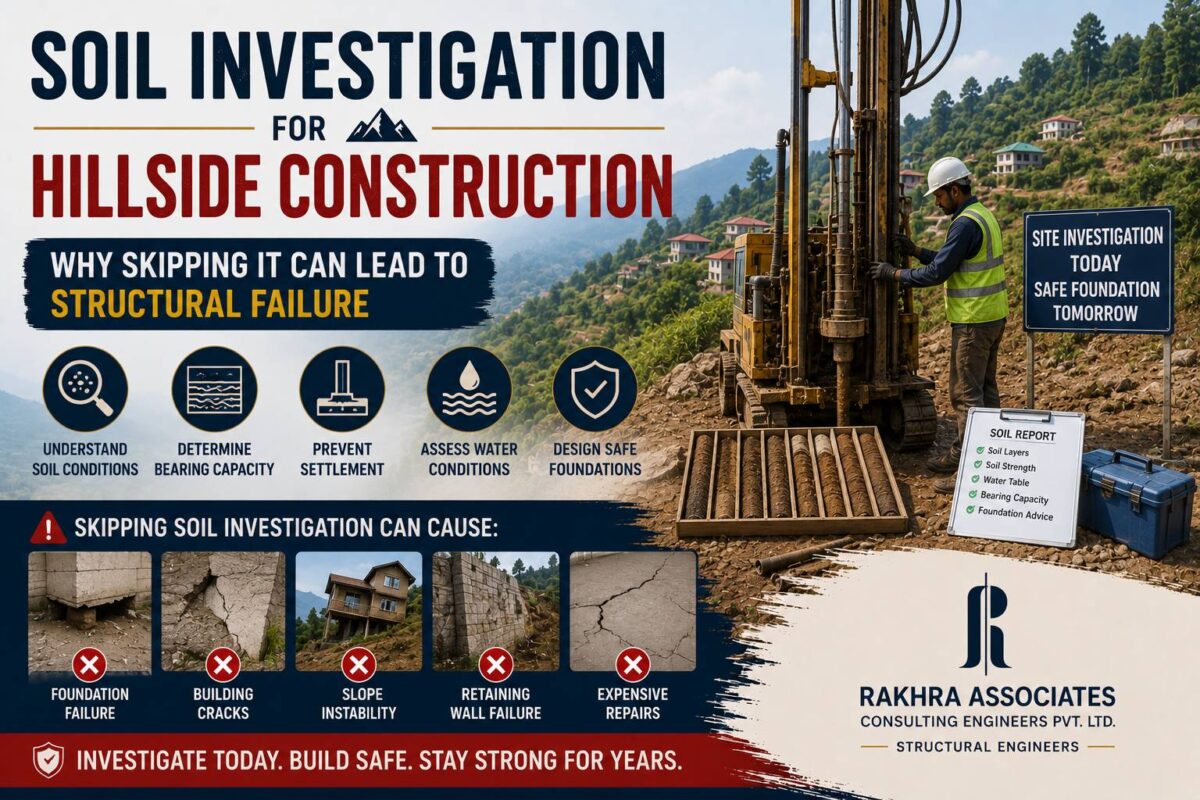
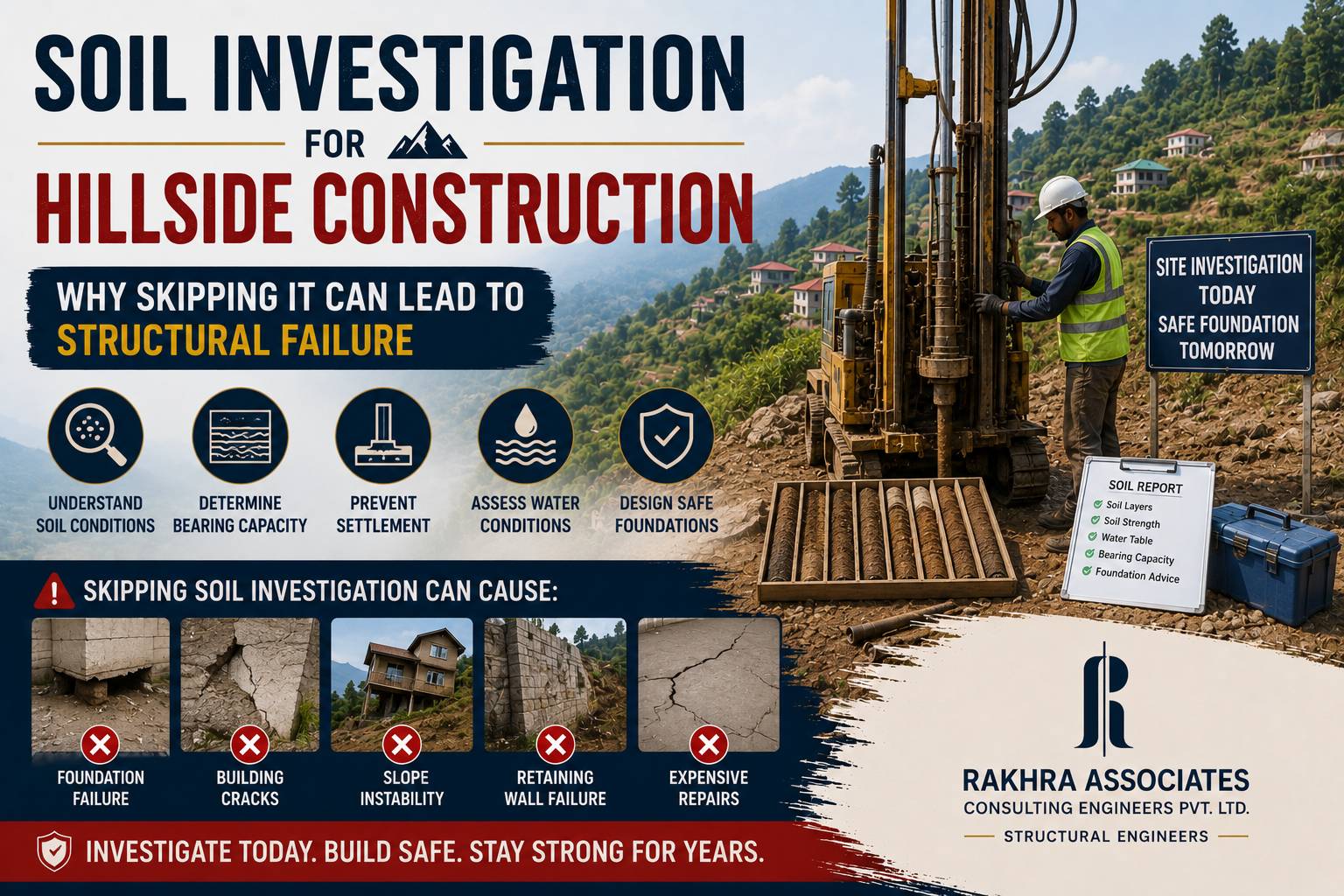
Soil Investigation for Hillside Construction: Why Skipping It Can Lead to Structural Failure
Himachal Pradesh has experienced rapid growth in residential housing, villas, hospitality projects, and commercial construction across regions such as Shimla, Mashobra, Solan, Kullu, Dharamshala, Manali, and surrounding hill towns. While these projects offer beautiful locations and unique architectural possibilities, hillside construction introduces structural complexities that differ significantly from flat-land development.
One of the most critical yet frequently overlooked aspects of construction in hilly regions is soil investigation.
Many property owners focus heavily on architectural layouts, elevations, finishes, and material selection while underestimating what lies beneath the structure. However, every building ultimately depends on the ground supporting it. If soil behavior is poorly understood, even a well-designed structure can experience settlement, cracking, slope instability, drainage problems, and long-term structural distress.
As Rakhra Associates Consulting Engineers Pvt. Ltd., experience across structural projects consistently highlights one principle: a safe structure begins below the foundation level.
Understanding soil before construction begins is often one of the most important decisions in any hillside project.
Related blog: Soil Investigation for Hillside Construction
Quick Answer
Soil investigation for hillside construction helps determine soil strength, bearing capacity, settlement characteristics, water conditions, and slope behavior. Skipping soil studies can increase the risk of foundation failures, structural movement, cracks, and expensive repairs.
What You Will Learn in This Guide
This article covers:
- What soil investigation means
- Why hillside construction requires geotechnical analysis
- Risks associated with skipping soil studies
- Common soil-related failures in Himachal projects
- How engineers conduct soil investigations
- Why soil conditions influence foundation design
- Frequently asked questions for homeowners and developers
What Is Soil Investigation?
Soil investigation refers to the process of evaluating subsurface ground conditions before construction begins.
Engineers and geotechnical specialists analyze:
- Soil composition
- Strength properties
- Water table conditions
- Settlement behavior
- Slope characteristics
- Load-bearing capacity
This information helps determine whether the ground can safely support proposed structures.
Without understanding soil conditions, structural design becomes based on assumptions rather than engineering data.
Why Hillside Construction Requires Special Soil Investigation
Construction on sloping terrain behaves differently from construction on level sites.
Hillside locations often include:
- Varying soil layers
- Uneven slopes
- Weathered rock formations
- Water flow through terrain
- Cut-and-fill conditions
- Differential soil properties
Even within the same project site, ground conditions may vary significantly.
As a result, standard foundation assumptions often become unreliable.
Why Soil Matters in Structural Engineering
A building transfers all structural loads into the ground through foundations.
Load transfer sequence:
Roof → Slab → Beam → Column → Foundation → Soil
If soil behavior changes unexpectedly, structural performance above ground may also change.
Soil conditions influence:
- Settlement behavior
- Foundation performance
- Structural movement
- Drainage behavior
- Long-term stability
Understanding these characteristics early reduces risk.
Common Soil Conditions Found in Himachal Pradesh
Hill regions may contain a combination of:
Residual soils
Formed through weathering of underlying rock.
Loose fill materials
Often created during excavation and site modification.
Rock strata
Rock conditions vary significantly across locations.
Clay-rich soils
Can experience expansion and shrinkage.
Mixed soil layers
Different materials may exist at varying depths.
Each condition influences structural behavior differently.
Risks of Skipping Soil Investigation Before Construction
Skipping geotechnical investigation may initially appear to save time and cost.
However, long-term consequences can become far more expensive.
Foundation Failure
Foundations designed without proper soil information may experience:
- Excessive settlement
- Load imbalance
- Structural movement
Weak support conditions increase structural risk.
Differential Settlement
Different portions of a building may settle unevenly.
This creates:
- Cracks
- Distortion
- Structural stress concentrations
Differential settlement becomes more likely in hillside projects.
Building Cracks
Poor soil conditions often contribute to:
- Wall cracks
- Floor cracks
- Stair-step cracking
- Foundation distress
Surface repairs rarely solve underlying problems.
Slope Instability
Soil investigations help evaluate slope performance.
Without proper understanding:
- Soil movement may occur
- Retaining walls may experience stress
- Excavation risks increase
Increased Construction Costs
Skipping investigation can result in:
- Design modifications
- Delays
- Material wastage
- Repair costs
- Retrofitting expenses
Early planning usually costs less than corrective work.
How Structural Engineers Use Soil Reports
Soil reports guide several major design decisions.
Structural engineers use investigation results for:
Foundation selection
Determining suitable support systems.
Bearing capacity assessment
Understanding load resistance.
Settlement estimation
Predicting future movement.
Retaining wall planning
Evaluating pressure conditions.
Excavation strategies
Understanding safe construction approaches.
Drainage considerations
Managing groundwater behavior.
How Soil Investigation Is Performed
Professional investigations involve multiple stages.
Site inspection
Initial observations identify terrain conditions.
Factors reviewed include:
- Slope angle
- Surface conditions
- Existing structures
- Water patterns
Borehole drilling
Subsurface layers are examined.
This helps understand:
- Soil variation
- Layer depth
- Rock conditions
Sample collection
Representative materials are collected.
Laboratory testing
Engineers analyze:
- Strength
- Density
- Moisture content
- Plasticity characteristics
Engineering recommendations
Final reports provide structural guidance.
Why Soil Bearing Capacity Matters
Bearing capacity refers to the ability of soil to support structural loads.
Low bearing capacity may cause:
- Settlement
- Foundation movement
- Structural distress
Higher bearing capacity generally improves stability.
However, soil behavior involves more than load resistance alone.
Drainage and movement characteristics also matter.
Why Water Conditions Matter in Hillside Soil Behavior
Water remains one of the most underestimated factors in hill construction.
Water may:
- Reduce soil strength
- Increase pressure
- Trigger erosion
- Affect settlement behavior
- Change slope stability
Heavy rainfall conditions across Himachal Pradesh increase these concerns.
Proper drainage planning remains critical.
Common Construction Mistakes Related to Soil
Several recurring mistakes continue affecting hillside projects.
Beginning excavation before investigation
Assuming nearby plots have similar conditions
Ignoring drainage behavior
Using standard foundation dimensions
Delaying structural consultation
Underestimating slope effects
Every site behaves differently.
How Early Soil Investigation Saves Construction Costs
Many people believe geotechnical studies increase project cost.
However, early investigation often reduces:
- Structural redesign expenses
- Foundation modifications
- Material wastage
- Construction delays
- Future repairs
Good engineering starts with informed decisions.
Why Structural Engineers Matter in Himachal Pradesh
Structural design in hill regions involves understanding:
- Soil behavior
- Slope performance
- Foundation systems
- Drainage conditions
- Retaining structures
- Load transfer mechanisms
Readers planning construction projects can also explore broader guidance related to structural engineers in Himachal Pradesh and understand how structural planning contributes to safer and more resilient development.
Frequently Asked Questions
Soil studies help determine whether the ground can safely support structural loads.
Yes. Soil conditions strongly influence foundation performance.
Skipping investigations may increase risks of settlement, cracking, and foundation problems.
Bearing capacity refers to the ability of soil to safely resist structural loads.
Yes. Settlement and movement often contribute to cracking.
Investigations may involve boreholes, laboratory testing, and geotechnical analysis.
Hill projects involve varying soil conditions and slope behavior.
Not always. Soil conditions may vary significantly within short distances.
Water can reduce strength and influence settlement behavior.
Yes. Foundation selection depends heavily on soil conditions.
Yes. Poor soil conditions may require specialized solutions.
Depth depends on project requirements and site conditions.
Yes. Soil properties influence lateral pressure and stability.
Yes. Soil reports guide important design decisions.
Investigations should ideally occur before design and excavation begin.
Final Thoughts
Hillside construction creates opportunities and challenges simultaneously. While architecture and aesthetics often receive attention, the true performance of any structure begins with understanding the ground beneath it. Soil investigation is not simply a technical process—it is a foundation-level risk management strategy.
Successful buildings are not created by assumptions. They are built through informed engineering decisions, and those decisions begin with understanding the soil itself.