


Blog
Retaining Wall Failures in Himachal Pradesh: Common Mistakes and Engineering Solutions
Construction across Himachal Pradesh has unique structural demands that differ significantly from projects built on flat land. Regions such as Shimla, Mashobra, Solan, Manali, Dharamshala, Kullu, and other hill areas involve sloped terrain, excavation challenges, rainfall exposure, varying soil conditions, and seismic considerations. Because of these factors, retaining walls become one of the most important structural components in hillside construction.
Retaining walls are often perceived as simple support walls designed only to hold soil. However, from a structural engineering perspective, retaining walls are highly important load-resisting systems that stabilize terrain, resist lateral earth pressure, support slopes, and protect nearby structures and foundations.
When retaining walls fail, the consequences can be severe. Structural movement, slope instability, water pressure buildup, cracks, erosion, and even partial landslides can affect nearby buildings and infrastructure.
As Rakhra Associates Consulting Engineers Pvt. Ltd., observations across hillside developments continue to show that many retaining wall failures occur not because walls are absent—but because they are incorrectly planned, designed, or executed.
This article explores common retaining wall mistakes, causes of failure, warning signs, engineering solutions, and preventive strategies relevant to projects across Himachal Pradesh.
Related Blog: Soil Investigation for Hillside Construction: Why Skipping It Can Lead to Structural Failure
Quick Answer
Retaining wall failures in Himachal Pradesh commonly occur due to poor drainage systems, underestimated soil pressure, weak foundation design, improper reinforcement detailing, slope instability, and inadequate structural planning. Site-specific structural engineering and proper load calculations significantly reduce these risks.
What You Will Learn
In this guide:
- Why retaining walls are critical in hill construction
- Common retaining wall failure causes
- Structural mistakes frequently seen in Himachal projects
- Warning signs homeowners should recognize
- Engineering solutions used to improve retaining wall performance
- Preventive measures before construction starts
- Frequently asked questions for homeowners and developers
Why Retaining Walls Are Critical in Himachal Pradesh Construction
In hill states, construction frequently involves cutting slopes and modifying terrain to create usable building spaces.
This creates additional soil pressure that naturally attempts to move downhill.
Retaining walls help resist these forces.
Their structural functions include:
- Resisting lateral earth pressure
- Stabilizing slopes
- Supporting excavated areas
- Reducing soil movement
- Controlling erosion
- Protecting foundations
- Improving site safety
Without properly designed retaining systems, sloped sites become vulnerable to instability and structural distress.
What Is Retaining Wall Failure?
Retaining wall failure occurs when the wall system loses its ability to safely resist pressure exerted by surrounding soil, water, and loading conditions.
Failures may appear gradually or suddenly.
Consequences may include:
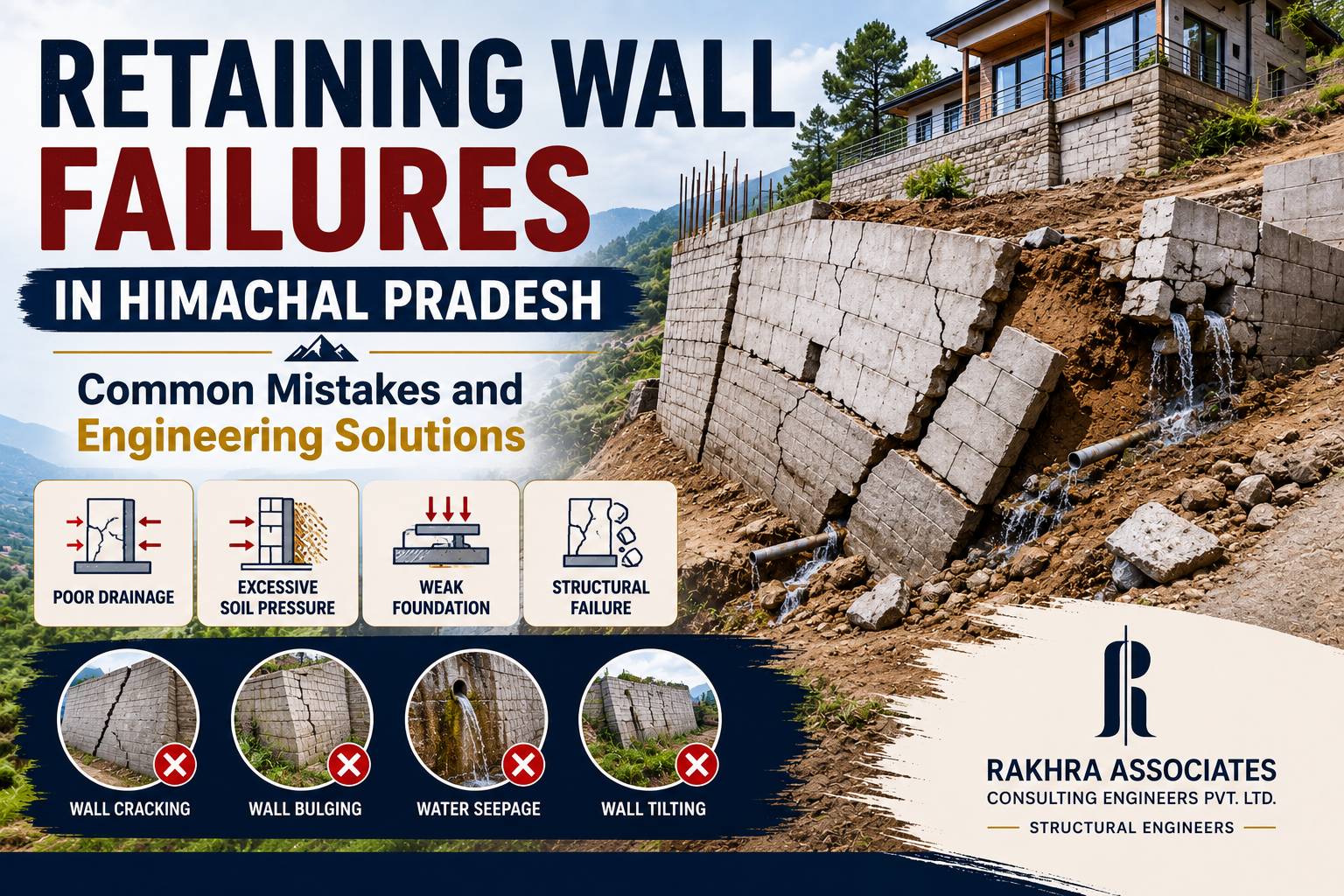
- Wall cracking
- Wall tilting
- Soil displacement
- Foundation distress
- Water seepage
- Structural movement
- Slope instability
Understanding root causes helps reduce long-term risks.
Common Causes of Retaining Wall Failures in Himachal Pradesh
Poor Drainage Behind Retaining Walls
One of the biggest causes of retaining wall failures involves inadequate drainage planning.
Many people underestimate water pressure behind retaining structures.
Rainwater accumulation creates hydrostatic pressure that adds significant force against walls.
This additional loading can cause:
- Cracking
- Wall displacement
- Bulging
- Foundation movement
- Structural failure
Drainage is not simply a site issue—it is a structural issue.
Common Causes of Retaining Wall Failures in Himachal Pradesh
Underestimation of Soil Pressure
Retaining walls resist lateral earth pressure generated by soil mass.
Improper calculations often underestimate:
- Soil properties
- Slope influence
- Water conditions
- Loading effects
Underdesigned walls may eventually experience excessive stress.
Common Causes of Retaining Wall Failures in Himachal Pradesh
Inadequate Foundation Systems
Retaining walls require stable foundations.
Weak support below the wall can create:
- Settlement
- Rotation
- Tilting
- Structural instability
Foundation design must consider:
- Soil conditions
- Water table conditions
- Loading requirements
- Slope characteristics
Common Causes of Retaining Wall Failures in Himachal Pradesh
Excessive Excavation and Hill Cutting
Excavation changes natural slope behavior.
Aggressive hill cutting without engineering assessment can disturb:
- Existing soil equilibrium
- Natural support systems
- Slope stability
This often increases retaining demands.
Common Causes of Retaining Wall Failures in Himachal Pradesh
Poor Reinforcement Detailing
Structural detailing directly influences retaining wall capacity.
Improper reinforcement placement may reduce:
- Structural strength
- Crack resistance
- Long-term durability
Small detailing mistakes can significantly affect performance.
Common Causes of Retaining Wall Failures in Himachal Pradesh
Construction Quality Issues
Even properly designed retaining systems can fail because of poor execution.
Common site issues include:
- Incorrect steel placement
- Honeycombing
- Poor concrete compaction
- Inadequate curing
- Dimension changes during construction
Structural quality control remains essential.
Why Water Is One of the Biggest Structural Threats
Water creates multiple risks simultaneously.
It may:
- Increase pressure behind walls
- Weaken surrounding soil
- Cause erosion
- Reduce soil strength
- Create seepage paths
Heavy rainfall conditions across Himachal Pradesh increase these risks.
Drainage planning should begin during design stages rather than after construction.
Warning Signs of Retaining Wall Problems
Homeowners and developers should monitor visible warning signs before larger failures occur.
Wall Tilting
Leaning walls often indicate movement or foundation distress.
Bulging Areas
Outward movement usually suggests pressure buildup.
Cracks in Walls
Structural cracks require evaluation.
Water Seepage
Persistent moisture indicates drainage concerns.
Soil Settlement Nearby
Settlement may indicate movement beneath retaining structures.
Surface Erosion
Visible soil loss often suggests instability.
Types of Retaining Walls Used in Hill Construction
Structural engineers select retaining systems based on:
- Site conditions
- Soil behavior
- Height requirements
- Loading conditions
Common retaining systems include:
Gravity Retaining Walls
Resist pressure using self-weight.
Cantilever Retaining Walls
Use reinforced concrete and leverage action.
Counterfort Retaining Walls
Provide support through additional structural elements.
Reinforced Earth Walls
Use soil reinforcement systems.
Specialized Retaining Solutions
Used where terrain conditions require advanced approaches.
How Structural Engineers Investigate Retaining Wall Failures
Professional structural evaluations often include:
Visual inspection
Initial assessment of visible symptoms.
Soil investigation
Understanding subsurface conditions.
Drainage assessment
Evaluating water movement patterns.
Crack analysis
Studying structural behavior indicators.
Stability review
Assessing wall performance under actual loading conditions.
Engineering Solutions for Retaining Wall Failures
Different structural conditions require different corrective approaches.
Drainage Improvement Systems
Managing water pressure remains a major priority.
Solutions may include:
- Drainage layers
- Weep holes
- Surface water management
- Controlled discharge systems
Structural Strengthening
Walls may require strengthening using:
- Additional reinforcement
- Concrete enhancement
- Structural retrofitting methods
Soil Stabilization
Improving surrounding soil conditions can reduce pressure effects.
Foundation Strengthening
Where settlement occurs, foundation improvements may be necessary.
Retrofitting Existing Structures
Existing retaining systems sometimes require engineering modifications.
Common Mistakes Homeowners and Contractors Make
Several repeating mistakes continue appearing in hill construction projects:
Ignoring drainage planning
Beginning excavation without engineering review
Using standard wall dimensions everywhere
Skipping soil investigations
Copying designs from nearby sites
Delaying structural consultation
Site-specific engineering matters.
Why Early Structural Planning Saves Cost
Many retaining wall issues develop because engineering input begins too late.
Early structural consultation helps:
- Improve wall efficiency
- Reduce redesign costs
- Optimize material use
- Improve excavation planning
- Reduce future repair risks
Good structural planning often reduces long-term expenses.
Why Specialized Structural Engineers Matter in Himachal Pradesh
Hill construction creates conditions that differ greatly from standard projects.
Structural engineers working in Himachal Pradesh frequently evaluate:
- Slope stability
- Soil variability
- Drainage behavior
- Seismic effects
- Earth pressure conditions
- Load transfer systems
For readers planning residential or commercial developments in hill regions, understanding the role of structural engineers in Himachal Pradesh can provide broader insights into safe and resilient construction practices.
Frequently Asked Questions
Common causes include poor drainage, weak foundations, underestimated soil pressure, construction defects, and slope instability.
Cracks may occur because of excessive pressure, settlement, poor reinforcement, or water-related issues.
Retaining systems stabilize slopes and resist soil movement.
Water creates hydrostatic pressure that significantly increases loading.
Cracks, bulging, tilting, seepage, and settlement are common indicators.
Yes. Strengthening and retrofitting methods may improve performance.
Yes. Soil properties directly influence design requirements.
Yes. Structural movement can impact foundations and surrounding areas.
The suitable retaining system depends on site conditions and engineering requirements.
Many hillside projects require retaining structures for safety and stability.
Yes. Seismic forces increase structural demands.
Tilting often results from foundation movement or excessive pressure.
Yes. Water accumulation significantly affects wall behavior.
Engineers review visible conditions, soil characteristics, drainage systems, and loading behavior.
Visible cracks, leaning walls, soil movement, or seepage indicate the need for evaluation.
Final Thoughts
Retaining walls are among the most important structural elements in hillside construction. Their performance influences not only slope stability but also the long-term safety of nearby buildings and infrastructure. Across Himachal Pradesh, changing terrain conditions, rainfall patterns, and increasing development activity make retaining wall design more critical than ever.
Successful hill construction depends on understanding that retaining systems are not simply walls—they are engineered structures requiring site-specific planning, structural analysis, and long-term performance consideration.