


Blog
Building Cracks in Hill Regions: Structural Causes and Professional Repair Approaches
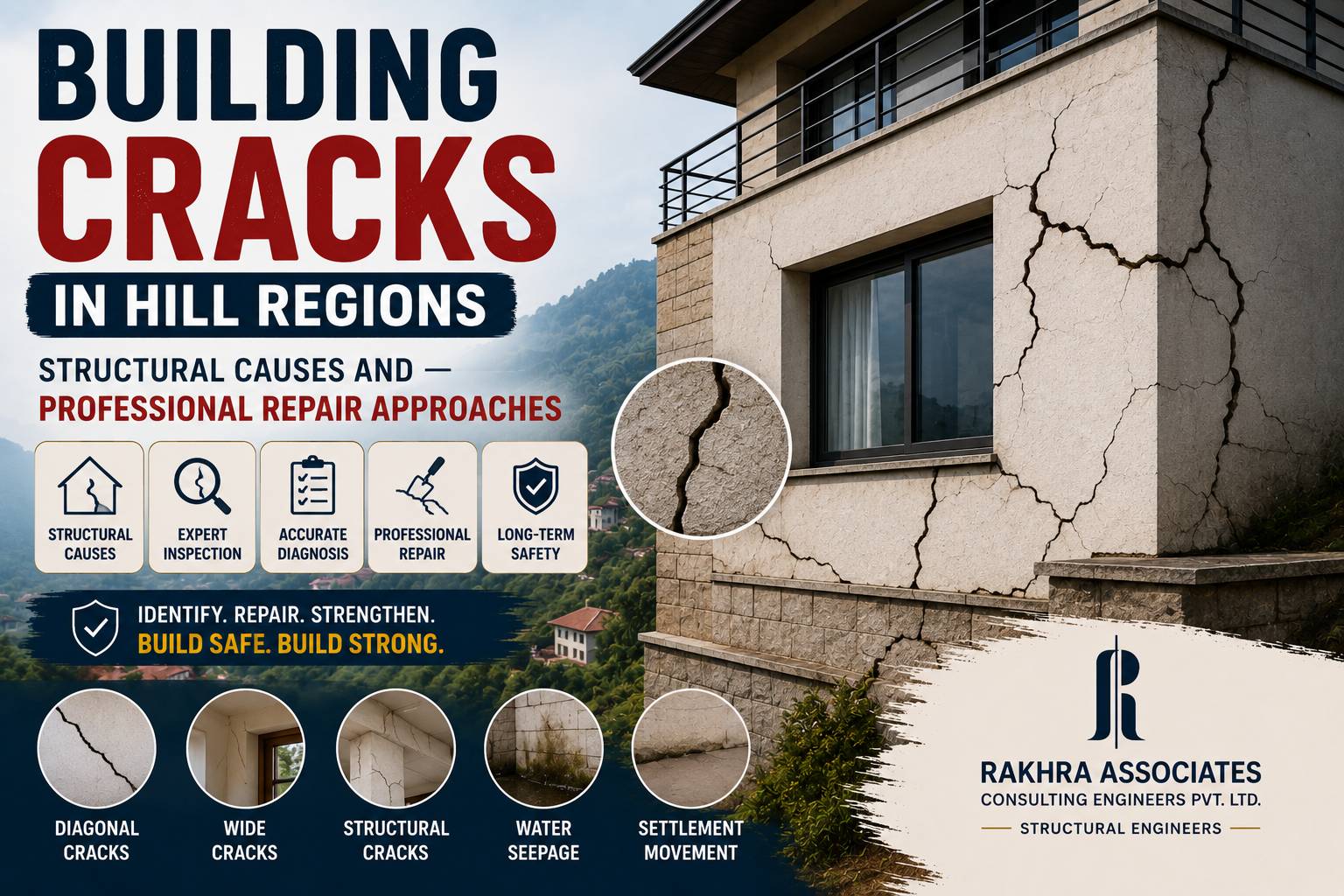
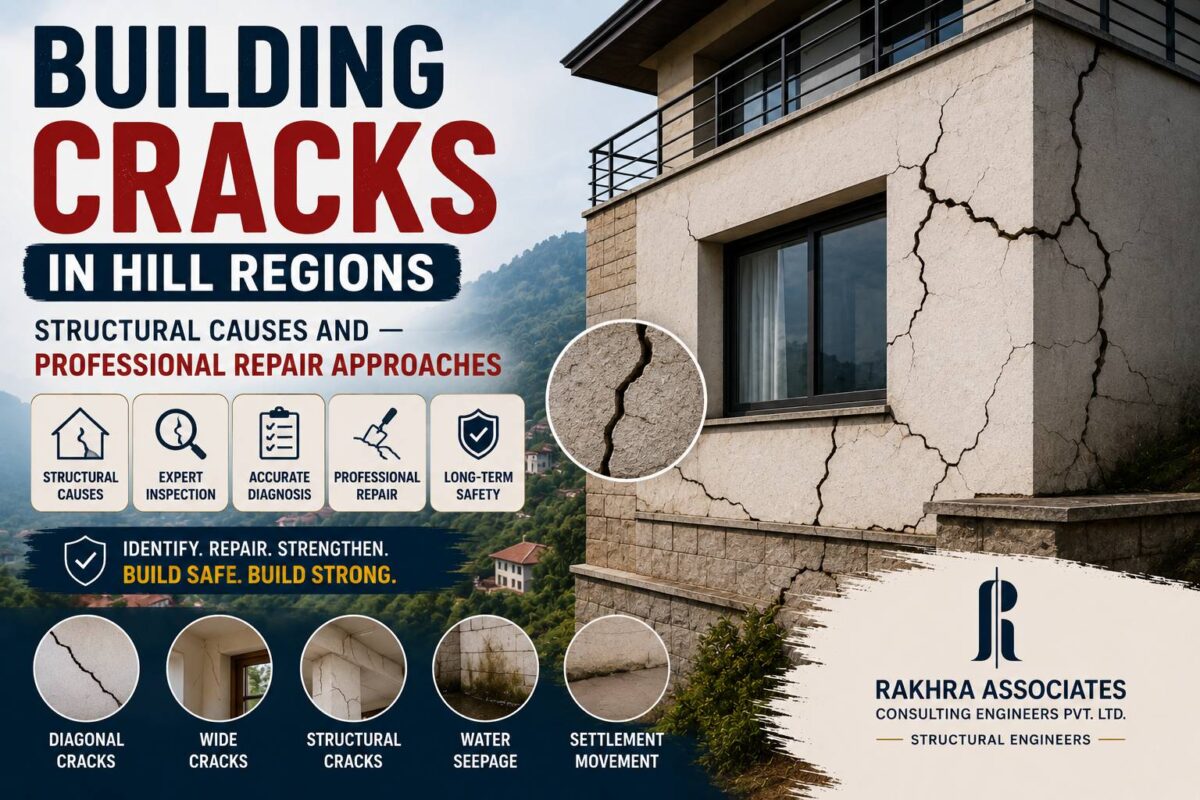
Buildings constructed in hilly regions face engineering challenges that differ significantly from structures built on flat terrain. Areas across Himachal Pradesh including Shimla, Mashobra, Solan, Manali, Dharamshala, Kullu, and surrounding regions experience complex site conditions involving slopes, varying soil properties, seismic activity, rainfall exposure, excavation-related changes, and retaining structures.
One of the most common concerns among homeowners and developers in hill regions is the appearance of cracks in buildings. Cracks are often ignored during early stages because many people assume they are only cosmetic problems. However, while some cracks are harmless surface imperfections, others can indicate deeper structural issues that may affect building safety and long-term performance.
Understanding why cracks develop is essential because repairing visible damage without addressing root causes often leads to repeated failures.
As Rakhra Associates Consulting Engineers Pvt. Ltd., observations from hillside projects continue to highlight one important principle: building cracks are symptoms, not causes. Proper structural assessment is necessary before deciding repair strategies.
This guide explores the structural causes of building cracks in hill regions, warning signs, investigation methods, and professional repair approaches.
Related Blog: Soil Investigation for Hillside Construction: Why Skipping It Can Lead to Structural Failure
Quick Answer
Building cracks in hill regions commonly occur due to foundation settlement, slope movement, soil instability, water seepage, seismic effects, poor construction practices, differential settlement, and drainage issues. Proper structural assessment helps identify root causes and determine suitable repair solutions.
What You Will Learn
This guide covers:
- Why cracks are more common in hill construction
- Different types of building cracks
- Structural and non-structural crack causes
- Warning signs homeowners should monitor
- Professional investigation methods
- Structural repair approaches
- Frequently asked questions useful for homeowners and developers
Why Buildings in Hill Regions Are More Vulnerable to Cracks
Hill construction introduces additional structural variables compared to flat land projects.
These include:
- Sloping terrain
- Differential loading conditions
- Variable soil layers
- Retaining wall influence
- Water movement through slopes
- Excavation effects
- Earthquake exposure
These factors influence how buildings settle and respond over time.
Even small movement beneath structures can create visible cracking.
Are All Cracks Dangerous?
No.
Many cracks remain non-structural and primarily affect appearance.
However, certain crack patterns may indicate serious structural concerns.
Understanding the difference between harmless and structural cracks becomes important.
Ignoring critical warning signs can allow problems to worsen over time.
Types of Building Cracks
Hairline Cracks
These are thin surface cracks usually caused by:
- Shrinkage
- Minor thermal movement
- Surface curing effects
Hairline cracks often remain cosmetic.
Vertical Cracks
Vertical cracks may occur because of:
- Settlement movement
- Material shrinkage
- Construction variations
Evaluation is recommended if crack width increases.
Horizontal Cracks
Horizontal cracking may indicate:
- Excessive soil pressure
- Structural movement
- Retaining pressure effects
These cracks often require investigation.
Diagonal Cracks
Diagonal cracking frequently suggests:
- Foundation movement
- Differential settlement
- Structural stress concentrations
These cracks should not be ignored.
Stair-Step Cracks
Common in masonry walls, stair-step patterns may indicate:
- Settlement
- Soil movement
- Foundation distress
Major Structural Causes of Building Cracks in Hill Regions
Foundation Settlement
One of the most common reasons behind structural cracking is settlement.
Settlement occurs when soil beneath foundations compresses or shifts unevenly.
This creates:
- Structural stress
- Load redistribution
- Cracking near openings and walls
Settlement risks increase in hillside projects because soil behavior can vary significantly across short distances.
Differential Settlement
Differential settlement occurs when one portion of a structure settles more than another.
Possible causes include:
- Variable soil properties
- Uneven moisture conditions
- Different foundation depths
- Excavation changes
Differential movement creates concentrated structural stress.
Slope Movement
Hillsides naturally experience gravitational forces.
Slope instability may develop because of:
- Heavy rainfall
- Excavation activity
- Poor retaining systems
- Soil erosion
Movement beneath foundations may transfer stresses into buildings.
Water Seepage and Drainage Problems
Water remains one of the most underestimated structural risks.
Poor drainage can:
- Soften supporting soil
- Increase hydrostatic pressure
- Cause erosion
- Affect foundation behavior
Persistent water problems often contribute to repeated cracking.
Retaining Wall Distress
Retaining systems influence nearby structures.
Retaining wall problems may create:
- Soil movement
- Settlement changes
- Pressure redistribution
This indirectly affects building performance.
Earthquake Effects
Himachal Pradesh lies within significant seismic zones.
Earthquakes generate:
- Horizontal forces
- Structural vibration
- Torsional movement
Repeated seismic activity may contribute to structural cracking over time.
Construction Quality Issues
Several construction-related issues increase crack risks:
- Poor concrete curing
- Improper reinforcement placement
- Weak workmanship
- Incorrect construction sequences
- Material inconsistencies
Quality control remains essential.
Warning Signs Homeowners Should Monitor
Certain crack characteristics require attention.
Rapidly increasing crack width
Growing cracks may indicate active movement.
Cracks near columns and beams
Load-bearing areas require evaluation.
Repeated repairs at same locations
Recurring cracks often suggest unresolved causes.
Doors and windows becoming difficult to operate
Structural movement may affect alignment.
Floor slope changes
Settlement beneath structures may create unevenness.
Water seepage around cracks
Moisture can worsen structural problems.
How Structural Engineers Investigate Building Cracks
Professional evaluations typically involve multiple stages.
Visual assessment
Initial inspection identifies crack patterns.
Crack mapping
Locations and patterns are documented.
Soil investigation review
Ground conditions influence movement behavior.
Structural analysis
Load paths and stress distribution are reviewed.
Drainage evaluation
Water movement patterns are assessed.
Foundation assessment
Settlement and support conditions are examined.
Professional Repair Approaches for Building Cracks
Repair methods depend on root causes rather than visible symptoms alone.
Epoxy Injection Methods
Useful for certain structural crack repairs.
Benefits include:
- Improved continuity
- Structural bonding
- Crack sealing
Structural Retrofitting
Where structural weaknesses exist, strengthening methods may be used.
Examples include:
- RCC jacketing
- Steel strengthening
- Structural enhancement systems
Foundation Improvement
Settlement-related issues may require:
- Foundation strengthening
- Underpinning solutions
- Load redistribution systems
Drainage Improvements
Water management often becomes essential.
Possible solutions:
- Surface drainage planning
- Controlled discharge systems
- Site grading improvements
Retaining System Strengthening
Nearby retaining structures may require engineering modification.
Common Mistakes Homeowners Make
Several mistakes repeatedly occur:
Repairing cracks without identifying causes
Ignoring small crack progression
Delaying structural evaluations
Assuming all cracks are cosmetic
Focusing only on surface repair materials
Structural diagnosis should always come first.
Why Early Structural Assessment Saves Cost
Early identification often prevents larger structural problems.
Timely engineering evaluation can:
- Reduce repair expenses
- Prevent structural deterioration
- Improve safety
- Minimize future damage
Small cracks today may become major repairs later.
Why Structural Engineers Matter in Himachal Pradesh
Hill construction requires understanding:
- Soil variability
- Slope behavior
- Retaining systems
- Drainage effects
- Foundation response
- Seismic considerations
For broader construction guidance, readers can explore additional information related to structural engineers in Himachal Pradesh and understand how structural planning contributes to safer hillside developments.
Frequently Asked Questions
Common causes include settlement, slope movement, water seepage, poor drainage, seismic effects, and construction quality issues.
No. Some cracks remain cosmetic while others may indicate structural concerns.
Diagonal cracks, widening cracks, and cracks near load-bearing components should be evaluated.
Yes. Settlement often creates structural stress.
Yes. Water affects soil behavior and structural conditions.
Surface repairs alone may not address underlying causes.
Yes. Seismic movement creates additional forces.
Structural engineers assess patterns, soil conditions, foundations, and drainage behavior.
Yes. Retaining distress can influence surrounding soil stability.
Strengthening methods may improve structural performance where necessary.
Even small cracks should be monitored for progression.
Movement beneath structures may change geometry.
Professional assessment is recommended when cracks increase, recur, or affect structural elements.
Final Thoughts
Building cracks in hill regions should never be evaluated only from a surface perspective. Cracks often indicate deeper interactions between soil conditions, slope behavior, foundations, drainage systems, and structural performance. As development activity continues across Himachal Pradesh, understanding these relationships becomes increasingly important.
Safe structures are not created simply by repairing visible damage—they depend on identifying and solving the root structural causes behind that damage.