


Blog
Why Himachal Needs Earthquake-Resilient Design More Than Ever
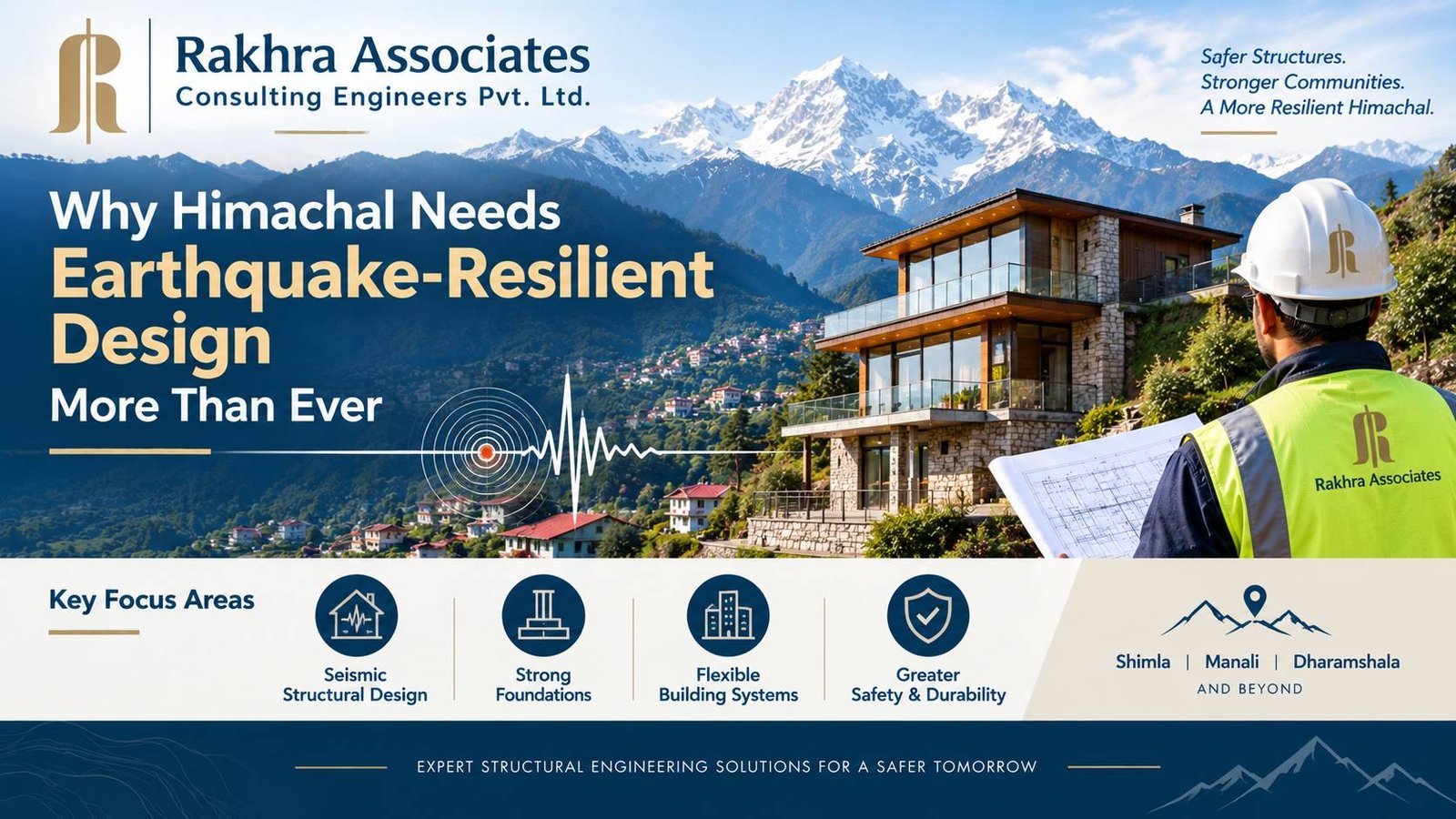
Himachal Pradesh sits in one of the most seismically active regions of India. Large parts of the state fall under Seismic Zone IV, with some areas — including parts of Chamba, Kangra, and the higher Himalayan belt — falling under Zone V, the highest-risk category defined in the Indian seismic code (IS 1893). For anyone building a home, hotel, or commercial property in the region, this single fact should shape almost every structural decision made on the project.
Understanding Himachal's Seismic Risk
The Himalayan region is geologically young and tectonically active — the same forces that created these mountains continue to build stress along fault lines beneath them. Himachal has a documented history of significant earthquakes, and seismologists have long flagged the central Himalayan seismic gap as a region capable of producing a major future earthquake.
What makes this especially relevant for structural design is that seismic risk in the hills isn't just about ground shaking — it's compounded by:
- Topographic amplification, where hill slopes and ridges can intensify shaking compared to flat ground
- Loose or weathered soil, common on hill slopes, which can amplify seismic waves
- Existing structural vulnerabilities, since many older hill buildings were constructed without formal seismic design
What Earthquake-Resilient Design Actually Means
Earthquake-resilient design isn't about making a building immovable — it's about controlling how a building responds to shaking, so it protects the people inside even under severe seismic force. Core principles include:
Ductile detailing — reinforcement detailing in RCC columns and beams that allows the structure to deform and absorb energy without sudden, brittle failure. This is one of the most important — and most frequently skipped — aspects of seismic-safe construction in smaller hill towns.
Regular, symmetric building configuration — irregular shapes, soft stories (like open ground floors used for parking), and asymmetric weight distribution significantly increase seismic vulnerability.
Base isolation and damping systems — for larger or critical structures (hospitals, hotels, institutional buildings), isolation systems can dramatically reduce the force transferred to the building during an earthquake.
Proper load path continuity — every structural element, from roof to foundation, must be connected in a way that transfers seismic forces down to the ground without weak links.
Lessons From Past Himalayan Earthquakes
Post-earthquake studies across the Himalayan belt consistently point to the same failure patterns: buildings without proper ductile detailing, unreinforced masonry, soft-story ground floors, and poor connection between walls and roofs. Structures designed and built according to code — with proper reinforcement detailing and quality control — have consistently performed far better in the same events.
This is the clearest argument for formal structural design: seismic codes exist precisely because they encode these hard-earned lessons.
What This Means for Your Project
If you're planning construction in Himachal Pradesh — whether a private residence, a homestay, or a larger commercial development — seismic design shouldn't be treated as an optional add-on. It needs to be built into the structural design from the concept stage, not retrofitted as an afterthought.
Practical steps we recommend to every client:
- Get a proper structural design done by a qualified structural engineer, not just an architectural drawing
- Ensure seismic zone factors specific to your exact location are used in design calculations
- Insist on ductile detailing in all RCC work, and supervise its execution on site
- For existing older buildings, get a seismic vulnerability assessment done
Frequently Asked Questions
A: Ductile detailing refers to specific reinforcement practices in RCC columns and beams — such as closely spaced stirrups near joints and proper anchorage lengths — that allow a structure to bend and absorb seismic energy rather than fail suddenly and brittlely. Without it, a building may look structurally sound on paper but fail catastrophically during actual shaking. It's one of the most cost-effective seismic safety measures available, since it primarily involves reinforcement detailing rather than large amounts of extra material.
A: Critical and high-occupancy structures like hospitals and hotels are typically designed with a higher importance factor in seismic calculations, meaning they must withstand greater force with a larger safety margin. These buildings may also use additional measures like base isolation or damping systems, which are less common in typical residential construction due to cost. The goal is to keep these structures operational and safe even after a significant earthquake, not just to prevent collapse.
A: Base isolation involves placing flexible bearings or isolators between a building's foundation and its superstructure, allowing the ground to move during an earthquake while the building above moves much less. This significantly reduces the seismic force transmitted into the structure. It's typically reserved for larger, critical, or high-value structures due to its cost, such as hospitals, data centers, or landmark buildings, rather than standard residential projects.
A: Topographic amplification occurs when hill slopes, ridges, and valleys alter how seismic waves travel through the ground, often intensifying shaking at ridge tops or specific slope locations compared to flat terrain. This means a structure's exact position on a hillside can meaningfully affect the seismic force it experiences, even within the same general seismic zone. Site-specific seismic microzonation studies, where available, help engineers account for this effect in design.
A: Seismic retrofitting is the process of strengthening an existing building to improve its earthquake performance, since it wasn't originally designed to current seismic standards. Common techniques include jacketing of columns with additional concrete or steel, adding shear walls or bracing, and strengthening connections between structural elements. Unlike new construction, retrofitting must work within the constraints of an existing structure, which often makes the assessment and design process more complex than starting from scratch.
A: Post-earthquake studies consistently find that buildings without proper ductile detailing, irregular or asymmetric shapes, soft ground floors, and poor quality construction are far more likely to fail than well-designed and properly built structures in the same area. Two buildings can be in the same seismic zone and experience the same ground shaking, yet perform completely differently based on design and construction quality. This is the core argument for insisting on formal structural design and construction supervision, not just architectural planning.
A: There's no fixed universal timeline, but a reassessment is generally recommended after any significant renovation, addition of floors, or visible structural distress such as new cracking. Buildings constructed before formal seismic codes were widely enforced, or those in higher-risk Zone V areas, benefit from a proactive vulnerability assessment even without visible damage. This is particularly relevant for older hill-town buildings in Himachal that predate modern seismic design practices.
A: A load path is the continuous route through which forces — including seismic forces — travel from the point they're applied down through the structure to the foundation and into the ground. If any link in this path is weak or discontinuous, such as a poorly connected wall-to-roof junction, the entire structure's seismic performance can be compromised regardless of how strong individual elements are. Ensuring load path continuity is a fundamental part of seismic-resilient design, not an optional detail.
A: Certain traditional techniques, such as timber-laced masonry (kath-kuni style), have historically shown reasonable seismic performance due to the flexibility timber bands provide within masonry walls. However, many traditional buildings also lack modern reinforcement and may have deteriorated over time, so their seismic adequacy should not be assumed without assessment. Combining traditional aesthetic elements with modern structural engineering is often the most practical approach for new hill construction.
A: Ask specifically whether the design uses the correct seismic zone factor for your exact location, whether ductile detailing has been incorporated into the reinforcement drawings, and whether the building's configuration (shape, floor plan, ground floor use) has been reviewed for seismic irregularities. It's also reasonable to ask for the seismic design basis to be documented in writing as part of your structural drawings. A qualified structural engineer should be able to answer these questions clearly and directly.
A: Most of Himachal falls under Seismic Zone IV, with parts of the higher Himalayan region, including areas near Chamba and Kangra, falling under Zone V.
A: Yes, in many cases, through retrofitting techniques such as column jacketing, shear walls, or bracing, depending on the building's current condition.
A: It typically adds a modest percentage to overall cost — far less than the cost of post-earthquake repair or reconstruction.
A: An open ground floor has far less lateral stiffness than the floors above, concentrating seismic stress at that level and making it prone to collapse.
A: Yes — regular, symmetric shapes perform significantly better than irregular or asymmetric layouts under seismic loading.
A: Yes, IS 1893 is the primary Indian standard governing seismic design criteria for buildings, including zone factors for different regions.
A: No — seismic design principles apply regardless of building height, though the specific measures required scale with size and importance of the structure.
A: No, unreinforced masonry is one of the most vulnerable construction types in seismic zones and generally requires reinforcement or bands for adequate safety.
A: Timeframes vary by building size and complexity, but a basic assessment can often be completed within a few weeks of site access and document review.
A: Yes, especially if original design documentation is unclear, since verifying actual seismic compliance protects both occupants and the investment.
Design for the Ground You're Building On
Earthquake risk in Himachal isn't hypothetical — it's a known, documented reality of building in the Himalayan region. The good news is that seismic-resilient design is a well-understood engineering discipline, not a mystery. It simply needs to be applied correctly, from the first structural drawing to the final inspection.
Rakhra Associates Consulting Engineers Pvt. Ltd. provides seismic-compliant structural design and vulnerability assessments for residential, commercial, and institutional projects across Himachal Pradesh. Talk to our team before you finalize your building plan.