


Blog
How to Choose a Structural Engineering Consultant for a Commercial, Industrial or Residential Project in India
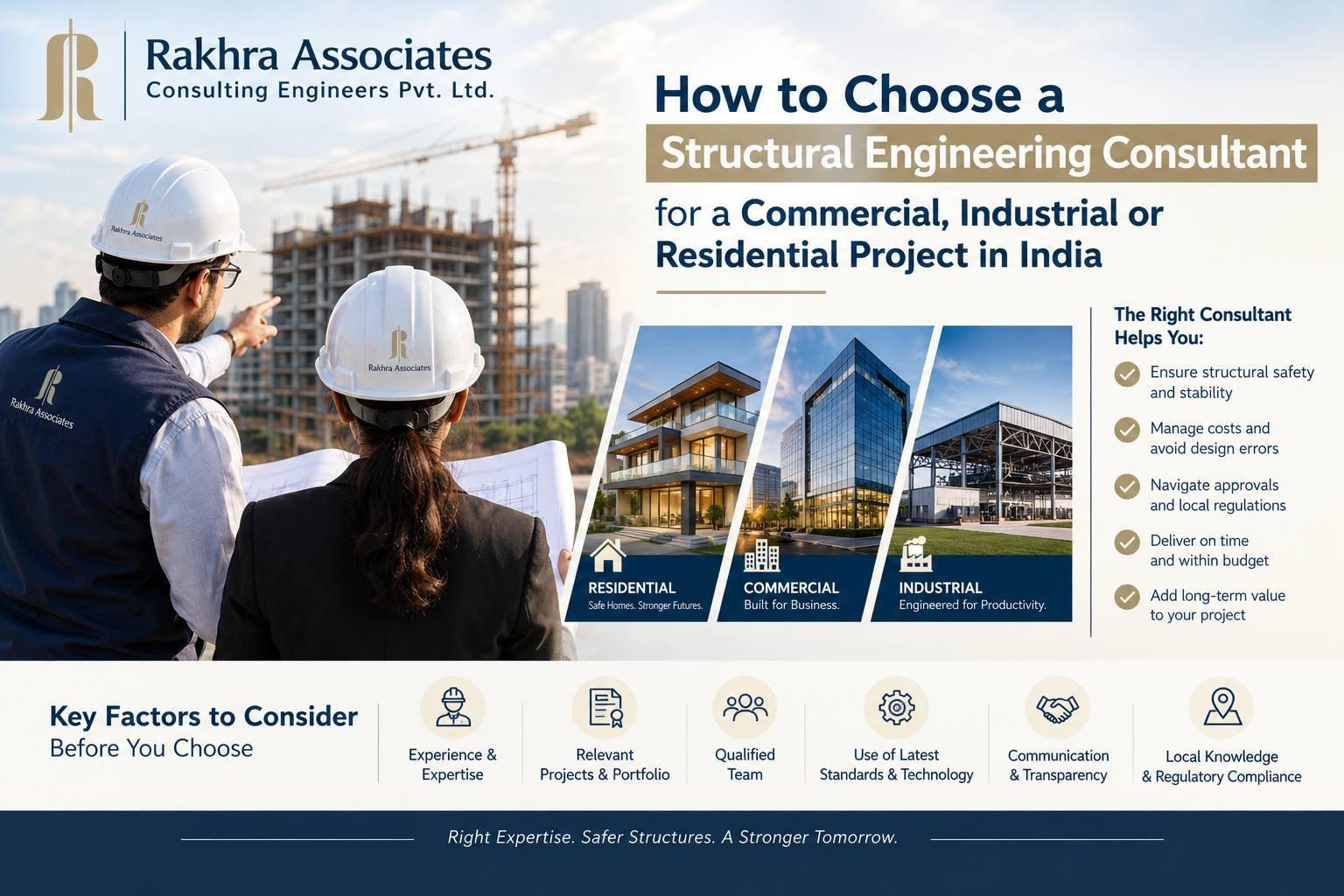
Choosing the right structural engineering consultant in India is one of the most important decisions you can make before starting a residential, commercial, institutional or industrial construction project. The structural consultant is responsible for much more than preparing drawings. They help determine how a building will safely carry its loads, how its structural system should be configured, how foundations should be designed, and how structural safety can be maintained throughout construction.
Whether you are developing a residential building, commercial complex, hospital, hotel, industrial facility, educational campus or multi-storey structure, the consultant you appoint can have a significant impact on structural safety, construction cost, durability, constructability and long-term performance.
But how do you choose the right consultant?
Price alone is not a reliable criterion. A competent structural design consultant should have the technical expertise, project experience, engineering software capabilities, detailing skills and site coordination experience required for the specific type of structure you are planning.
This guide explains the most important factors to evaluate before hiring a structural engineering consultant in India.
What Does a Structural Engineering Consultant Do?
A structural engineering consultant develops the engineering strategy that allows a building or structure to safely resist the loads and forces acting on it.
Depending on the project, their responsibilities may include:
- Structural analysis
- RCC structural design
- Steel structure design
- Foundation design
- Seismic design
- Wind-load assessment
- Structural drawings and detailing
- Structural calculations
- Construction-stage technical support
- Site inspections and coordination
- Structural audits
- Retrofitting and strengthening
- Third-party inspection
- Proof checking
- Technical consultation
The exact scope depends on the project.
For example, the structural requirements of a G+2 residential building are very different from those of a hospital, industrial building, high-rise tower, auditorium, warehouse or large-span structure.
This is why experience with similar projects should be one of your first selection criteria.
15 Factors to Consider When Choosing a Structural Engineering Consultant in India
1. Check Experience With Similar Projects
The first question should not be:
“How many years have you been working?”
Instead, ask:
“Have you designed structures similar to mine?”
A consultant who has extensive experience with residential buildings may not necessarily be the right choice for a complex industrial facility.
Similarly, an industrial structural consultant may not have the specialized experience required for hospitals, high-rise residential towers or large-span public buildings.
Look for experience relevant to your project type, such as:
- Residential buildings
- Commercial buildings
- Industrial buildings
- Hospitals
- Hotels
- Educational institutions
- IT buildings
- Warehouses
- High-rise structures
- Steel structures
- Large-span buildings
- Infrastructure projects
A consultant with relevant project experience is more likely to anticipate design and construction challenges before they become expensive problems.
2. Evaluate RCC and Steel Design Capability
A good structural design consultant should have a strong understanding of the structural systems appropriate for the project.
For RCC construction, this can involve:
- Slabs
- Beams
- Columns
- Shear walls
- Rafts
- Footings
- Retaining walls
- Staircases
- Water-retaining structures
For steel structures, the requirements can include:
- Steel columns
- Beams
- Trusses
- Bracing systems
- Industrial frames
- Large-span roofs
- Connections
- Platforms
- Specialized steel structures
The consultant should understand not only how to analyse these systems but also how to detail them for practical construction.
3. Look at High-Rise Building Experience
If you are planning a multi-storey or high-rise building, high-rise experience becomes particularly important.
As building height increases, structural design becomes more sensitive to:
- Lateral loads
- Wind forces
- Seismic forces
- Building stiffness
- Drift
- P-Delta effects
- Foundation behaviour
- Load transfer
- Structural irregularities
A consultant experienced in high-rise design should understand how these factors interact rather than treating each structural element independently.
Rakhra Associates' published project portfolio includes multi-storey residential and commercial developments, including projects exceeding 15 and 20 storeys.
4. Check Industrial Building Experience
Industrial structures often have requirements that are substantially different from conventional residential construction.
Depending on the facility, structural engineers may need to consider:
- Heavy equipment loads
- Crane loads
- Dynamic loads
- Large column spacing
- Industrial floors
- Steel framing
- Mezzanine structures
- Vibration
- Storage loads
- Large-span roofs
- Service openings
If you are developing a manufacturing plant, warehouse, industrial shed or processing facility, choose a structural consultant for industrial buildings who understands these requirements.
A consultant familiar only with conventional residential RCC construction may not be the ideal choice for a technically demanding industrial project.
5. Verify Foundation Design Capability
The foundation is the interface between the structure and the ground.
A structural consultant should understand how the building loads interact with the available soil conditions and coordinate appropriately with geotechnical information.
Foundation design may involve:
- Isolated footings
- Combined footings
- Raft foundations
- Pile foundations
- Pile caps
- Basement foundations
- Retaining structures
The foundation system should not be selected simply because it was used on another nearby project.
The consultant should consider the structural loads, soil investigation data, groundwater conditions, settlement considerations and project requirements.
6. Check Knowledge of Seismic Design
India has significant variation in seismic risk across different regions.
A structural consultant should understand the applicable seismic provisions and how they affect structural configuration, analysis, detailing and ductility.
Important considerations can include:
- Seismic zone
- Structural system
- Building irregularity
- Ductile detailing
- Lateral load resistance
- Drift control
- Load combinations
- Foundation behaviour
This becomes particularly important for projects located in regions with higher seismic demand.
A consultant should be capable of designing according to the applicable Indian Standards and project-specific requirements rather than relying on generic design assumptions.
7. Ask Which Structural Analysis Software Is Used
Modern structural engineering relies heavily on computational analysis.
Depending on the project, consultants may use software such as:
- STAAD.Pro
- ETABS
- SAFE
- AutoCAD
- BIM-based tools
- Other specialized structural analysis and detailing software
However, software alone does not make a good structural engineer.
The important question is whether the engineer understands the engineering principles behind the model.
A software-generated result still needs engineering judgement.
Rakhra Associates states that its team uses tools including STAAD.Pro, ETABS, CYPE and AutoCAD for structural design and related workflows.
8. Examine the Quality of Structural Drawings and Detailing
Structural analysis is only one part of the job.
The design ultimately needs to be converted into drawings that contractors can understand and execute.
Structural drawings may include:
- Foundation layouts
- Column layouts
- Beam layouts
- Slab reinforcement drawings
- Structural sections
- Staircase details
- Reinforcement details
- Steel fabrication drawings
- Connection details
- Structural schedules
Poor detailing can create confusion at the construction site and may lead to rework, delays or unsafe modifications.
Therefore, before hiring a structural design firm, ask to see examples of the type and level of documentation they provide.
9. Consider Site Coordination Experience
Structural engineering does not end when the drawings are issued.
Construction sites frequently encounter practical issues such as:
- Architectural changes
- Service openings
- Reinforcement congestion
- Site constraints
- Material changes
- Construction sequencing problems
- Differences between drawings and actual site conditions
A consultant who can coordinate with architects, contractors, MEP consultants and project managers can help resolve these issues more effectively.
Ask whether site visits and technical coordination are included within the proposed scope.
10. Ask About Proof Checking and Design Review
For large or technically complex projects, independent design review or proof checking can provide an additional layer of quality control.
Proof checking may involve reviewing:
- Structural modelling
- Design assumptions
- Load calculations
- Structural members
- Foundation design
- Reinforcement detailing
- Compliance with applicable standards
This can be especially valuable for large commercial, institutional, industrial and infrastructure projects.
11. Check Structural Audit and Existing-Building Expertise
Not every project involves new construction.
If you are purchasing, renovating, modifying or extending an existing building, you may need a consultant who understands:
- Structural audits
- Building condition assessment
- NDT testing
- Structural health assessment
- Retrofitting
- Structural strengthening
- Additional floor feasibility
- Change-of-use assessment
This expertise becomes particularly important when an existing structure is being asked to carry additional loads.
For example, adding another floor to an old building without evaluating its existing columns, beams and foundations can create serious structural risks.
12. Look for Retrofitting and Strengthening Experience
Retrofitting is a specialized area of structural engineering.
It may be required because of:
- Structural deterioration
- Corrosion
- Cracks
- Increased loading
- Change in building use
- Earthquake vulnerability
- Construction defects
- Age-related deterioration
- Additional floors
Possible strengthening solutions may include:
- RCC jacketing
- Steel jacketing
- Beam strengthening
- Column strengthening
- FRP strengthening
- Foundation strengthening
- Additional structural members
The appropriate solution should only be selected after proper investigation and structural assessment.
Rakhra Associates' published project experience includes the structural retrofitting and conversion of an existing two-storey commercial building into a seven-storey hotel, while retaining existing column positions and foundations.
13. Evaluate Third-Party Inspection Capability
For large projects, third-party inspection can provide independent oversight of construction quality.
A third-party inspection may evaluate:
- Materials
- Reinforcement
- Structural steel
- Concrete work
- Workmanship
- Construction practices
- Compliance with drawings
- Critical construction stages
This can help identify deviations before they become difficult or expensive to correct.
Rakhra Associates lists Third Party Inspection among its engineering and project management services.
14. Review the Consultant's Project Portfolio
A project portfolio gives you a better indication of actual experience than a list of services.
Look for evidence of completed or ongoing work across relevant categories.
Rakhra Associates' published portfolio includes residential, commercial, healthcare, educational and hospitality projects, as well as specialized structures and projects across multiple locations in India.
Its published project examples include hospitals, universities, housing projects, hotels, commercial developments, IT buildings and specialized large-span structures.
When evaluating any consultant, ask:
- What similar projects have you completed?
- Where were they located?
- What was the building size?
- How many floors did they have?
- Was the structure RCC or steel?
- Did you provide site coordination?
- Did you handle structural drawings and detailing?
- Can references or project documentation be provided?
15. Don't Choose a Consultant Based Only on the Lowest Fee
Structural engineering is an area where reducing professional fees at the expense of engineering quality can become expensive later.
A poorly coordinated structural design can result in:
- Material wastage
- Construction delays
- Rework
- Site conflicts
- Design changes
- Increased steel consumption
- Foundation modifications
- Construction difficulties
The objective should not be to find the cheapest structural engineering company.
Instead, look for the best balance between:
Technical competence + relevant experience + design quality + site support + project understanding + professional fee.
A competent consultant can sometimes reduce the overall project cost through efficient structural planning and material optimization.
Structural Engineering Consultant vs Structural Design Firm: What Should You Hire?
These terms are sometimes used interchangeably, but the scope can vary.
A structural engineer may work independently or as part of a consultancy.
A structural engineering company may provide a broader range of services, including:
- Structural design
- Structural analysis
- Detailed drawings
- Structural audits
- Retrofitting
- Site inspections
- Third-party inspection
- Project management
- Technical consultancy
For a small residential project, a qualified structural engineer may be sufficient.
For a large commercial, industrial, institutional or infrastructure project, a multidisciplinary structural engineering consultancy may be more appropriate.
The correct choice ultimately depends on the project's size, complexity and scope.
What Questions Should You Ask Before Hiring a Structural Consultant?
Before signing a consultancy agreement, ask these questions:
Technical Questions
- Have you designed similar buildings?
- Do you undertake both RCC and steel structural design?
- Do you have high-rise project experience?
- Do you handle industrial structures?
- Do you undertake foundation design?
- How do you address seismic design?
- Which structural analysis software do you use?
- Do you provide detailed structural drawings?
- Do you provide design calculations?
- Do you coordinate with the architect and MEP consultants?
Construction Questions
- Do you provide site inspections?
- How frequently will the structural engineer visit the site?
- Do you provide construction-stage technical support?
- How are design changes handled?
- Do you provide third-party inspection services?
Existing Building Questions
- Do you conduct structural audits?
- Do you provide NDT testing or coordinate NDT investigations?
- Do you undertake structural retrofitting?
- Can you assess whether an existing building can support an additional floor?
- Do you provide structural strengthening solutions?
These questions can help you distinguish between a consultant who simply produces drawings and one who can support the project throughout its structural lifecycle.
Why Early Structural Consultation Matters
One of the biggest mistakes project owners make is involving the structural engineer too late.
Structural engineering should ideally begin during the planning stage.
Early involvement allows the engineer to coordinate:
Architectural Planning → Structural System → Foundation Strategy → Material Selection → Analysis → Detailed Design → Construction
This can prevent architectural layouts that are difficult or unnecessarily expensive to engineer.
For example, column positions, structural grids, floor-to-floor heights, spans, basements and service requirements can all influence the structural system.
Early coordination can therefore improve both constructability and cost efficiency.
Why Rakhra Associates Can Be Considered for Structural Engineering Projects
Rakhra Associates Consulting Engineers Pvt. Ltd. is a Chandigarh-based structural engineering and project management consultancy providing services including structural design, planning, project management, estimation, DPR preparation, third-party inspection, structural safety certification and other civil engineering services.
The firm's published portfolio spans multiple sectors, including residential, commercial, healthcare, hospitality and educational projects. It also lists specialized structures and projects in locations across India.
Its project experience includes multi-storey residential and commercial buildings, hospitals, hotels, educational campuses, IT buildings and specialized structures such as large-span and dome structures.
This breadth of experience can be particularly relevant when selecting a structural engineering consultant in India for projects where structural design, coordination and construction requirements need to be considered together.
Final Checklist: How to Choose the Right Structural Engineering Consultant
Before appointing a consultant, evaluate these factors:
- Experience with your type of project
- RCC structural design capability
- Steel structural design capability
- High-rise experience, if applicable
- Industrial project experience, if applicable
- Foundation design capability
- Seismic design knowledge
- Structural analysis software expertise
- Quality of structural drawings
- Construction detailing capability
- Site inspection and coordination
- Proof checking/design review
- Structural audit experience
- NDT and structural assessment capability
- Retrofitting and strengthening experience
- Third-party inspection capability
- Relevant completed projects
- Clear scope of consultancy
- Transparent professional fees
- Ability to coordinate with architects and other consultants
Frequently Asked Questions
Look for a consultant with relevant project experience, strong RCC and steel design capabilities, knowledge of applicable Indian Standards, structural analysis expertise, quality detailing, site coordination experience and a proven project portfolio.
A structural consultant analyses and designs the structural system of a building, including elements such as foundations, columns, beams, slabs, shear walls and structural steel systems.
Yes. A qualified structural engineer can design the structural system, foundations and reinforcement according to the building requirements, site conditions and applicable standards.
A structural consultant provides engineering design, analysis and technical guidance. A contractor is responsible for executing the construction work according to the approved drawings and specifications.
Look for experience with commercial buildings of similar size and complexity, along with expertise in RCC or steel design, foundations, seismic considerations, structural detailing and construction coordination.
Complex industrial buildings often require specialized structural knowledge because of heavy equipment, large spans, crane loads, vibration, dynamic loads and specialized operational requirements.
Structural consultants may use programs such as STAAD.Pro, ETABS, SAFE, AutoCAD, CYPE and BIM-related tools depending on the project requirements.
Yes. Structural consultants can conduct or coordinate structural inspections, condition assessments, NDT investigations and structural audits to determine the condition of an existing building.
A structural engineer can assess the existing structural system, foundations, materials, loads and condition to determine whether additional loading may be feasible and what strengthening may be required.
Structural retrofitting is the process of modifying or strengthening an existing structure to improve its strength, stiffness, durability, load-carrying capacity or resistance to specific hazards.
Site coordination allows structural engineers to address construction-stage issues, clarify drawings, review modifications and coordinate structural requirements with architectural and services-related work.
Not necessarily. Professional competence, relevant experience, design quality, scope of services and construction support should be considered alongside fees.
Some established structural engineering consultancies have experience across multiple sectors. However, you should always verify their actual portfolio and experience with structures comparable to your own project.
Ideally, the structural consultant should be involved during the planning and design stage rather than after architectural decisions have already been finalized.
Early structural involvement helps coordinate architectural planning, structural grids, spans, foundations, floor levels and material choices, potentially reducing design changes, construction difficulties and unnecessary structural costs.
Conclusion
Choosing the right structural engineering consultant in India is a technical and commercial decision—not simply a matter of comparing quotations.
The right consultant should understand your building type, structural system, site conditions, applicable design requirements and construction realities. They should be capable of taking a project from structural analysis and design through detailed drawings and, where required, site coordination, inspection, auditing and strengthening.
For residential buildings, commercial developments, industrial facilities, hospitals, hotels, educational institutions and complex structures, relevant project experience should be one of the most important factors in your decision.
Before appointing a structural design consultant, evaluate their technical capabilities, completed projects, detailing standards, software expertise, site coordination process, inspection capabilities and experience with structures similar to yours.
A well-designed structure is not simply about using more steel or concrete. It is about developing the right structural system for the building, loads, site conditions, performance requirements and construction methodology.
That is why selecting the right structural engineering consultancy at the beginning of a project can have a lasting impact on safety, constructability, durability and overall project cost.